
Skip to main content Accessibility help
×
  • Cited by 35
    • Show more authors
    • Open Access
      You have digital access to this book
    • Select format
    • Publisher:
      Cambridge University Press
      Publication date:
      05 June 2014
      29 May 2014
      ISBN:
      9781139381628
      9781107031340
      9781316502860
      Creative Commons:
      Creative Common License - CC Creative Common License - BY Creative Common License - NC
      This content is Open Access and distributed under the terms of the Creative Commons Attribution licence CC-BY-NC 4.0.
      https://creativecommons.org/creativelicenses
      Dimensions:
      (228 x 152 mm)
      Weight & Pages:
      0.53kg, 242 Pages
      Dimensions:
      (229 x 152 mm)
      Weight & Pages:
      0.37kg, 246 Pages
    Open Access
    You have digital access to this book
    Selected: Digital
    View content
    Add to cart View cart Buy from Cambridge.org

    Book description

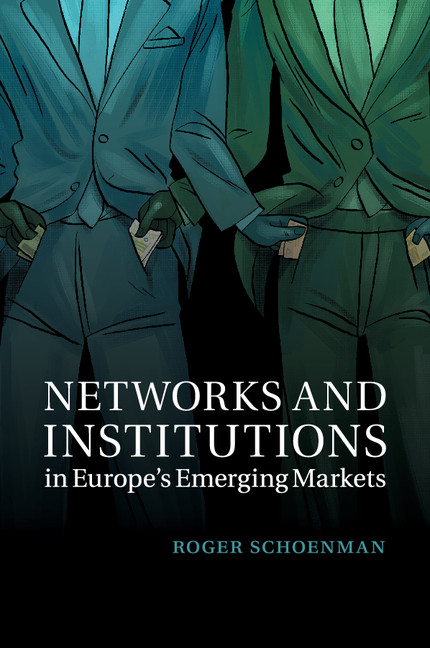
    Do ties between political parties and businesses harm or benefit the development of market institutions? The post-communist transition offers an unparalleled opportunity to explore when and how networks linking the polity and the economy support the development of functional institutions. A quantitative and qualitative analysis covering eleven post-socialist countries combined with detailed case studies of Bulgaria, Poland and Romania documents how the most successful post-communist countries are those in which dense networks link politicians and businesspeople, as long as politicians are constrained by intense political competition. This combination allowed Poland to emerge with stable institutions while Bulgaria demonstrates that in developing economies intense political competition alone is harmful in the absence of dense personal and ownership networks. Indeed, as Romania illustrates, networks are so critical that their weakness is not mitigated even by low political competition. This title is available as Open Access on Cambridge Books Online and via Knowledge Unlatched.

    Reviews

    ‘Roger Schoenman’s book transforms the well-known adage of the police investigator to 'follow the money' to 'follow the links' from one associate to the next. The irony of the so-called market reforms is that they provided the opportunity for entrepreneurs who realized the value of connections of old networks to create a new political and economic elite class. This reality was not, and is not, always pretty. Schoenman's analysis explains why some countries succeeded and others failed. It is a rich and analytical study that breaks away from the emphasis on macro-institutions to explain how countries are built bottom up.’

    Bruce Kogut - Sanford C. Bernstein Professor, Columbia University, New York

    ‘Roger Schoenman’s remarkable new book dives deeply into the fascinating (and often sordid) world of business and party linkages in emerging Europe. He explains why and when the mutual self-dealing of the oligarchs and the party elites can have broadly beneficial results, and he explains the dire consequences when one side or the other gets the upper hand for good.’

    Wade Jacoby - Mary Lou Fulton Professor of Political Science, Brigham Young University

    Refine List

    Actions for selected content:

    Select all | Deselect all
    • View selected items
    • Export citations
    • Download PDF (zip)
    • Save to Kindle
    • Save to Dropbox
    • Save to Google Drive

    Save Search

    You can save your searches here and later view and run them again in "My saved searches".

    Please provide a title, maximum of 40 characters.
    ×

    Contents

    Full book PDF
    • Networks and Institutions in Europe’s Emerging Markets - Half title page
      pp i-ii
    • Series page
      pp iii-iv
    • Networks and Institutions in Europe’s Emerging Markets - Title page
      pp v-v
    • Copyright page
      pp vi-vi
    • Dedication
      pp vii-viii
    • Contents
      pp ix-ix
    • Figures
      pp x-x
    • Tables
      pp xi-xi
    • Acknowledgements
      pp xii-xiv
    • Introduction
      pp 1-26
    • Part I - Foundations
      pp 27-52
    • 1 - Approaches to institution building
      pp 29-52
    • Part II - The Role of Networks
      pp 53-128
    • 2 - When broad networks increase cooperation
      pp 55-83
    • 3 - Tracing ownership networks
      pp 84-128
    • Part III - The Role of Uncertainty
      pp 129-164
    • 4 - When uncertainty increases cooperation
      pp 131-144
    • 5 - Tracing elite career networks
      pp 145-164
    • Part IV - Bringing It Together
      pp 165-195
    • 6 - Institutional development in new democracies
      pp 167-184
    • 7 - Conclusion: political varieties of capitalism in emerging markets
      pp 185-195
    • List of interviews
      pp 196-199
    • References
      pp 200-215
    • Index
      pp 216-226
    • Miscellaneous Endmatter
      pp 227-231

    Metrics

    Altmetric attention score

    Full text views

    Total number of HTML views: 0
    Total number of PDF views: 0 *
    Loading metrics...

    Book summary page views

    Total views: 0 *
    Loading metrics...

    * Views captured on Cambridge Core between #date#. This data will be updated every 24 hours.

    Usage data cannot currently be displayed.

    Accessibility standard: Unknown

    Why this information is here

    This section outlines the accessibility features of this content - including support for screen readers, full keyboard navigation and high-contrast display options. This may not be relevant for you.

    Accessibility Information

    Accessibility compliance for the HTML of this book is currently unknown and may be updated in the future.
