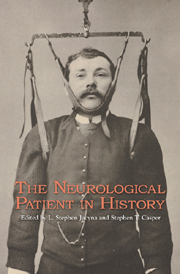
The Neurological Patient in History

-
Select format
-
- Publisher:
- Boydell & Brewer
- Publication date:
- 12 September 2012
- 15 February 2012
- ISBN:
- 9781580467704
- 9781580464123
- Dimensions:
- Weight & Pages:
- 00kg,
- Dimensions:
- Weight & Pages:
- Subjects:
- History, History of Medicine
You may already have access via personal or institutional login- Subjects:
- History, History of Medicine
Show more authors 
You may already have access via personal or institutional login
Book description
Parkinson's, Alzheimer's, Tourette's, multiple sclerosis, stroke: all are neurological illnesses that create dysfunction, distress, and disability. With their symptoms ranging from impaired movement and paralysis to hallucinations and dementia, neurological patients present myriad puzzling disorders and medical challenges. Throughout the nineteenth and twentieth centuries countless stories about neurological patients appeared in newspapers, books, medical papers, and films. Often the patients were romanticized; indeed, it was common for physicians to cast neurological patients in a grand performance, allegedly giving audiences access to deep philosophical insights about the meaning of life and being. Beyond these romanticized images, however, the neurological patient was difficult to diagnose. Experiments often approached unethical realms, and treatment created challenges for patients, courts, caregivers, and even for patient advocacy organizations. In this kaleidoscopic study, the contributors illustrate how the neurological patient was constructed in history and came to occupy its role in Western culture. Stephen T. Casper is assistant professor in Humanities and Social Sciences at Clarkson University. L. Stephen Jacyna is reader in the History of Medicine and Director of the Centre for the History of Medicine at University College London.
Contents
Contents
Metrics
Altmetric attention score
Full text views
Full text views helpTotal number of HTML views: 0
Total number of PDF views: 0 *
 Loading metrics...
* Views captured on Cambridge Core between #date#. This data will be updated every 24 hours.
Usage data cannot currently be displayed.
Accessibility standard: Unknown
Why this information is here
This section outlines the accessibility features of this content - including support for screen readers, full keyboard navigation and high-contrast display options. This may not be relevant for you.
Accessibility Information
Accessibility compliance for the PDF of this book is currently unknown and may be updated in the future.