Skip to main content Accessibility help
×
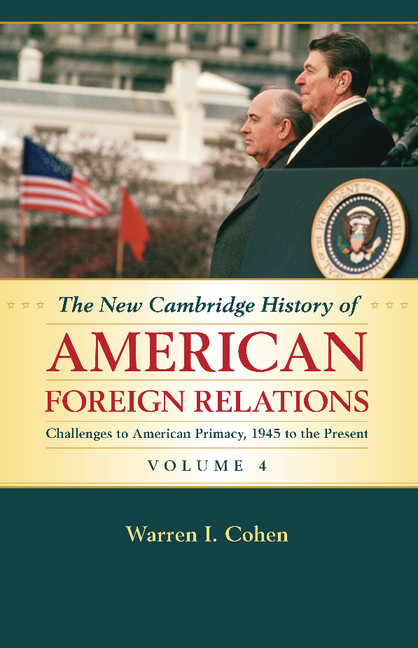
    Volume 4: Challenges to American Primacy, 1945 to the Present
    Show more authors
  • You may already have access via personal or institutional login
  • Select format
  • Publisher:
    Cambridge University Press
    Publication date:
    05 June 2013
    13 May 2013
    ISBN:
    9781139032513
    9780521763622
    9781107536135
    Dimensions:
    (228 x 152 mm)
    Weight & Pages:
    0.75kg, 396 Pages
    Dimensions:
    (229 x 152 mm)
    Weight & Pages:
    0.608kg, 396 Pages
You may already have access via personal or institutional login
  • Selected: Digital
    Add to cart View cart Buy from Cambridge.org

    Book description

    Since their first publication, the four volumes of the Cambridge History of American Foreign Relations have served as the definitive source for the topic, from the colonial period to the Cold War. The fourth volume of the updated edition explores the conditions in the international system at the end of World War II, the American determination to provide leadership, and the security dilemma each superpower posed for the other. This revised and expanded edition incorporates recent scholarship and revelations, carrying the narrative through the years following the end of the Cold War into the administration of Barack Obama. The character of the American political system is explored, including the separation of political powers and the role of interest groups that prompted American leaders to exaggerate dangers abroad to enhance their domestic power. This new edition examines the conditions in the international system from the end of World War II to the present, focusing on the American determination to provide world leadership.
    Reviews

    ‘Warren I. Cohen qualifies as the dean of America’s diplomatic historians. In this brilliant new volume, he brings to bear all his experience, perspective, and extraordinary insight to describe America’s struggles for primacy in the world over the past seven decades. This book is a remarkable achievement.’

    James Mann - The Johns Hopkins University

    ‘Few historians can match Warren I. Cohen’s masterful ability to synthesize and analyze the complex trajectory of American international history. In this revised and updated history of American foreign relations since 1945, he deftly shows how U.S. policy makers dealt with an array of challenges from Stalin to bin Laden. We see how vision and ambition intersected with threat perception and domestic politics to shape America’s role in the international arena. This is a terrific book to consider for our classes.’

    Melvyn Leffler - University of Virginia

    Refine List

    Actions for selected content:

    Select all | Deselect all
    • View selected items
    • Export citations
    • Download PDF (zip)
    • Save to Kindle
    • Save to Dropbox
    • Save to Google Drive

    Save Search

    You can save your searches here and later view and run them again in "My saved searches".

    Please provide a title, maximum of 40 characters.
    ×

    Contents

    • 6 - America’s Longest War
      pp 141-173
    • View abstract

      Summary

      The late 1940s marked the origin of what the journalist and political philosopher Walter Lippmann called, in 1947, the Cold War, denoting the emerging confrontation between the United States and the Soviet Union. The term remained in use as a shorthand description of Soviet-American relations and an explanation of most of American foreign policy until 1989 or 1990. World War II ended in the summer of 1945, and the Korean War began in the summer of 1950. The United States and the Soviet Union spent much of the intervening five years defining their postwar relationship. Each nation pursued its vision of world order, exploring the possibilities of cooperation in achieving its goals, and testing the limits of the other's tolerance in pursuit of unshared goals. Each exploited the extraordinary opportunity to extend its influence in the vacuum created by the defeat of Germany and Japan and the decline of British power.
    • 7 - The Rise and Fall of Détente
      pp 174-208
    • View abstract

      Summary

      Franklin D. Roosevelt and his colleagues expected the United States to emerge from the postwar as the greatest power on earth. And after this war, unlike the aftermath of World War I, they were determined to assert American leadership. The apotheosis of the American-vision emerged from the Bretton Woods Conference of 1944. The principal goal at Bretton Woods was the creation of mechanisms for assuring stable-exchange rates. Indeed, Chiang Kai-shek, the Chinese-leader, to the irritation of the Americans, had posted half a million of his best-equipped forces as a barrier to Communist-expansion rather than risk those assets against the Japanese. Roosevelt died and Harry S. Truman became the thirty-third president of the United States. In 1945, Truman went to Potsdam where, amid the ruins of Hitler's Reich, he met with Churchill and Stalin in the last major conference of the war. Truman set sail for home, ordered atom bombs dropped on Hiroshima and Nagasaki, and World War II was over.
    • 8 - In God’s Country
      pp 209-234
    • View abstract

      Summary

      In China, civil war loomed and the task of regaining even the marginal living-standards of the prewar era was gravely threatened. The newly empowered military establishment wanted funds to preserve the massive-forces the United States had assembled in the course of the war, forces that could now be used to deter would-be aggressors. A number of American-officials had begun thinking of the Soviet Union as the next enemy well before the end of the war. By the end of 1948, the United States and the Soviet Union were obviously no longer allies or friends. Walter Lippmann's term, Cold War, seemed apt. Both nations had ended their processes of demobilization and had begun military preparedness programs. The Communist-conquest of China, the Alger Hiss case, and the Soviet nuclear explosion fed disparate but overlapping forces in the United States.
    • 9 - America and the World, 1945–1991
      pp 235-250
    • View abstract

      Summary

      Stalin's Korean protégés, were determined to fight, to unite Korea by force. He tried to keep Korean Communist forces on a tight rein and supplied primarily with defensive weapons. All of Truman's advisers saw the events in Korea as a test of American will to resist Soviet attempts to expand their power, and their system. In Beijing, Mao and his advisers were terribly apprehensive about American intentions. The United States ordered warships to the Taiwan Strait to prevent Mao's forces from invading Taiwan and mopping up the remnants of Chiang Kai-shek's army there. Throughout the Korean War, the Soviet Union gave diplomatic support to its Korean and Chinese allies. The Korean War ended in 1953, shortly after the death of Stalin. The Korean War was a momentous turning point in the Cold War. An almost inevitable civil war among a people, Communist and non-Communist, determined to unite their country, became an international war and a catalyst for a terrifying arms-race.
    • 10 - The New World Order
      pp 253-301
    • View abstract

      Summary

      Concerns over Berlin and Cuba led American forces to confront Soviet forces in situations in which a misstep, a rash action by an aggressive or nervous officer, might have led to war. Nikita Khrushchev provoked each of these crises. The Berlin crisis he created in 1958 provides a useful example of how he functioned. The revival of German power in the late 1950s, and evidence of growing German influence within the Western alliance, worried Soviet analysts. By the spring of 1960, the American government knew unequivocally, from intelligence gathered by U-2 over-flights of the Soviet Union, that Khrushchev's claims of missile superiority were unwarranted. The Cuban Communist party was legalized and its members began to play a role, although relatively minor, in the implementation of Fidel Castro's programs. Air raids by CIA-operated bombers had failed to eliminate the tiny Cuban air force but had prompted a Cuban military alert and protest to the United Nations.
    • 11 - The “War” Against Terrorism
      pp 302-342
    • View abstract

      Summary

      America's war in Vietnam is the textbook example of great-power arrogance and self-deception, of the abuse and dissipation of wealth and power. American leaders discovered Indochina early in World War II, when the Japanese intruded on the French empire. Indochina became enormously important to the Dwight Eisenhower administration primarily because it was perceived in 1954 as the site of the next round in the battle with the Sino-Soviet split. John F. Kennedy's first emergency in Indochina came in Laos, where Eisenhower's attempts to create a pro-Western, anti-Communist regime had proven counterproductive. M. Nixon, Republican presidential candidate, had persuaded the South Vietnamese to reject any peace terms the Lyndon Johnson administration might be prepared to accept. The American military had long advocated a strike at Vietnamese sanctuaries in Cambodia, including what they believed to be the headquarters for the Communist insurgency in the South. Fifty-five thousand Americans and millions of Vietnamese died in the American phase of the Vietnamese revolution.
    • Bibliographic Essay
      pp 343-356
    • View abstract

      Summary

      Richard Nixon and Henry Kissinger, like all postwar American leaders, sought a stable world order in which American interests would be preserved. They wanted to end the asymmetry between Washington and Moscow, to be free to act as quickly and ruthlessly in pursuit of American interests as they imagined the Soviet Politburo acted. From the Kremlin, Leonid Brezhnev and his colleagues looked at the United States with growing disdain. The Soviets were troubled by the Nixon administration's effort to obtain funding for deployment of an anti-ballistic missile system. Perhaps the most serious problem the United States faced in the 1970s was posed by the decline in its economic power, especially as aggravated by the policies of the Johnson and Nixon administrations. The Soviets pressed hard for détente with Western Europe. Under the leadership of Ronald Reagan, the American people were prepared to mortgage the future of their children in a renewed effort to win the Cold War.

    Metrics

    Altmetric attention score

    Full text views

    Total number of HTML views: 0
    Total number of PDF views: 0 *

    Loading metrics...

    Book summary page views

    Total views: 0 *
    Loading metrics...

    * Views captured on Cambridge Core between #date#. This data will be updated every 24 hours.

    Usage data cannot currently be displayed.

    Accessibility standard: Unknown

    Why this information is here

    This section outlines the accessibility features of this content - including support for screen readers, full keyboard navigation and high-contrast display options. This may not be relevant for you.

    Accessibility Information

    Accessibility compliance for the HTML of this book is currently unknown and may be updated in the future.