Skip to main content Accessibility help
×
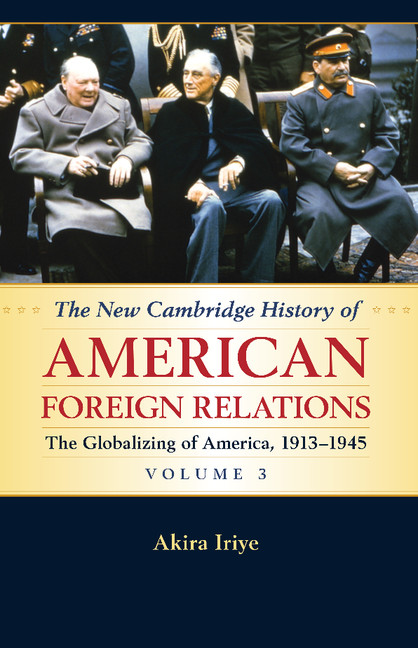
    Volume 3: The Globalizing of America, 1913–1945
    Show more authors
  • You may already have access via personal or institutional login
  • Select format
  • Publisher:
    Cambridge University Press
    Publication date:
    05 June 2013
    29 April 2013
    ISBN:
    9780511980589
    9780521763288
    9781107536197
    Dimensions:
    (228 x 152 mm)
    Weight & Pages:
    0.51kg, 266 Pages
    Dimensions:
    (229 x 152 mm)
    Weight & Pages:
    0.42kg, 270 Pages
You may already have access via personal or institutional login
  • Selected: Digital
    Add to cart View cart Buy from Cambridge.org

    Book description

    Since their first publication, the four volumes of The Cambridge History of American Foreign Relations have served as the definitive source for the topic, from the colonial period to the Cold War. This third volume of the updated edition describes how the United States became a global power - economically, culturally and militarily - during the period from 1913 to 1945, from the inception of Woodrow Wilson's presidency to the end of the Second World War. The author also discusses global transformations, from the period of the First World War through the 1920s when efforts were made to restore the world economy and to establish a new international order, followed by the disastrous years of depression and war during the 1930s, to the end of the Second World War. Throughout the book, themes of Americanisation of the world and the transformation of the United States provide the background for understanding the emergence of a trans-national world in the second half of the twentieth century.
    Reviews

    ‘A clear overview of American ascendance - cultural, military, and economic - in an era punctuated by war and economic crisis. Iriye’s global perspective helps us understand the rise of the United States in the context of wider challenges to European power; his analysis of deglobalizing forces and reglobalizing efforts casts new light on American leadership in this tumultuous time.’

    Kristin Hoganson - author of Consumers’ Imperium: The Global Production of American Domesticity

    ‘No one has done more than Akira Iriye to promote the study of U.S. foreign relations in a global frame that includes civil society actors and institutions. Skilfully bridging the domains of politics, economics, and culture, The Globalizing of America, 1913–1945 charts the United States’ interwar rise as a world power largely defined by its pursuit of economic interdependence, in the context of global crises and struggles over the nationalizing and internationalizing of power. Far from isolated in the decades prior to World War II, he shows that the United States possessed a growing presence abroad, particularly in the fields of investment, commerce, philanthropy, education and popular culture, that would come to transform both the world and the United States itself.’

    Paul A. Kramer - author of The Blood of Government: Race, Empire, the United States, and the Philippines

    ‘Iriye has no peer as an international historian, as attested to by this revision of his third volume of The Cambridge History of American Foreign Relations. With command and complexity he highlights America’s role from the First World War to the end of the Second in restructuring the global system without neglecting the agency of other states and non-state actors. The Globalizing of America, 1913–1945 is history at its best: a multidimensional study of power that is as accessible as it is challenging.’

    Richard H. Immerman - Temple University, Philadelphia

    ‘Akira Iriye’s volume, now updated with recent scholarship, continues to represent the best of historical interpretation and writing on its period. Scholars and students will continue to benefit from the provocative insights and graceful style of America’s most distinguished international historian.’

    Emily S. Rosenberg - editor of A World Connecting, 1870–1945

    Refine List

    Actions for selected content:

    Select all | Deselect all
    • View selected items
    • Export citations
    • Download PDF (zip)
    • Save to Kindle
    • Save to Dropbox
    • Save to Google Drive

    Save Search

    You can save your searches here and later view and run them again in "My saved searches".

    Please provide a title, maximum of 40 characters.
    ×

    Contents

    • 6 - The 1920s – The Economic Aspect
      pp 89-103
    • The Diplomacy of the Dollar
    • View abstract

      Summary

      The globalizing of America started long before 1913. This chapter traces the history of U.S. foreign relations from 1913 to 1945. It recalls that the nation had come into existence and conducted its external affairs in a world in which technological and economic globalization had begun to connect different parts of the globe. Growing American assertiveness in foreign affairs was buttressed by certain ideologies that stressed power, order, and civilization. Much of this was part of the trends in European thinking. It may be noted that while Western cultural dominance in the world continued, there was now also a greater degree of self-consciousness, even of defensiveness, in the age of imperialism. Even before 1914 the ideas both of economic interdependence and of peaceful settlement of disputes were sufficiently advanced in the United States to constitute a vision of American leadership in international relations.
    • 7 - The 1920s – The Cultural Aspect
      pp 104-118
    • Peace as an Ideology
    • View abstract

      Summary

      The coming of the Great War had little or nothing directly to do with the United States. One consequence of the growing importance of the American question in the European war was the need to persuade the Americans themselves of this fact, that is, to make them realize that, despite their official neutrality and widespread aversion to becoming involved in the conflict, they were in fact playing an increasingly vital role in it and that their actions even as nonbelligerents would have serious implications for the outcome of the struggle. The United States had prepared itself economically and intellectually for a crucial role in the European conflict. In the meantime, as the United States was preparing itself for an ultimate involvement in the European war, it was pursuing active, interventionist policies in East Asia and the Caribbean, something of a rehearsal for what was to come in Europe.
    • 8 - The Collapse of International Order
      pp 119-133
    • The Failure of Reglobalization
    • View abstract

      Summary

      By far the greatest reason for the ultimate success of the American war effort was the nation's economic resources, which it shared generously with its allies. The impressive performance of American military power and economic resources was matched, and sustained, by an ideological offensive led by President Wilson. This was not surprising in view of his keen interest, prior to 1917, in shaping the world to come after the war. Now that the United States was in the war, however, the aspirations of a neutral nation's leader developed into official enunciations of principles that were to guide the deliberations of the belligerents as they groped for peace. When the belligerents met in Paris at the beginning of 1919 to consider peace terms, American and Japanese forces were still in Siberia. Lenin, for his part, considered it prudent to retain some connection with the Western nations, in particular the United States, the country that would have the most to offer economically.
    • 9 - Totalitarianism and the Survival of Democracy
      pp 134-151
    • Totalitarianism and War
    • View abstract

      Summary

      The Paris peace conference was convened on January 18, 1919, and lasted until June 28, when a peace treaty with Germany was signed at the Versailles palace. Aspects of the peace were extremely harsh toward Germany, but some of the arrangements for the postwar world reflected the Wilsonian vision. It is not strange that, even given Wilson's well-known interest in the economic foundations of world order, he gave so little thought to this aspect of the Versailles peace. Perhaps he was too preoccupied with the more immediate political and military issues to give due attention to the question of transnational migration raised by China and Japan. Because the globalizing of America has been a major historical event of the past several decades, Wilsonianism should be seen not as a transient phenomenon, a reflection of some abstract idealism, but as a potent definer of contemporary history.
    • 10 - The Emergence of Geopolitics
      pp 152-171
    • Wars in Asia and Europe
    • View abstract

      Summary

      The postwar world began in 1919, with the signing of the Versailles peace treaty. This chapter explores aspects of the international system of the 1920s and the role played by the United States in its evolution and preservation. First of all, despite the confusion of the immediate postwar years, the major powers showed remarkable readiness to undertake programs of disarmament. Disarmament could not be separated from other questions of Asian-Pacific security, in particular the future of the Anglo-Japanese alliance and the fortification of the powers' bases in the Pacific Ocean. The peace of the 1920s was built on more than merely disarmament agreements. It was sustained through various other arrangements, including the League of Nations, the Locarno Conference treaties in Europe, and the Washington Conference treaties for Asia. In the meantime, in Europe the postwar peace remained fragile in the immediate aftermath of the Versailles conference.
    • 11 - The Road to Pearl Harbor
      pp 172-192
    • The European War and U.S. Neutrality
    • View abstract

      Summary

      American capital was the main sustainer of the international economic system during the 1920s. The role of American financial resources has sometimes been referred to as the diplomacy of the dollar. In some such fashion, a revitalized global economy came to hinge on a relationship of financial interdependence between the United States and Europe, and indeed the rest of the world as well. The penetration of world markets by American goods as well as capital and technology was providing a basis, the economic foundation, for the postwar international order. If American economic influence was linking different parts of the world closer together, thereby creating a greater sense of global interdependence, there was a contrary trend as well: the new immigration policy of the United States. Both the 1921 and the 1924 immigration laws established a quota system on the basis of nationality.
    • 12 - The Global Conflict
      pp 193-218
    • The Diplomacy of War
    • View abstract

      Summary

      Peace as a dominant idea was a distinctive feature of the postwar decade. Peace was such an ideology in the 1920s. It is relevant to note in this context that women in various countries played an active part in promoting ideas about peace. One of the earliest transnational women's organizations, the Women's International League for Peace and Freedom, had been established on the eve of the Great War. The proposition that peace was an intellectual engagement led to a major contribution of the postwar period: the idea that cultural and intellectual cooperation among nations was an effective way of promoting peace. Americans were very much part of the cultural internationalism. Cultural and intellectual cooperation represented an earnest activity by the world's leaders to contribute to internationalism and peace, and Americans were very much part of the movement. American missionaries continued to engage in humanitarian work in China and India.
    • Bibliographic Essay
      pp 219-238
    • View abstract

      Summary

      The postwar global economy had some advantages over the prewar globalization, such as its functioning in a better international political climate, but it had one serious problem, its excessive dependence on the United States. The world had become so accustomed to depending on American financial resources that it would be faced with a threat of total collapse unless the United States now did something to alleviate the situation. The American and British representatives believed that to grant Japan's request would jeopardize their Pacific possessions' security. The economic and diplomatic crises of the Hoover years witnessed a severe challenge to the ideological foundations of American foreign policy and of postwar international relations. Capitalism and democracy at home, and economic interdependence and cultural exchange abroad, had been visualized as essential elements of a reglobalized world. To be sure, many colonies remained, and not all countries espoused liberalism or democracy.

    Metrics

    Altmetric attention score

    Full text views

    Total number of HTML views: 0
    Total number of PDF views: 0 *

    Loading metrics...

    Book summary page views

    Total views: 0 *
    Loading metrics...

    * Views captured on Cambridge Core between #date#. This data will be updated every 24 hours.

    Usage data cannot currently be displayed.

    Accessibility standard: Unknown

    Why this information is here

    This section outlines the accessibility features of this content - including support for screen readers, full keyboard navigation and high-contrast display options. This may not be relevant for you.

    Accessibility Information

    Accessibility compliance for the HTML of this book is currently unknown and may be updated in the future.