Skip to main content Accessibility help
×
    Volume 1: Dimensions of the Early American Empire, 1754–1865
    Show more authors
  • You may already have access via personal or institutional login
  • Select format
  • Publisher:
    Cambridge University Press
    Publication date:
    05 February 2013
    28 February 2013
    ISBN:
    9781139030397
    9781107005907
    9781107536227
    Dimensions:
    (228 x 152 mm)
    Weight & Pages:
    0.59kg, 336 Pages
    Dimensions:
    (229 x 152 mm)
    Weight & Pages:
    0.54kg, 338 Pages
You may already have access via personal or institutional login
  • Selected: Digital
    Add to cart View cart Buy from Cambridge.org

    Book description

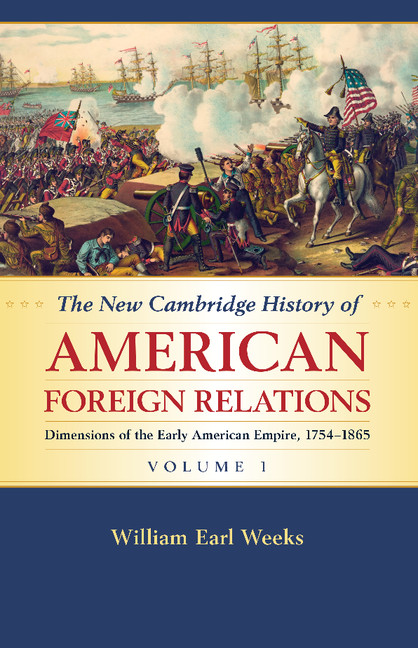
    Since their first publication, the four volumes of the Cambridge History of American Foreign Relations have served as the definitive source for the topic, from the colonial period to the Cold War. This entirely new first volume narrates the British North American colonists' pre-existing desire for expansion, security and prosperity and argues that these desires are both the essence of American foreign relations and the root cause for the creation of the United States. They required the colonists to unite politically, as individual colonies could not dominate North America by themselves. Although ingrained localist sentiments persisted, a strong, durable Union was required for mutual success, thus American nationalism was founded on the idea of allegiance to the Union. Continued tension between the desire for expansion and the fragility of the Union eventually resulted in the Union's collapse and the Civil War.
    Reviews

    ‘William Weeks is to be congratulated on his concise and masterful synthesis relating the rise of the American republic. His account provides the best explanation we have of how the concept of ‘empire’ can integrate both external and internal developments in the formative era of American history. Teachers and students alike will both admire and benefit greatly from the skill with which Weeks accomplishes this task.’

    J. C. A. Stagg - University of Virginia

    Refine List

    Actions for selected content:

    Select all | Deselect all
    • View selected items
    • Export citations
    • Download PDF (zip)
    • Save to Kindle
    • Save to Dropbox
    • Save to Google Drive

    Save Search

    You can save your searches here and later view and run them again in "My saved searches".

    Please provide a title, maximum of 40 characters.
    ×

    Contents

    • 7 - Bullying Britain, Conquering Mexico, Claiming the Canal
      pp 178-209
    • View abstract

      Summary

      Franklin's vision of an expanding British North American empire required a colonial union. The lesson, Franklin learned from the example of the Six Nations Confederacy was about the importance of union to the establishment of the imperial control of North America. The most radical aspect of Franklin's vision was his conception of an emerging parity between England and the colonies. Washington's and Franklin's efforts to spur unity suggest that the move toward the creation of an American union is best understood as a 'grasstips' movement. Franklin and Washington's participation in the expansionist thrust reflected both the personal and the public interests each had in acquiring control of the Ohio Country. The revolutionary faction in the colonies wouldn't accept political subordination or limitations on its territorial and commercial expansionism. The bloody battles at Lexington and Concord in April 1775 marked the beginning of a de facto war of independence for the colonies.
    • 8 - Disunion
      pp 210-238
    • View abstract

      Summary

      Victory over Great Britain brought forth a wave of proto-nationalist literature, much of it emerging from the nation's few institutions of higher learning. The immediate postwar period found the United States facing imposing challenges, both domestic and foreign, which threatened to shatter the unity essential to the nation's future. Americans did not let concerns about the French revolutionary experiment prevent them from attempting to profit from the European war. Facing challenges to their economic interests on the high seas, Americans also confronted an ongoing war with the Indians on the western frontier, especially in the Ohio Country. Wayne's defeat of the Miami Confederacy in August 1794 had paved the way for the Treaty of Greenville in 1795, finally securing the Ohio Country for the United States. The crushing of the whiskey rebels in November 1794 had served notice far beyond western Pennsylvania that the new sovereignty established by the Constitution had teeth and was not to be taken lightly.
    • 9 - The Imperial Crisis
      pp 239-272
    • View abstract

      Summary

      France, led by Napoleon, vindicated Adams's limited war policy by agreeing to settle the commercial policy dispute. The Convention of 1800 with France and the temporary cessation of hostilities in Europe combined to create a period of calm before the accession in March 1801 of Thomas Jefferson to the presidency. Some Federalists at the time and some historians since have portrayed the Louisiana Purchase as a stroke of diplomatic luck that owed little to Jefferson's presidential leadership. Jefferson's war on Barbary piracy represented a similar expansion of both the imperial reach of the United States and the power of the executive to make war. On June 22, 1807, the British warship HMS Leopard, patrolling the lower Chesapeake Bay, overtook and broadsided an American frigate, which was en route to the Mediterranean to take part in the Barbary War. Jefferson saw the embargo as a means of bringing back the self-sacrifice and patriotism that epitomized 'the Spirit of 76'.
    • Bibliographic Essay
      pp 273-290
    • View abstract

      Summary

      Taylor sees four intertwined dimensions to the Civil War of 1812. First, a struggle between Loyalists and Americans for control of the new province of Upper Canada. Second, the efforts of Irish immigrants to the United States, many of them recent, to continue their ongoing struggle against British colonialism, this time in Canada under the American flag. Third, the involvement of Native American tribes on both sides of the conflict, pursuing their individual agendas, often against other Indians. Fourth, an intense domestic partisanship that spilled into outright treason as some members of the Federalist party served as spies and smugglers for the British. The War of 1812 stands as an important victory for the American Empire. The return of peace and the end of the high seas controversies caused by the Napoleonic Wars did much to change the national mood after 1815. James Monroe is the least renowned of the three Virginians elected to the presidency between 1800 and 1820.

    Metrics

    Altmetric attention score

    Full text views

    Total number of HTML views: 0
    Total number of PDF views: 0 *

    Loading metrics...

    Book summary page views

    Total views: 0 *
    Loading metrics...

    * Views captured on Cambridge Core between #date#. This data will be updated every 24 hours.

    Usage data cannot currently be displayed.

    Accessibility standard: Unknown

    Why this information is here

    This section outlines the accessibility features of this content - including support for screen readers, full keyboard navigation and high-contrast display options. This may not be relevant for you.

    Accessibility Information

    Accessibility compliance for the HTML of this book is currently unknown and may be updated in the future.