News Frames and National Security

-
Select format
-
- Publisher:
- Cambridge University Press
- Publication date:
- 18 December 2014
- 29 December 2014
- ISBN:
- 9781139022200
- 9780521113595
- 9780521130554
- Dimensions:
- (228 x 152 mm)
- Weight & Pages:
- 0.52kg, 238 Pages
- Dimensions:
- (228 x 152 mm)
- Weight & Pages:
- 0.36kg, 232 Pages
You may already have access via personal or institutional login
Show more authors 
You may already have access via personal or institutional login
Book description
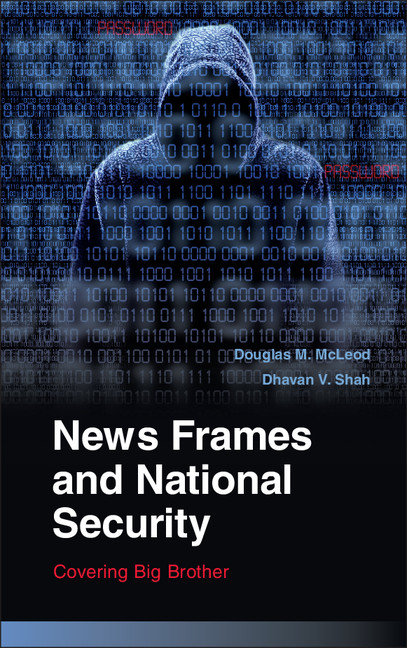
Did media coverage contribute to Americans' tendency to favor national security over civil liberties following the 9/11 attacks? How did news framing of terrorist threats support the expanding surveillance state revealed by Edward Snowden? Douglas M. McLeod and Dhavan V. Shah explore the power of news coverage to render targeted groups suspicious and to spur support for government surveillance. They argue that the tendency of journalists to frame stories around individual targets of surveillance - personifying the domestic threat - shapes citizens' judgments about tolerance and participation, leading them to limit the civil liberties of a range of groups under scrutiny and to support 'Big Brother'.
Reviews
'This is an impressive collection of theories and empirical studies of framing effects in the important area of national security vs. civil liberties during the War on terror, it is theoretically sound and methodically rigorous … this volume is a comprehensive synthesis of the theoretical approaches and research studies surrounding training effects on national security and civil liberties issues. The unifying model can be applied to framing effects in other research domains.'
Weiwu Zhang Source: Communication Booknotes Quarterly
Contents
Contents
Metrics
Full text views
Full text views helpTotal number of HTML views: 0
Total number of PDF views: 0 *
 Loading metrics...
* Views captured on Cambridge Core between #date#. This data will be updated every 24 hours.
Usage data cannot currently be displayed.
Accessibility standard: Unknown
Why this information is here
This section outlines the accessibility features of this content - including support for screen readers, full keyboard navigation and high-contrast display options. This may not be relevant for you.
Accessibility Information
Accessibility compliance for the PDF of this book is currently unknown and may be updated in the future.