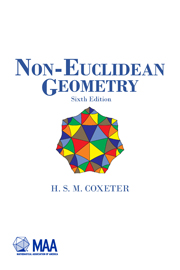
Non-Euclidean Geometry

-
The digital format of this book is no longer available to purchase from Cambridge Core. Other formats may be available.
-
Select format
-
- Publisher:
- Mathematical Association of America
- Publication date:
- 05 September 2014
- 01 June 1998
- ISBN:
- 9781614445166
- 9780883855225
- Dimensions:
- Weight & Pages:
- Dimensions:
- Weight & Pages:
- 00kg,
- Subjects:
- Mathematics, Geometry and Topology
- Series:
- Spectrum
You may already have access via personal or institutional login- Subjects:
- Mathematics, Geometry and Topology
- Series:
- Spectrum
Show more authors 
You may already have access via personal or institutional login
Book description
Throughout most of this book, non-Euclidean geometries in spaces of two or three dimensions are treated as specializations of real projective geometry in terms of a simple set of axioms concerning points, lines, planes, incidence, order and continuity, with no mention of the measurement of distances or angles. This synthetic development is followed by the introduction of homogeneous coordinates, beginning with Von Staudt's idea of regarding points as entities that can be added or multiplied. Tranformations that preserve incidence are called collineations. They lead in a natural way to isometries or 'congruent transformations'. Following a recommendation by Bertrand Russell, continuity is described in terms of order. Elliptic and hyperbolic geometries are derived from real projective geometry by specializing an elliptic or hyperbolic polarity which transforms points into lines (in two dimensions) or planes (in three dimensions) and vice versa.
Contents
Contents
Metrics
Altmetric attention score
Full text views
Full text views helpTotal number of HTML views: 0
Total number of PDF views: 0 *
 Loading metrics...
* Views captured on Cambridge Core between #date#. This data will be updated every 24 hours.
Usage data cannot currently be displayed.
Accessibility standard: Unknown
Why this information is here
This section outlines the accessibility features of this content - including support for screen readers, full keyboard navigation and high-contrast display options. This may not be relevant for you.
Accessibility Information
Accessibility compliance for the PDF of this book is currently unknown and may be updated in the future.