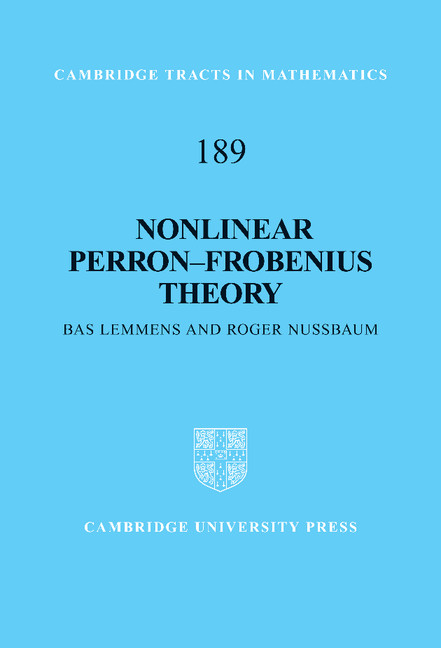
Nonlinear Perron–Frobenius Theory

-
Select format
-
- Publisher:
- Cambridge University Press
- Publication date:
- 05 May 2012
- 03 May 2012
- ISBN:
- 9781139026079
- 9780521898812
- Dimensions:
- (228 x 152 mm)
- Weight & Pages:
- 0.62kg, 336 Pages
- Dimensions:
- Weight & Pages:
You may already have access via personal or institutional login
Show more authors 
You may already have access via personal or institutional login
Book description
In the past several decades the classical Perron–Frobenius theory for nonnegative matrices has been extended to obtain remarkably precise and beautiful results for classes of nonlinear maps. This nonlinear Perron–Frobenius theory has found significant uses in computer science, mathematical biology, game theory and the study of dynamical systems. This is the first comprehensive and unified introduction to nonlinear Perron–Frobenius theory suitable for graduate students and researchers entering the field for the first time. It acquaints the reader with recent developments and provides a guide to challenging open problems. To enhance accessibility, the focus is on finite dimensional nonlinear Perron–Frobenius theory, but pointers are provided to infinite dimensional results. Prerequisites are little more than basic real analysis and topology.
Reviews
'In their introduction the authors state that 'the main purpose of this book is to give a systematic self-contained introduction to nonlinear Perron–Frobenius theory and to provide a guide to various challenging open problems'. They have achieved their aim excellently.'
Hans Schneider - University of Wisconsin, Madison
‘Undoubtedly, this remarkable book will be of interest to all specialists in nonlinear analysis and its applications. Certainly, any mathematical library ought to carry this book.’
Peter Zabreiko Source: Zentralblatt MATH
'This textbook is a carefully arranged journey through large parts of this beautiful theory, which has seen various contributions by the authors in the past. The material is accessible with little more than a basic knowledge of linear algebra, real analysis and some topology. The book is self-contained, all results are proven very rigorously, and where appropriate, the evolution of results is explained and framed in the historical context. I recommend this book very warmly and without any reservations to anyone interested in nonlinear Perron–Frobenius theory.'
Bjorn S. Ruffer Source: Mathematical Reviews
Contents
Contents
Metrics
Altmetric attention score
Full text views
Full text views helpTotal number of HTML views: 0
Total number of PDF views: 0 *
 Loading metrics...
* Views captured on Cambridge Core between #date#. This data will be updated every 24 hours.
Usage data cannot currently be displayed.
Accessibility standard: Unknown
Why this information is here
This section outlines the accessibility features of this content - including support for screen readers, full keyboard navigation and high-contrast display options. This may not be relevant for you.
Accessibility Information
Accessibility compliance for the PDF of this book is currently unknown and may be updated in the future.