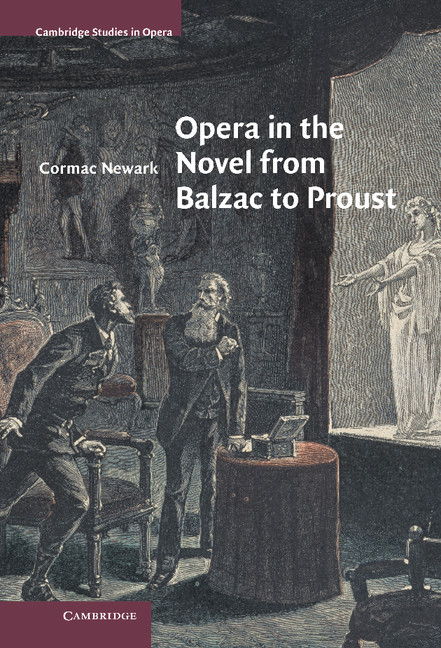
Opera in the Novel from Balzac to Proust

-
Select format
-
- Publisher:
- Cambridge University Press
- Publication date:
- 03 May 2011
- 31 March 2011
- ISBN:
- 9780511921216
- 9780521118903
- Dimensions:
- (228 x 152 mm)
- Weight & Pages:
- 0.61kg, 298 Pages
- Dimensions:
- Weight & Pages:
- Subjects:
- Literature, Area Studies, Music, Opera, European Literature, European Studies
- Series:
- Cambridge Studies in Opera
You may already have access via personal or institutional login- Subjects:
- Literature, Area Studies, Music, Opera, European Literature, European Studies
- Series:
- Cambridge Studies in Opera
Show more authors 
You may already have access via personal or institutional login
Book description
The turning point of Madame Bovary, which Flaubert memorably set at the opera, is only the most famous example of a surprisingly long tradition, one common to a range of French literary styles and sub-genres. In the first book-length study of that tradition to appear in English, Cormac Newark examines representations of operatic performance from Balzac's La Comédie humaine to Proust's À la recherche du temps perdu, by way of (among others) Dumas père's Le Comte de Monte-Cristo and Leroux's Le Fantôme de l'Opéra. Attentive to textual and musical detail alike in the works, the study also delves deep into their reception contexts. The result is a compelling cultural-historical account: of changing ways of making sense of operatic experience from the 1820s to the 1920s, and of a perennial writerly fascination with the recording of that experience.
Reviews
‘With an obvious and informed enthusiasm for the subject, Newark balances literary and musicological considerations with quite and persuasive authority … casts revealing light on a significant period in the development of opera.’
Source: Opera
Contents
Contents
Metrics
Altmetric attention score
Full text views
Full text views helpTotal number of HTML views: 0
Total number of PDF views: 0 *
 Loading metrics...
* Views captured on Cambridge Core between #date#. This data will be updated every 24 hours.
Usage data cannot currently be displayed.
Accessibility standard: Unknown
Why this information is here
This section outlines the accessibility features of this content - including support for screen readers, full keyboard navigation and high-contrast display options. This may not be relevant for you.
Accessibility Information
Accessibility compliance for the PDF of this book is currently unknown and may be updated in the future.