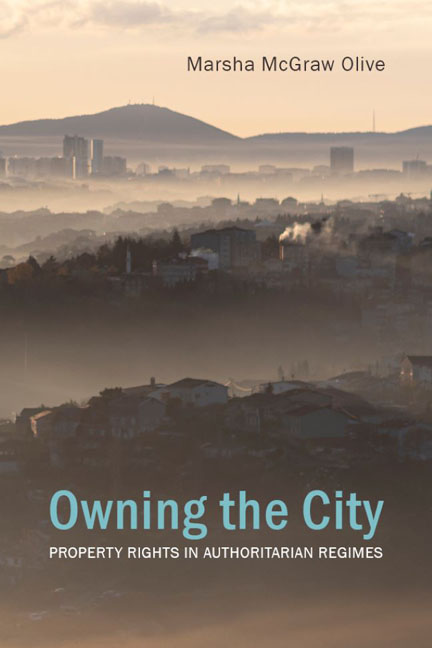
Owning the City

-
Select format
-
- Publisher:
- Agenda Publishing
- Publication date:
- 20 January 2024
- 07 July 2022
- ISBN:
- 9781788214698
- 9781788214681
- Dimensions:
- Weight & Pages:
- Dimensions:
- Weight & Pages:
You may already have access via personal or institutional login
Show more authors 
You may already have access via personal or institutional login
Book description
Competition between democratic and authoritarian systems is playing out in global cities, where real property rights influence regime legitimacy and economic performance. Two questions inspire debate. Why does the property-owning middle class, which was integral to democratic development in the West, support illiberal governments? Do differences between political systems affect the success of global cities?
Marsha McGraw Olive unravels these questions by comparing urban land governance in Europe and Eurasia. Democracies largely, but not exclusively, perform better than hybrid or authoritarian regimes on real property rights, land-related regulations, and citizen engagement in urban planning. Case studies of Moscow and Istanbul show that urban real property is fundamental to regime stability, bringing wealth to average citizens and favoured elites. This formula, perfected by President Putin, bestows economic but not political benefits to middle-class property owners.
The book argues that all cities need to improve land governance to cope with twenty-first century urban challenges. Cities that respect property rights and put citizens at the centre of urban planning achieve better outcomes. In contrast, illiberal leaders who rely on opaque property deals are inciting public backlash and slowing economic growth. In the global political competition, real property rights are a chink in the authoritarian armour.
Contents
Contents
Metrics
Full text views
Full text views helpTotal number of HTML views: 0
Total number of PDF views: 0 *
 Loading metrics...
* Views captured on Cambridge Core between #date#. This data will be updated every 24 hours.
Usage data cannot currently be displayed.
Accessibility standard: Unknown
Why this information is here
This section outlines the accessibility features of this content - including support for screen readers, full keyboard navigation and high-contrast display options. This may not be relevant for you.
Accessibility Information
Accessibility compliance for the PDF of this book is currently unknown and may be updated in the future.