Palaeopathology

-
Select format
-
- Publisher:
- Cambridge University Press
- Publication date:
- 20 November 2020
- 10 December 2020
- ISBN:
- 9781108583961
- 9781108499583
- 9781108730884
- Dimensions:
- (253 x 177 mm)
- Weight & Pages:
- 0.94kg, 378 Pages
- Dimensions:
- (253 x 177 mm)
- Weight & Pages:
- 0.81kg, 378 Pages
- Subjects:
- Archaeological Theory and Methods, Archaeology, Archaeological Science
- Series:
- Cambridge Manuals in Archaeology
You may already have access via personal or institutional login- Subjects:
- Archaeological Theory and Methods, Archaeology, Archaeological Science
- Series:
- Cambridge Manuals in Archaeology
2nd edition
Show more authors 
You may already have access via personal or institutional login
Book description
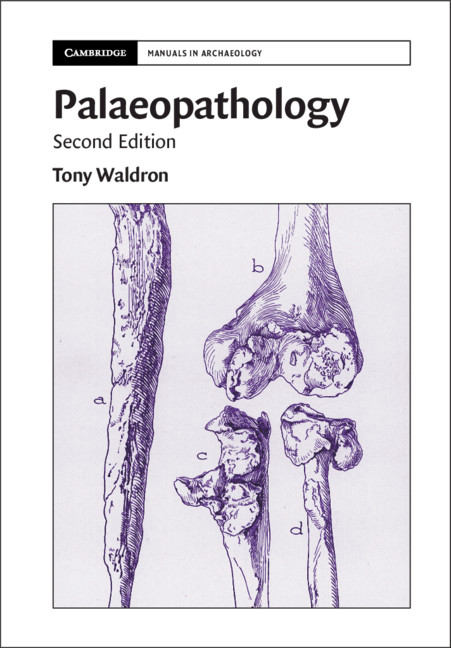
Palaeopathology is an evidence-based guide to the principal types of pathological lesions often found in human remains and how to diagnose them. Tony Waldron presents an innovative method of arriving at a diagnosis in the skeleton by applying what he refers to as 'operational definitions'. The method ensures that those who study bones will use the same criteria for diagnosing disease, thereby enabling valid comparisons to be made between studies. Waldron's book is based on modern clinical knowledge and provides background information on the natural history of bone disease. In addition, the volume demonstrates how results from studies should be analysed, methods of determining the frequency of disease, and other types of epidemiological analysis. This edition includes new chapters on the development of palaeopathology, basic concepts, health and disease, diagnosis, and spinal pathology. Chapters on analysis and interpretation have been thoroughly revised and enlarged.
Reviews
‘This is a well-written and authoritative text that assumes a suitable background in relevant biomedical disciplines … The book will primarily be of interest to archaeologists, forensic anthropologists, bone specialists, and those working in or studying related fields … Recommended.’
T. Brennan Source: CHOICE
Contents
Contents
Metrics
Full text views
Full text views helpTotal number of HTML views: 0
Total number of PDF views: 0 *
 Loading metrics...
* Views captured on Cambridge Core between #date#. This data will be updated every 24 hours.
Usage data cannot currently be displayed.
Accessibility standard: Unknown
Why this information is here
This section outlines the accessibility features of this content - including support for screen readers, full keyboard navigation and high-contrast display options. This may not be relevant for you.
Accessibility Information
Accessibility compliance for the HTML of this book is currently unknown and may be updated in the future.