Parliamentarism

-
Select format
-
- Publisher:
- Cambridge University Press
- Publication date:
- 05 July 2019
- 18 July 2019
- ISBN:
- 9781108585330
- 9781108475747
- 9781108468855
- Dimensions:
- (228 x 152 mm)
- Weight & Pages:
- 0.52kg, 268 Pages
- Dimensions:
- (229 x 152 mm)
- Weight & Pages:
- 0.4kg, 268 Pages
You may already have access via personal or institutional login
Show more authors 
You may already have access via personal or institutional login
Book description
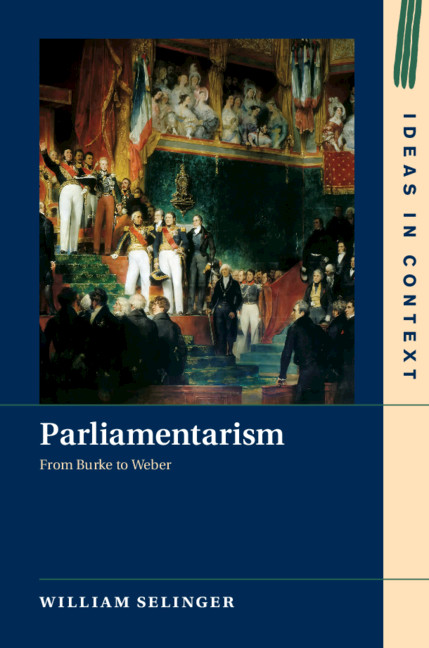
For eighteenth- and nineteenth-century authors such as Burke, Constant, and Mill, a powerful representative assembly that freely deliberated and controlled the executive was the defining institution of a liberal state. Yet these figures also feared that representative assemblies were susceptible to usurpation, gridlock, and corruption. Parliamentarism was their answer to this dilemma: a constitutional model that enabled a nation to be truly governed by a representative assembly. Offering novel interpretations of canonical liberal authors, this history of liberal political ideas suggests a new paradigm for interpreting the development of modern political thought, inspiring fresh perspectives on historical issues from the eighteenth to early twentieth centuries. In doing so, Selinger suggests the wider significance of parliament and the theory of parliamentarism in the development of European political thought, revealing how contemporary democratic theory, and indeed the challenges facing representative government today, are historically indebted to classical parliamentarism.
Reviews
‘Political theorists interested in the history of ideas, constitutional theory, and comparative constitutionalism will want to read this … Highly recommended.’
M. J. Dudas Source: Choice
‘Selinger’s book is not only a fresh reading of intellectual history intended for professional historians but also a call to rethink our current visions of the so-called liberal democracies in the light of the parliamentary tradition.’
Ján Tomaštík and Jan Holzer Source: International Journal of Parliamentary Studies
Contents
Contents
Metrics
Altmetric attention score
Full text views
Full text views helpTotal number of HTML views: 0
Total number of PDF views: 0 *
 Loading metrics...
* Views captured on Cambridge Core between #date#. This data will be updated every 24 hours.
Usage data cannot currently be displayed.
Accessibility standard: Unknown
Why this information is here
This section outlines the accessibility features of this content - including support for screen readers, full keyboard navigation and high-contrast display options. This may not be relevant for you.
Accessibility Information
Accessibility compliance for the HTML of this book is currently unknown and may be updated in the future.