Party Competition between Unequals

-
Select format
-
- Publisher:
- Cambridge University Press
- Publication date:
- 25 July 2009
- 09 June 2008
- ISBN:
- 9780511510298
- 9780521887656
- 9780521169080
- Dimensions:
- (228 x 152 mm)
- Weight & Pages:
- 0.61kg, 340 Pages
- Dimensions:
- (234 x 156 mm)
- Weight & Pages:
- 0.48kg, 338 Pages
You may already have access via personal or institutional login
Show more authors 
You may already have access via personal or institutional login
Book description
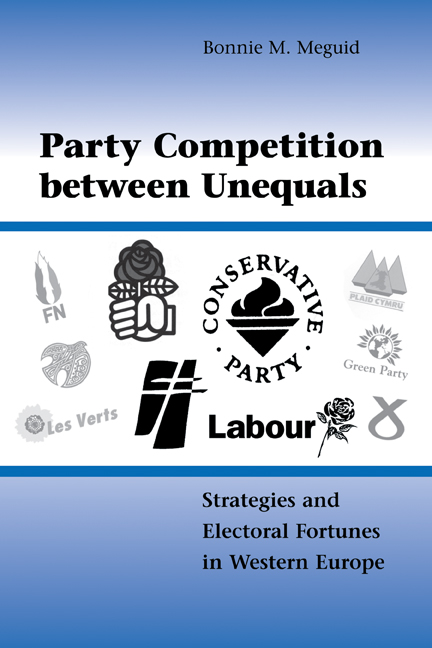
Why do some political parties flourish, while others flounder? In this book, Meguid examines variation in the electoral trajectories of the new set of single-issue parties: green, radical right, and ethnoterritorial parties. Instead of being dictated by electoral institutions or the socioeconomic climate, as the dominant theories contend, the fortunes of these niche parties, she argues, are shaped by the strategic responses of mainstream parties. She advances a theory of party competition in which mainstream parties facing unequal competitors have access to a wider and more effective set of strategies than posited by standard spatial models. Combining statistical analyses with in-depth case studies from Western Europe, the book explores how and why established parties undermine niche parties or turn them into weapons against their mainstream party opponents. This study of competition between unequals thus provides broader insights into the nature and outcome of competition between political equals.
Reviews
'In this well-written, accessible, and superbly researched book, Meguid offers a new framework for explaining what she calls niche party success and failure. … Meguid's book significantly advances our understanding of the relationship between mainstream and niche parties, niche party success and failure, and party competition between unequals and nonproximal parties.'
Source: Journal of Politics
'… the book offers brilliant academic intrigue … good reading for social scientists and their students, [and] also for policy analysts and policy makers …'
Source: CEU Political Science Journal
'In this very valuable contribution to comparative state-church studies, Ahmet T. Kuru takes readers on a deep and illuminating dive to examine why three self-consciously 'secular' states - the United States, France, and Turkey - have come to treat religion in the public sphere so differently from one another … Kuru offers a fresh and well-researched perspective on the resulting clashes, and he demonstrates why assertive secularism won out in twentieth century France and Turkey.'
Jonathan Laurence Source: Culture and Society
Contents
Contents
Metrics
Altmetric attention score
Full text views
Full text views helpTotal number of HTML views: 0
Total number of PDF views: 0 *
 Loading metrics...
* Views captured on Cambridge Core between #date#. This data will be updated every 24 hours.
Usage data cannot currently be displayed.
Accessibility standard: Unknown
Why this information is here
This section outlines the accessibility features of this content - including support for screen readers, full keyboard navigation and high-contrast display options. This may not be relevant for you.
Accessibility Information
Accessibility compliance for the PDF of this book is currently unknown and may be updated in the future.