The Persistent Power of Human Rights

-
Select format
-
- Publisher:
- Cambridge University Press
- Publication date:
- 05 March 2013
- 07 March 2013
- ISBN:
- 9781139237161
- 9781107028937
- 9781107609365
- Dimensions:
- (228 x 152 mm)
- Weight & Pages:
- 0.72kg, 374 Pages
- Dimensions:
- (228 x 152 mm)
- Weight & Pages:
- 0.59kg, 374 Pages
You may already have access via personal or institutional login- Series:
- Cambridge Studies in International Relations (126)
Show more authors 
You may already have access via personal or institutional login
Book description
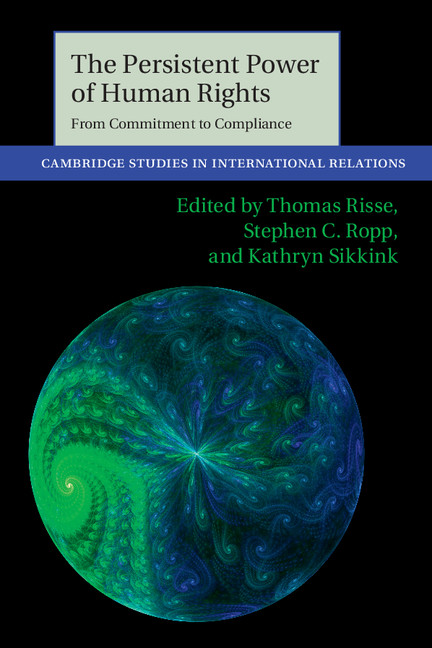
The Power of Human Rights (published in 1999) was an innovative and influential contribution to the study of international human rights. At its center was a 'spiral model' of human rights change which described the various socialization processes through which international norms were internalized into the domestic practices of various authoritarian states during the Cold War years. The Persistent Power of Human Rights builds on these insights, extending its reach and analysis. It updates our understanding of the various causal mechanisms and conditions which produce behavioural compliance, and expands the range of rights-violating actors examined to include democratic and authoritarian Great Powers, corporations, guerrilla groups, and private actors. Using a unique blend of quantitative and qualitative research and theory, this book yields not only important new academic insights but also a host of useful lessons for policy-makers and practitioners.
Reviews
‘A superb collection of essays epitomizing the new wave of human rights scholarship that is more evaluative, inter-disciplinary, quantitative, critical and engaged. Essential reading for anyone seeking to understand how, when and why the international human rights system works (and doesn’t work).’
Philip G. Alston - John Norton Pomeroy Professor of Law, New York University
‘The Persistent Power of Human Rights shows the persistent imagination of a group of scholars who developed the spiral model more than a decade ago. The revisited version is as significant for our understanding of social norms as the 1999 book was - a must for students of human rights.'
Michael Zürn - Director at the WZB and Professor of International Relations, Freie Universität Berlin
Contents
Contents
Metrics
Altmetric attention score
Full text views
Full text views helpTotal number of HTML views: 0
Total number of PDF views: 0 *
 Loading metrics...
* Views captured on Cambridge Core between #date#. This data will be updated every 24 hours.
Usage data cannot currently be displayed.
Accessibility standard: Unknown
Why this information is here
This section outlines the accessibility features of this content - including support for screen readers, full keyboard navigation and high-contrast display options. This may not be relevant for you.
Accessibility Information
Accessibility compliance for the PDF of this book is currently unknown and may be updated in the future.