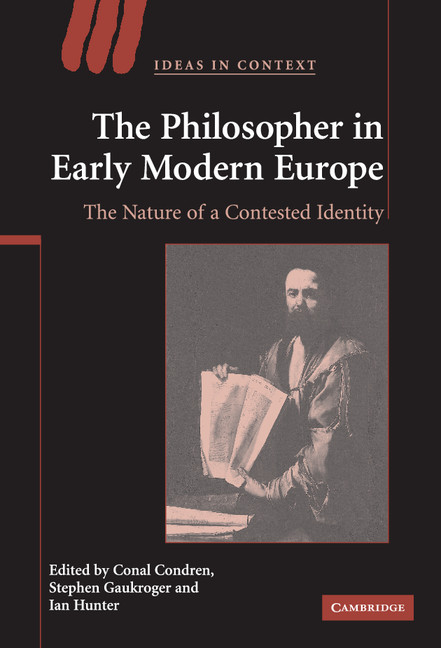
The Philosopher in Early Modern Europe

-
Select format
-
- Publisher:
- Cambridge University Press
- Publication date:
- 06 November 2009
- 28 September 2006
- ISBN:
- 9780511490460
- 9780521866460
- 9780521123891
- Dimensions:
- (228 x 152 mm)
- Weight & Pages:
- 0.625kg, 302 Pages
- Dimensions:
- (229 x 152 mm)
- Weight & Pages:
- 0.45kg, 304 Pages
- Subjects:
- History of Philosophy, History of Ideas, History, Philosophy, History of Ideas and Intellectual History
- Series:
- Ideas in Context (77)
You may already have access via personal or institutional login- Subjects:
- History of Philosophy, History of Ideas, History, Philosophy, History of Ideas and Intellectual History
- Series:
- Ideas in Context (77)
Show more authors 
You may already have access via personal or institutional login
Book description
In this groundbreaking collection of essays the history of philosophy appears in a fresh light, not as reason's progressive discovery of its universal conditions, but as a series of unreconciled disputes over the proper way to conduct oneself as a philosopher. By shifting focus from the philosopher as proxy for the universal subject of reason to the philosopher as a special persona arising from rival forms of self-cultivation, philosophy is approached in terms of the social office and intellectual deportment of the philosopher, as a personage with a definite moral physiognomy and institutional setting. In so doing, this collection of essays by leading figures in the fields of both philosophy and the history of ideas provides access to key early modern disputes over what it meant to be a philosopher, and to the institutional and larger political and religious contexts in which such disputes took place.
Reviews
“This is a thought-provoking collection. It fits a now-familiar scholarly mold of seeing knowledge as embedded in particular societies and their histories. In this case, contributors show how what counts as ‘philosophy’ in any time and place depends on these local particularities, detailing the assertion, for Early Modern Europe, via arguments both of wider temporal sweep and of intricate analysis of particular figures and their writings. At the same time, and for this reader more interestingly, some of its contributors explore how those who then carried out the tasks of philosophy did so within a context of changing experiences of personhood…This work is a major contribution to such a project.”
Timothy J. Reiss, Metascience
Contents
Contents
Metrics
Altmetric attention score
Full text views
Full text views helpTotal number of HTML views: 0
Total number of PDF views: 0 *
 Loading metrics...
* Views captured on Cambridge Core between #date#. This data will be updated every 24 hours.
Usage data cannot currently be displayed.
Accessibility standard: Unknown
Why this information is here
This section outlines the accessibility features of this content - including support for screen readers, full keyboard navigation and high-contrast display options. This may not be relevant for you.
Accessibility Information
Accessibility compliance for the PDF of this book is currently unknown and may be updated in the future.