Skip to main content Accessibility help
×
    Show more authors
  • You may already have access via personal or institutional login
  • Select format
  • Publisher:
    Cambridge University Press
    Publication date:
    05 March 2012
    16 February 2012
    ISBN:
    9780511977831
    9780521899666
    9781107654273
    Dimensions:
    (228 x 152 mm)
    Weight & Pages:
    0.78kg, 410 Pages
    Dimensions:
    (229 x 152 mm)
    Weight & Pages:
    0.55kg, 410 Pages
You may already have access via personal or institutional login
  • Selected: Digital
    Add to cart View cart Buy from Cambridge.org

    Book description

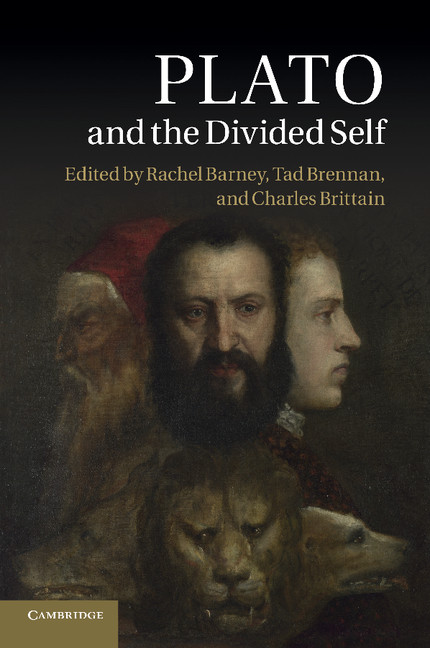
    Plato's account of the tripartite soul is a memorable feature of dialogues like the Republic, Phaedrus and Timaeus: it is one of his most famous and influential yet least understood theories. It presents human nature as both essentially multiple and diverse - and yet somehow also one - divided into a fully human 'rational' part, a lion-like 'spirited part' and an 'appetitive' part likened to a many-headed beast. How these parts interact, how exactly each shapes our agency and how they are affected by phenomena like erôs and education is complicated and controversial. The essays in this book investigate how the theory evolves over the whole of Plato's work, including the Republic, Phaedrus and Timaeus, and how it was developed further by important Platonists such as Galen, Plutarch and Plotinus. They will be of interest to a wide audience in philosophy and classics.

    Reviews

    'This volume represents an invaluable contribution to the field of Platonic moral psychology. The essays it contains are filled with fresh ideas, insights, and challenges, and they are sure to stimulate new debates in the ongoing scholarly discussion of Plato’s views on the soul.'

    Joshua Wilburn Source: Philosophy in Review

    Refine List

    Actions for selected content:

    Select all | Deselect all
    • View selected items
    • Export citations
    • Download PDF (zip)
    • Save to Kindle
    • Save to Dropbox
    • Save to Google Drive

    Save Search

    You can save your searches here and later view and run them again in "My saved searches".

    Please provide a title, maximum of 40 characters.
    ×

    Contents

    • 8 - Psychic contingency in the Republic
      pp 174-208
    • View abstract

      Summary

      The most notorious difference between the Phaedo and Republic is the detailed presentation of the tripartite soul in the latter in contrast with the one-part psychology of the former. This chapter examines what difference this makes for our understanding of the three "types" of virtue namely slavish virtue, political or civic, habituated virtue and genuine or philosophical virtue. In the Phaedo's conception of a philosopher, the chapter argues that Plato opens up conceptual space for a type of virtue that falls short of genuine, complete virtue, but is nevertheless not slavish. In both the Phaedo and Republic what most significantly distinguishes philosophers from non-philosophers is their recognition of and concern with Forms. Philosophers' lack of fear of death and indifference to (or disdain of) the pleasures and pains of the body make Phaedo (a "Phd-philosopher") fit very well the ordinary descriptions of courageous and temperate characters.
    • 9 - Erôs before and after tripartition
      pp 211-237
    • View abstract

      Summary

      In Book Four of Plato's Republic, Socrates divides the soul. This chapter shows that according to Book Four's division of the soul, the soul's unearned unity must and can be complex. It identifies a Platonic account of complex unity that explains why the whole soul is a locus of moral responsibility and at least enables explaining the unity of consciousness. Although Socrates has left room for the soul to be a complex whole comprising multiple parts, he has also made it clear that the parts are separate sources of psychological activity. The unearned unity of the soul is, like earned unity, a function of agreement among its parts, but unearned unity does not require each part of the soul to recognize the aims that it shares with the other parts. So the moral responsibility of the whole soul is akin to the collective responsibility of a corporate agent.
    • 11 - Pictures and passions in the Timaeus and Philebus
      pp 259-280
    • View abstract

      Summary

      The chapter argues that Plato's psychology represents our motivations as themselves person-like with the aim of showing us the lineaments of philosophic virtue and of the self-transformation required for its development. It examines the way one ordinarily uses personification to think about our own motivations. The chapter highlights that Plato uses personification in a similar way with respect to the development of philosophic virtue. Parallels between Plato's psychology and the theology of the Republic suggest that one ought to regard personification as a likely story told for its effects on our self-conceptions and behavior. Finally, it is important to acknowledge that personification is a feature not only of Plato's middle-period but also of his late psychology, where it appears to conflict with two significant theoretical developments in the psychology: the denial of belief to appetite, and the recognition of the requirements for unity of the experiencing subject.
    • 12 - Soul and state in Plato's Laws
      pp 281-308
    • View abstract

      Summary

      The spirited part of the soul is best understood as a response to the introduction of appetitive souls into the world. All of its functions involve responding to and relating to appetitive souls. One must understand that spirit's roles divide sharply in two, corresponding to the fact that the rational soul is forced to confront appetitive souls in two venues: the appetitive souls in the bodies of other people that surround it, and the appetitive soul inside its own body. Since there are many souls in many bodies, and appetitive goods are finitely available, there is competition for them. Spirit is needed to help negotiate the distribution of appetitive goods among multiple agents. It is worth saying, that spirit's sensitivity to the oikeion is not in competition with its sensitivity to honor, but rather one of the preconditions of it.
    • 13 - Plutarch on the division of the soul
      pp 311-330
    • View abstract

      Summary

      This chapter focuses on the force of the analogy and Socrates' prescription for recognizing the soul. It discusses the condition of the embodied soul compared with that of Glaucus. To look at the god in his sea-bound condition, encrusted with all sorts of marine detritus is, says Socrates, to be prevented from glimpsing him as he really is. Soul's independence from body is given by its distinct ontological status: indestructible as opposed to destructible. This independence is built into the metaphysical framework that the immortality argument has purported to establish. So those elements are essentially add-ons to the soul that will come and go with the body. Socrates lays great emphasis, on the objective of viewing the soul in its pure form. If the soul's ideal state is incompatible with embodiment, one can still speak intelligibly, where the soul is embodied, of one component being the natural ruler.
    • 14 - Galen and the tripartite soul
      pp 331-349
    • View abstract

      Summary

      Radical psychic contingency involves not just the moderate idea, present in Republic VIII-IX, that it is contingent how the parts of any given human soul are related to one another, but involves, more radical ideas: first, that with respect to at least some of the so-called parts, it is contingent what sort of internal structure each actually has in any given individual; and second, that it is contingent how many genuine parts actually belong to any given individual soul. Embracing contingency would allow Plato, to ventriloquize about differently constituted souls in different dialogues and even in different passages within the same dialogue. The ideal epithumêtikon seems to be something like a collection of the sort of necessary appetites that Socrates contrasts with unnecessary ones. The thumoeidos will rule the soul of a timocratic character, while the epithumêtikon will rule the souls of oligarchic, democratic, and tyrannical characters.
    • Bibliography
      pp 368-382
    • View abstract

      Summary

      This chapter compares the accounts of the nature, aims, and activity of erôs in the Symposium and the Phaedrus and assesses the evidence for the impact of tripartition. Unlike the Phaedrus, the Symposium contains very little about the nature of the soul. Socrates argues that the desire for good things and happiness manifests itself in creative activity in the presence of beauty because this is the distinctively mortal way in which one can achieve a share of happiness. Desiring agents are distinguished in the Symposium not by being dominated by a distinctive part of the soul, but by different specifications of the good central to the happy life, and in the different ways in which they try to secure that good. The Symposium is concerned to explore the role of erôs in the good life, and each speaker is to praise erôs.

    Metrics

    Altmetric attention score

    Full text views

    Total number of HTML views: 0
    Total number of PDF views: 0 *

    Loading metrics...

    Book summary page views

    Total views: 0 *
    Loading metrics...

    * Views captured on Cambridge Core between #date#. This data will be updated every 24 hours.

    Usage data cannot currently be displayed.

    Accessibility standard: Unknown

    Why this information is here

    This section outlines the accessibility features of this content - including support for screen readers, full keyboard navigation and high-contrast display options. This may not be relevant for you.

    Accessibility Information

    Accessibility compliance for the HTML of this book is currently unknown and may be updated in the future.