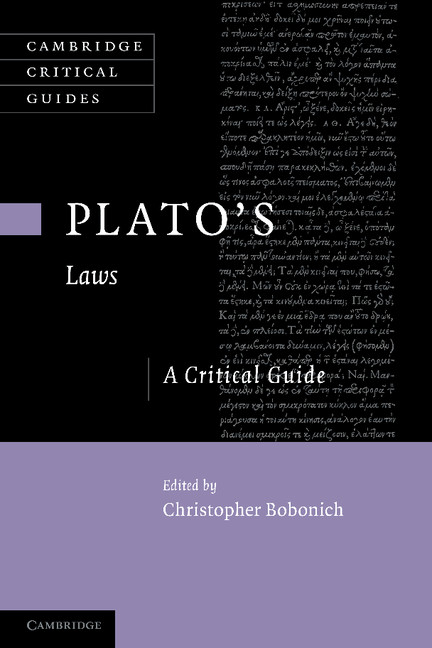
Plato's 'Laws'

-
Select format
-
- Publisher:
- Cambridge University Press
- Publication date:
- 06 December 2010
- 11 November 2010
- ISBN:
- 9780511781483
- 9780521884631
- 9781107658684
- Dimensions:
- (228 x 152 mm)
- Weight & Pages:
- 0.54kg, 254 Pages
- Dimensions:
- (229 x 152 mm)
- Weight & Pages:
- 0.35kg, 254 Pages
You may already have access via personal or institutional login
Show more authors 
You may already have access via personal or institutional login
Book description
Long understudied, Plato's Laws has been the object of renewed attention in the past decade and is now considered to be his major work of political philosophy besides the Republic. In his last dialogue, Plato returns to the project of describing the foundation of a just city and sketches in considerable detail its constitution, laws and other social institutions. Written by leading Platonists, the essays in this volume cover a wide range of topics central for understanding the Laws, such as the aim of the Laws as a whole, the ethical psychology of the Laws, especially its views of pleasure and non-rational motivations, and whether and, if so, how the strict law code of the Laws can encourage genuine virtue. They make an important contribution to ongoing debates and will open up fresh lines of inquiry for further research.
Reviews
"...The quality and insight of the contributions are very high, and the range of addressed themes very broad...."
--Diego De Brasi, Philipps-Universität Marburg, Bryn Mawr Classical Review
"...a good paper on Plato’s moral psychology.... articulate and carefully reasoned work on the Timaeus is attributed to the Laws..."
--Philosophy in Review, John Mouracade, University of Alaska Anchorage
Contents
Contents
Metrics
Altmetric attention score
Full text views
Full text views helpTotal number of HTML views: 0
Total number of PDF views: 0 *
 Loading metrics...
* Views captured on Cambridge Core between #date#. This data will be updated every 24 hours.
Usage data cannot currently be displayed.
Accessibility standard: Unknown
Why this information is here
This section outlines the accessibility features of this content - including support for screen readers, full keyboard navigation and high-contrast display options. This may not be relevant for you.
Accessibility Information
Accessibility compliance for the PDF of this book is currently unknown and may be updated in the future.