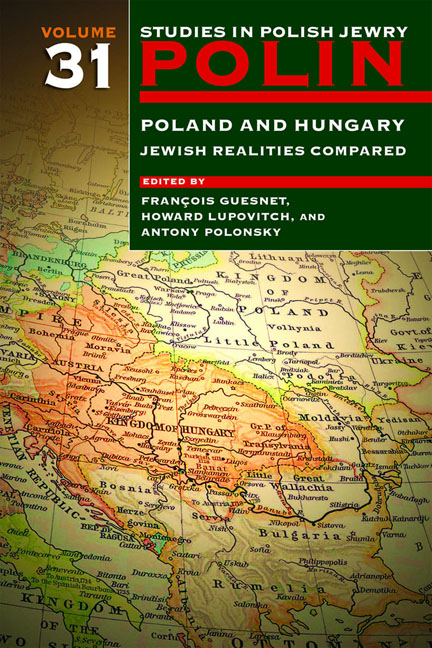
Polin: Studies in Polish Jewry Volume 31

-
The digital format of this book is no longer available to purchase from Cambridge Core. Other formats may be available.
-
Select format
-
- Publisher:
- Liverpool University Press
- Publication date:
- 11 July 2020
- 19 December 2018
- ISBN:
- 9781789624564
- 9781906764715
- 9781906764722
- Dimensions:
- Weight & Pages:
- Dimensions:
- Weight & Pages:
- Series:
- Polin: Studies in Polish Jewry
You may already have access via personal or institutional login- Series:
- Polin: Studies in Polish Jewry
Volume 31
Show more authors 
You may already have access via personal or institutional login
Book description
At the beginning of the twentieth century, the Jewish communities of Poland and Hungary were the largest in the world and arguably the most culturally vibrant, yet they have rarely been studied comparatively. Despite the obvious similarities, historians have mainly preferred to highlight the differences and emphasize instead the central European character of Hungarian Jewry. Collectively, these essays offer a different perspective. The volume has five sections. The first compares Jewish acculturation and integration in the two countries, analysing the symbiosis of magnates and Jews in each country's elites and the complexity of integration in multi-ethnic environments. The second considers the similarities and differences in Jewish religious life, discussing the impact of Polish hasidism in Hungary and the nature of 'progressive' Judaism in Poland and the Neolog movement in Hungary. Jewish popular culture is the theme of the third section, with accounts of the Jewish involvement in Polish and Hungarian cabaret and film. The fourth examines the deterioration of the situation in both countries in the interwar years, while the final section compares the implementation of the Holocaust and the way it is remembered. The volume concludes with a long interview with the doyen of historians of Hungary, István Deák.
Contents
Contents
Metrics
Altmetric attention score
Full text views
Full text views helpTotal number of HTML views: 0
Total number of PDF views: 0 *
 Loading metrics...
* Views captured on Cambridge Core between #date#. This data will be updated every 24 hours.
Usage data cannot currently be displayed.
Accessibility standard: Unknown
Why this information is here
This section outlines the accessibility features of this content - including support for screen readers, full keyboard navigation and high-contrast display options. This may not be relevant for you.
Accessibility Information
Accessibility compliance for the PDF of this book is currently unknown and may be updated in the future.