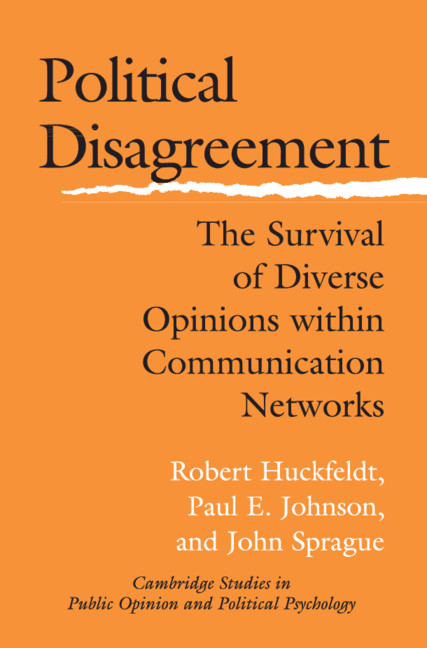
Political Disagreement

-
Select format
-
- Publisher:
- Cambridge University Press
- Publication date:
- 03 December 2009
- 12 July 2004
- ISBN:
- 9780511617102
- 9780521834308
- 9780521542234
- Dimensions:
- (228 x 152 mm)
- Weight & Pages:
- 0.482kg, 272 Pages
- Dimensions:
- (228 x 152 mm)
- Weight & Pages:
- 0.37kg, 274 Pages
You may already have access via personal or institutional login
Show more authors 
You may already have access via personal or institutional login
Book description
Political disagreement is widespread within the communication network of ordinary citizens; furthermore, political diversity within these networks is entirely consistent with a theory of democratic politics built on the importance of individual interdependence. The persistence of political diversity and disagreement does not imply that political interdependence is absent among citizens or that political influence is lacking. The book's analysis makes a number of contributions. The authors demonstrate the ubiquitous nature of political disagreement. They show that communication and influence within dyads is autoregressive - that the consequences of dyadic interactions depend on the distribution of opinions within larger networks of communication. They argue that the autoregressive nature of political influence serves to sustain disagreement within patterns of social interaction, as it restores the broader political relevance of social communication and influence. They eliminate the deterministic implications that have typically been connected to theories of democratic politics based on interdependent citizens.
Reviews
‘Political Disagreement discovers, in the contingencies of personal acquaintanceship, a foundation for democratic dissent. It is a work of the first order of originality, intellectual power, and importance.’
Paul M. Sniderman - Stanford University
‘A wonderful example of what social science can be … a well-articulated theory of how and why one’s informal, face-to-face social networks are more diverse than social conformity and dissonance studies suggest. It then goes on to explain how this diversity helps citizens form and maintain their political beliefs and attitudes, and yes, even be persuaded. In a series of strong empirical tests, Huckfeldt demonstrates that from this diversity of opinion, citizens become capable of thinking more deeply about issues and - this a key point - develop tolerance for different points of view. Rarely do we see a better blend of theory informed empirical tests of important substantive and normative questions central to the conditions underlying a democratic citizenry.’
Milton Lodge - Stony Brook University
Contents
Contents
Metrics
Altmetric attention score
Full text views
Full text views helpTotal number of HTML views: 0
Total number of PDF views: 0 *
 Loading metrics...
* Views captured on Cambridge Core between #date#. This data will be updated every 24 hours.
Usage data cannot currently be displayed.
Accessibility standard: Unknown
Why this information is here
This section outlines the accessibility features of this content - including support for screen readers, full keyboard navigation and high-contrast display options. This may not be relevant for you.
Accessibility Information
Accessibility compliance for the PDF of this book is currently unknown and may be updated in the future.