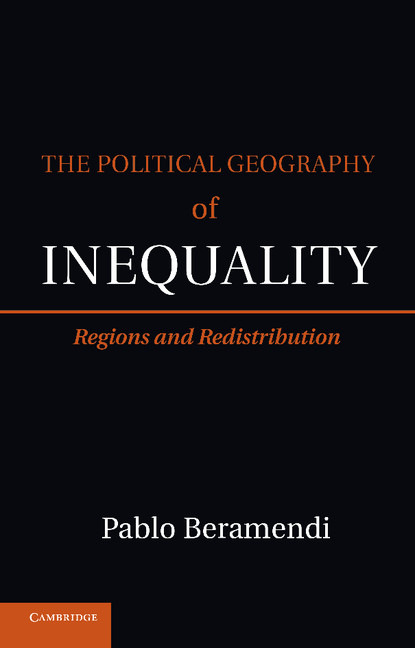
The Political Geography of Inequality

-
Select format
-
- Publisher:
- Cambridge University Press
- Publication date:
- 05 April 2012
- 26 March 2012
- ISBN:
- 9781139042796
- 9781107008137
- 9781107637214
- Dimensions:
- (234 x 156 mm)
- Weight & Pages:
- 0.59kg, 320 Pages
- Dimensions:
- (234 x 156 mm)
- Weight & Pages:
- 0.49kg, 318 Pages
You may already have access via personal or institutional login
Show more authors 
You may already have access via personal or institutional login
Book description
This book addresses two questions - why some political systems have more centralized systems of interpersonal redistribution than others, and why some political unions make larger efforts to equalize resources among their constituent units than others. This book presents a new theory of the origin of fiscal structures in systems with several levels of government. The argument points to two major factors to account for the variation in redistribution: the interplay between economic geography and political representation on the one hand, and the scope of interregional economic externalities on the other. To test the empirical implications derived from the argument, the book relies on in-depth studies of the choice of fiscal structures in unions as diverse as the European Union, Canada and the United States in the aftermath of the Great Depression; Germany before and after Reunification; and Spain after the transition to democracy.
Awards
Honourable Mention, 2014 Luebbert Best Book Award, Comparative Politics Section, American Political Science Association
Winner, 2013 Best Book Award, European Politics and Society Section, American Political Science Association
Reviews
"Across the world, federations and quasi-federations come in all shapes and sizes. Their welfare and redistributive consequences are also strikingly different. In this terrific, sophisticated, agenda-setting book, Pablo Beramendi explains why. The Political Geography of Inequality is a must-read."
Carles Boix, Princeton University
"By integrating the study of inequality with the study of federalism this ambitious book casts new light on both. The theoretical synthesis Beramendi proposes helps explain such diverse phenomena as why some countries and regions are better able to respond to economic shocks, why some countries can sustain higher levels of redistribution and equality, and why it is so difficult for currency unions like the Eurozone to succeed. The book is a remarkable achievement that will have a major impact on the field of comparative political economy for years to come."
Torben Iversen, Harvard University
"The design of fiscal unions is a topic of central importance not only in Europe but in all countries with some degree of local autonomy. In a methodologically sophisticated analysis, Beramendi destroys several stereotypes according to which local autonomy must be associated with a high degree of individual inequality. This is an eye-opening contribution."
Adam Przeworski, New York University
Contents
Contents
References
References
, and (2002) “Reversals of Fortune: Geography and Institutions in the Making of the Modern World Income Distribution.” Quarterly Journal of Economics, 117(4): 1231–1294.
and (2006) Economic Origins of Dictatorship and Democracy. Cambridge: Cambridge University Press.
(1986) Social Security: Visions and Revisions. Cambridge: Cambridge University Press.
(1998) We the People: Transformations. Cambridge, MA: Belknap Press.
and (2002) “Trade, Democracy, and the Size of the Public Sector: The Political Underpinnings of Openness.” International Organization, 56(2): 229–262.
(1999) Federalism and its Discontents: Fiscal and Legislative Power Sharing in Germany, 1948–1999. Institute of Governmental Studies. Berkeley, CA: University of California-Berkeley. Pp. 16–99.
(2003)[1999] El Estado Autonomico: Federalismo y Hechos Diferenciales. Madrid, Alianza Editorial.
. (1996) “El Regimen de los Convenios de colaboracion entre administraciones: un problema pendiente” en Informe de las Comunidades Autonomas, Barcelona: Instituto de Derecho Publico.
and (1998) “Economic Risks and Political Risks in Fiscal Unions.” The Economic Journal, 108: 989–1008.
and (2004) Fighting Poverty in the US and Europe: A World of Difference. Oxford: Oxford University Press.
, and (2001) ”Why Doesn't the United States Have a European Style Welfare State?” Brookings Paper on Economic Activity , (Fall): 187–278.
and (2003) The Size of Nations. London: MIT Press.
and (1998) “Openness, Country Size and Government.” Journal of Public Economics, 69: 305–321.
and (1999) Southern Paternalism and the American Welfare State. Cambridge: Cambridge University Press.
(1968) The Formative Years of Social Security, Madison: University of Wisconsin Press.
., and (2010) A Political Theory of Decentralization Dynamics, Madrid: Juan March Institute, Working Paper 2009/248.
and , (1988) “The Formative Years of U.S. Social Spending Policies: Theories of the Welfare State and the American States during the Great Depression.” American Sociological Review, 53: 661–678.
, , , and (1987) “The Political Origins of Unemployment Insurance in Five American States.” Studies in American Political Development, 2: 137–182.
(1992) The Territorial Imperative. Pluralism, Corporatism and Economic Crisis. Cambridge: Cambridge University Press.
(1999) “Procesos de implantación de políticas de rentas mínimas de inserción en España.” CSIC-WP.
(1995) Incomes and the Welfare State. Cambridge: Cambridge University Press.
(1999) The Economic Consequences of Rolling Back the Welfare State. Cambridge, MA: MIT-CES, Cambridge.
(2002) “Social Inclusion and the European Union”, Journal of Common Market Studies, 40(4): 625–43.
and (1988) “Elections, coalitions and legislative outcomes.” American Political Science Review: 82(2): 405–422.
and (2008) “Redistribution and Affirmative Action.” In et al. (eds.) Selected Works of Michael Wallerstein. Cambridge, Cambridge University Press.
, (2008) “Standardized Income Inequality Data for Use in Cross-National Research”, Sociological Inquiry, 77:3–22.
and (2006) “Diversity, Disparity and Civil Conflict in Federal States.” World Politics, 59:1–50.
(2008) Econometric Analysis of Panel Data. New York: John Wiley.
(1987) The Welfe State and Canadian Federalism, Quebec, Mc-Gill-Press University Press.
(1992) “Neoconservatism in an Open Economy: The social Role of the Canadian State”, International Political Science Review, 13: 149–170.
(1997) “The Social Policy Divide: the welfare state in Canada and the United States.” In et al. (eds.) Degrees of Freedom: Canada and the United States in a Changing World, Kingston-Montreal, McGill-Queens University Press.
(2005) “Canada: Nation Building in a Federal Welfare State.” In et al. (eds) Federalism and the Welfare State. Cambridge, Cambridge University Press.
and (1998) El Estado de las Autonomias:Hacia un Nuevo Federalismo?Bilbao IVAP.
. (1999) La Political Europea de España. Barcelona, Ariel.
(1974) The Dynasty: The Rise and Fall of Social Credit in Alberta. Oronto, Maclellan.
(ed.) (2003) La Competencia Politica en la España de las Autonomias. Barcelona, ICPS.
(1933) [1913] An Economic Interpretation of the Constitution of the United States, New York, The Free Press.
and (1995) “What To Do (and Not To Do) with Times-Series–Cross-Section Data in Comparative Politics.” American Political Science Review, 89(3): 634–647.
(2005) “Federalism as a Public Good.” Constitutional Political Economy 16(2): 189–204.
(2008) The Robust Federation. Cambridge, Cambridge University Press.
, , Jr., and (2001) “A Political Theory of Federalism.” In , , and (eds.), Constitutional Culture and Democratic Rule. New York, NY: Cambridge University Press, pp. 223–270.
(1989) “Intergovernmental Relations in the 1980s.” Publius: The Journal of Federalism, 19(4): 199–217.
(2001) “The politics of income inequality in the OECD: the role of second order effects.” Working Paper 284. Luxembourg Income Study.
(2007) “Inequality and the territorial fragmentation of solidarity.” International Organization, 61: 783–820.
(2007b) “Federalism.” In and (eds.) Handbook of Comparative Politics. Oxford: Oxford University Press.
and (2008) “Inequality and Democratic Representation: the road traveled and the path ahead.” In and (eds.), Democracy, Inequality and Representation: A Comparative Perspective. RussellSage Foundation, forthcoming.
and . (2009) “Diverse Disparities: the Politics and Economics of Wage, Markets, and Disposable Income Inequalities.” Political Research Quarterly, 62(2): 257–275.
and (2008) “Distributive Tensions in Developing Federations.” Paper presented at the Annual Meetings of the American Political Science Association.
and . (2004) “Spain: Unfulfilled Federalism, 1978–2004.” In and (eds.), Federalism and Territorial Cleavages. Baltimore, John Hopkins University Press.
, and . (2010) “Inequality and Labor Market Coordination in the Early XXth Century.” Mimeo. DPIR University of Oxford.
and (2010) “Foundational Bargains: Distributive Conflicts and Representation in Federations.” Duke University. Unpublished manuscript.
(1991) America's Welfare State. From Roosevelt to Reagan. Baltimore: The John Hopkins University Press.
(2004) Essays on the Great Depression. Princeton, NJ: Princeton University Press.
(1981) “A Critique of Tiebout's Theory of Local Public Expenditures” Econometrica, 49(3): 713–740.
and . (1991) “La Distribución de la Renta y el Sistema de Transferencias Intergubernamentales en la República Federal de Alemania.” Hacienda Pública Española, 118(2): 39–65.
(2003) Democracy and Redistribution. New York, Cambridge University Press.
and (1996) “Distributional Conflicts, Factor Mobility and Political Integration.” American Economic Associations Papers and Proceedings 86(2): 99–104.
and (1997) “The Breakup of Nations: a Political Economy Analysis.” Quarterly Journal of Economics 112: 1057–1090.
(1990) “Vom kooperativen Föderalismus zum Europa der Regionen.” Aus Politik and Zeitgeschichte, 4: 36–44.
(2005) “Mind the Gap! European Integration between Level and Scope.” Journal of European Public Policy, 12(2): 1–20.
and . (2005) La Financiacion de las Comunidades Autonomas: Politicas Tributarias y Solidaridad Interterritorial. Barcelona, Universidad de Barcelona.
, , , , and . (2003) “Distribution and Redistribution in Post-industrial Societies.” World Politics 55: 193–228.
(2009) Peace by Design. Oxford, Oxford University Press.
and (1980) The Power to Tax. Cambridge, Mass: Cambridge University Press.
and (2004) “Varieties of Capitalism and Political Divides over European Integration” in and (eds.) European Integration and Political Conflict, Cambridge, Cambridge University Press.
and (2005) “Location, location, location” European Union Politics 6,2:155–180.
(1984) “The New Deal and Southern Politics.” In and (eds.) The New Deal and the South, Jackson, University Press of Mississippi.
(1950) “Federalism and Fiscal Equity.” American Economic Review, 40: 583–599.
(1995) “Federalism As an Ideal Political Order and an Objective for Constitutional Reform.” Publius: The Journal of Federalism, 25(2): 19–27.
and (1970) “An Efficiency Basis for Federal Fiscal Equalisation.” In (ed.) The Analysis of Public Output, New York. NBER.
(1991) “Efficiency, Democracy and West German Federalism.” In and (eds.), German Federalism Today, St MartinPress, New York.
; (1999) Pressemitteilung 117/1999: Finanzausgleichsgesetz ist als Übergangsrecht bis Ende 2004 nach bestimmten Maßgaben weiter anwendbar; Accessed Febr. 5th 2008: http://www.bverfg.de/bverfg_cgi/pressemitteilungen/text/bvg117-99.
, , , and (2006) Political Positions on the European Social and Economic Model. Friedrich Ebert Stifftung.
and (2005) “Does Competition for Capital Discipline Governments? Decentralization, Globalization and Public Policy.” American Economic Review 95(3): 817–830.
(1979) “The Social Credit in Alberta, 1935–1971.” In Calderola (ed.) Society and Politics in Alberta.: 33–48.
(1978) “The Expansion of the Political Economy: A Comparative Analysis.” American Political Science Review 72: 1243–61.
(2000) “‘We Who Have Wallowed in the Mud of Flanders’: First World War Veterans, Unemployment and the Development of Social Welfare in Canada, 1929–39.” Journal of the Canadian Historical Association 11: 125–149.
(2005) From Unemployment Insurance to Employment Insurance: Waging War on the Welfare State. Vancouver, University of British Columbia Press.
and (eds.) (1993) Small Differences that Matter. Labor Markets and Income Maintenance in Canada and the United States. NBER.
(1997) “Net Financial Transfers in the European Union: Who gets What and Why.” Journal of Politics. 59(2): 469–96.
, , and (2000) Rebuilding Canadian Party Politics. Vancouver, UBC Press.
(2005) “Redistribution Policy: A European Model.” Journal of Public Economics, 89: 1305–1331.
and . (1992) “Federalism and Clubs. Towards an Economic Theory of Overlapping Political Jurisdictions.” European Economic Review, 36: 639–646.
and . (1995) “Elements for a Theory of Jurisdictional Change.” In , and (eds.) Politics and Institutions in an Integrated Europe. New York: Springer.
and (2004) The Formation of National Party Systems. Princeton, NJ: Princeton University Press.
and (2004) Spain and the European Union. Palgrave, McMillan.
(1998) “The Spanish State of Autonomies: Non Institutional Federalism” in (ed.) Politics and Policy in Democratic Spain, London: Frank Cass.
(1991) Politica y Derecho: La Construccion de la Autonomia Vasca. Madrid, Centro de Estudios Constitucionales.
(1993) “Canada's Social Policy Deficit: Implications for Fiscal Federalism.” In , , and , (eds.) The Future of Fiscal Federalism, Queen's University, School of Policy Studies.
(1994) Social Canada in the Milenium, Toronto, C.D.Howe Institute.
(1990) “Centripetal and Centrifugal Incentives in Electoral Systems” American Journal of Political Science, 34: 903–35.
(1997) Making Votes Count. Cambridge, Cambridge University Press.
(1997) Policymaking in the EU, London, Routledge.
et al. (1996) “Mobility and Redistribution: A Survey.” Public Finance 51(3): 325–52.
and (1999) “Political Confederation.” American Political Science Review, 93(1): 69–83.
and (2000) “Federal Mandates by Popular Demand.” Journal of Political Economy 108(5): 905–927.
(1990) “La Doctrina Constitucional sobre el Principio de Cooperacion” In (ed.) Comunidades Autonomas e Instrumentos de Cooperacion. Madrid, Tecnos.
, and (2002) The PGL file collection: File structures and procedures. Paper, Berlin: Science Center.
, , and (2006) “Risks at Work: The Demand and Supply Sides of Government Redistribution.” Oxford Review of Economic Policy, 22(3): 365–389.
, , and (2007) “Economic Interests and the Origins of Electoral Systems.” American Political Science Review, 101(3): 373–393.
(1994) “Die Treuhandstalt im politischen System der Bundesrepublik.” Aus Politik und Zeitgeschichte, 94: 31–42.
(1995) Die Kampf um die Finanzierung der deutschen Einheit. Cologne: Max Plank Institute for the Study of Society. Discussion Paper 95/1.
(1999) “Reformloser Wandel: Stabilität und Anpassung im politischen Akteursystem der Bundesrepublik.” In (ed.) 50 Jahre Bundesrepublik Deutschland. Wiesbaden: Westdeutscher Verlag.
(2004) The End of a Model? Crisis and Transformation of the German Welfare State. Working Paper. Osnabrück: University of Osnabrück.
(1983) “Federalism and the Democratic Process.” In and (eds.) Nomos XXV. Liberal Democracy. New York: New York University Press.
, and . (2005) “Self Enforcing Federalism.” The Journal of Law, Economics and Organization 21(1): 103–135.
, and (2001) La España de los Nacionalismos y las Autonomias. Madrid, Sintesis.
(1996) “Economic Globalization and the shifting boundaries of German Federalism.” Publius: The Journal of Federalism, 26(1): 27–52.
(1974) The Immigration Programme. Berkeley: University of California Press.
and (2010) Natural Experiments of History, Cambridge, MA: Harvard University Press.
(2006) Federalism, Fiscal Authority and Centralization in Latin America. New York: Cambridge University Press.
(1999) Ever Closer Union. London: Palgrave.
(1981) A Chronology of Response. The Evolution of Unemployment Insurance from 1940 to 1980, Paper prepared for Employment and Immigration Canada.
(1996) The Making of Economic Policy. Cambridge, MA: MIT Press.
and (1998) “Fiscal Federalism and Redistributive Politics.” Journal of Public Economics 68: 153–180.
(1934) “A National Program of Unemployment Insurance,” The New Republic, LXXX: 215–216.
(1936) Social Security in the United States. An Analysis and Appraisal of the Federal Social Security Act, New York: MacGraw Hill.
(2008) “Improving Causal Inference: Strengths and Limitations of Natural Experiments.” Political Research Quarterly 61(2): 282–293.
(2007) “La corresponsabilidad fiscal en la financiación autonomic.” Principios 7: 109–121.
(2007) The European Economy since 1945, Princeton, NJ: Princeton University Press.
(1987) Exploring Federalism. Tuscaloosa: The University of Alabama Press.
and (2003) “Decentralization and Political Institutions.” Unpublished Paper, Moscow: Center for Economic and Financial Research.
and (1991) “Mobility and Redistribution.” The Journal of Political Economy 99(4): 828–858.
(1936) Insecurity: A Challenge to America. New York: Random House.
(2007) Modernizacion y Estado de Bienestar en España. Madrid: Siglo XXI.
(1985) Politics against Markets: the Social Democratic Road to PowerPrinceton, NJ: Princeton University Press.
(2002) Standard Eurobarometer 57, Brussels: European Union Research Group.
(2003) Standard Eurobarometer 59, Brussels: European Union Research Group.
(2004) 34th Financial Report on the European Agricultural Guidance and Guarantee Fund, Brussels: Commission of the European Communities.
(2004b) Standard Eurobarometer 61, Brussels: European Union Research Group.
(1991) “Aktuelle Probleme des Finanzpolitik und des Finanzausgleichs.” In (ed.), Die Zukunft des kooperativen Föderalismus in Deutschland. Munich: Hanns-Seidel Stiftung Verlag.
(2005) “A Sequential Theory of Decentralization: Latin American Cases in Comparative Perspective.” American Political Science Review, 99(3):327–346.
(1991) “Counterfactuals and Hypothesis Testing in Political Science.” World Politics, 43: 169–195.
(2005) The Boundaries of Welfare. Oxford: Oxford University Press.
, , and (2004) Designing Federalism. Cambridge, MA: Cambridge University Press.
(2007) Neuregelung seit 2005; Accessed on Febr. 10th 2008: http://www.fm.baden-wuerttemberg.de/de/Neuregelung_seit_2005/110291.html
(2007) Der bundesstaatliche Finanzausgleich: Kurzuebersich zu den Regelungen fuer die Jahre 2005 bis 2019; Accessed on Febr. 10th 2008: http://www.fm.baden-wuerttemberg.de/fm/2347/brosch%FCre_lfa.427664.pdf
(2007) Der bundesstaatliche Finanzausgleich: Ueberblick, Zielesetzung, Instrumente; Accessed on Febr. 10th 2008: www.stmf.bayern.de/finanzpolitik/laenderfinanzausgleich/info_finanzausgleich.pdf
; Finanzausgleich: Funktionen und Funktionsweise; Accessed on Feb. 11th 2008: http://cdl.niedersachsen.de/blob/images/C2320000_L20.pdf
and (1995) State and Party in America's New Deal. Madison: The University of Wisconsin Press.
(1979) Business and Social Reform in the Thirties. Toronto, Lorimer.
(1989) The Social Credit Phenomenon in Alberta. Toronto: University of Toronto Press.
(1999) “Employment, Welfare Support and Income Distribution in East Germany.” In (ed.) Recasting East Germany: Social Transformation after the GDR. London, Routledge.
and (1963) Monetary History of the United States, 1867–1960. Princeton, NJ: Princeton University Press.
, , and (eds.) (2003) Estado de Bienestar y Comunidades Autonomas. Madrid: Tecnos.
and (2003) “Globalization and Fiscal Decentralization.” In and (eds.) Globalizing Authority. Princeton, NJ: Princeton University Press.
and (1996) “An Institutional Critique of Intergovernmentalism.” International Organization 50(2): 269–300.
(2004) Federalism and Democracy in Latin America. Baltimore: John Hopkins University Press.
, , and (2004) “Reallocative Federalism: Overrepresentation and Public Spending in the Western Hemisphere.” In (ed.) Federalism and Democracy in Latin America. Baltimore: John Hopkins University Press.
(2005) “The Political Economy of Hatred.” Quarterly Journal of Economics, 120(1): 45–86.
(2004) “Las Bases Sociales de la Politica Española” Revista Española de Investigaciones Sociologicas 4: 119–142.
., , and (1999) “How Unification and Immigration Affected the German Income Distribution.” European Economic Review 43: 867–878.
(1973) “State and Local Fiscal Behaviour and Federal Grant Policy,” In Selected Essays of Edward M. Gramlich, Northampton, MA: Edward Elgar: 21–57.
(1987) “Cooperation and Competition in Public Welfare Policies,” In Selected Essays of Edward M. Gramlich, Northampton, MA: Edward Elgar, 1997: 309–327.
(2000) Econometric Analysis. New York: Prentice Hall.
(1997) The Emergence of Social Security in Canada. Vancouver: UBC Press.
(1994) “German Federalism after Unification: The Legal-Constitutional Response.” Publius: The Journal of Federalism 24: 81–99.
(2001) “A Major Operation or an Aspirin for a Serious Illness? The Recent Agreement Between the Federation and the Länder on Financing the Länder.” AICGS Report.
(2003) The Länder and German Federalism. Manchester: Manchester University Press.
(2005) “German Federalism and Recent Reform Efforts” German Law Journal 6(10): 1283–1296.
(2007) “German Federalism Reform” German Law Journal 8(1): 111–132.
, , and (eds.) (1995) The Politics of Democratic Consolidation: Southern Europe in Comparative Perspective. Baltimore and London: The Johns Hopkins University Press.
and (2002) “Business Power and Social Policy: Employers and the Formation of the American Welfare State.” Politics and Society 30,(2): 277–325.
and (2009) “Varieties of Capitalism and Institutional Complementarities in the Macroeconomy: and Empirical Assessment.” British Journal of Political Science 39: 449–482.
and (2001) Varieties of Capitalism. Oxford, Oxford University Press.
(2002) “Fiscal Policy in the European Union.” European Union Politics 3(2):139–150.
(1995) Social Policy in the European Union. New York: Palgrave.
(2001) “The Agony of Central Power: Fiscal Federalism in the German Reich.” European Review of Economic History 5(1): 119–142.
(2004) “Can Welfare Expansion Result in Disintegration? The Integration of East Germany into the German Pension System.” German Politics 13(1): 81–105.
(2004) “Trends in East-West German Migration from 1989 to 2002.” Demographic Research 11(7): 173–194.
(2002) “Regional Parties and National Politics in Europe.” Comparative Political Studies 35(6):657–685.
and (1998) “Cooperation and Political Economy Performance in Affluent Capitalism.” American Journal of Sociology 103(6): 1631–1673.
and (1992) “Politics, Institutions and Welfare Spending in Industrialized Democracies1960–1982.” American Political Science Review 86(3): 658–674.
and (2002) “Birds of a Different Feather?Varieties of Capitalism, Factor Specificity, and Interindustry Labor Movements.” Mimeo. Cambridge, MA: Harvard University Press.
(2001) “Legislative Behavior and Party Competition in the European Parliament.” Journal of Common Market Studies 39(4): 663–688.
(2005) The Political System of the European Union. New York: Palgrave.
and (2010) “Contesting the European Union? Why the Dutch and the French Rejected the European Constitution?” Political Research Quarterly 64(2): 309–322.
and . (2003) “Unraveling the Central State, but How? Types of Multi-level Governance.” American Political Science Review 97(2): 1118–1140.
, and (2008) “Regional Authority in 42 Democracies, 1950–2006: A Measure and Five Hypotheses.” Regional and Federal Studies 18(2–3): 111–302.
and (2010a) “Polanyi in Brussels? Embeddedness and the Three Dimensions of European Economic Integration”, Discussion Paper MPISS.
and (2010b) “A New Phase of European Integration: Organized Capitalisms in Post-Ricardian Europe” West European Politics 33, 344–368.
(1985) Ethnic Groups in Conflict. Berkeley: University of California Press.
and (2001) Development and Crisis of the Welfare State. Chicago: University of Chicago Press.
, , and (1993) “Social Demoracy, Christian Democracy, Constitutional Structure and the Welfare State.” American Journal of Sociology, 99(3): 711–750.
(2005) “Inter-regional Mobility in the Accession Countries. A Comparison to EU-15 Member States.” WIFO Working Papers, No. 249.
(2005) “Federal Stability in Unequal Societies.” Constitutional Political Economy, 16(2): 113–124.
. and (1997a) “The Political Economy of Federalism.” In (ed.), Perspectives of Public Choice. Cambridge: Cambridge University Press.
. and (1997b) “Rethinking Federalism.” Journal of Economic Perspectives 11(4): 43–64.
(1999) Contested Economic Institutions. The Politics of Macroeconomics and Wage Bargaining in Advanced Democracies. Cambridge: Cambridge University Press.
(2005) Capitalism, Democracy, and Welfare. Cambridge: Cambridge University Press.
(2006) “Capitalism and Democracy.” In and (eds.), Oxford Handbook of Political Economy. Oxford: Oxford University Press.
and (2006) “Electoral Institutions and the Politics of Coalitions: Why some democracies redistribute more than others.” American Political Science Review 100(2): 165–181.
and (2009) “Distribution and Redistribution: The Shadow of the XIX Century.” World Politics 61(3): 438–486.
(1995) “The Non-Reform of the German Federal System after Unification.” West European Politics 18(2): 252–272.
and (eds.) (1991) German Federalism Today, New York: St Martin Press.
and (1993) “Unification and Maastricht: The Response of the Länder Governments.” In and (eds.) Federalism, Unification and European Integration. London: Franck Cass.
(2006) “Electoral Politics and Poverty Relief: How Changing Electoral Incentives Can Help the Poor.” Manuscript. Stanford, CA: Stanford University.
(1987) Policy and Politics in West Germany: The Growth of a Semi-sovereign State. Philadelphia: Temple University Press.
(1998) Securing the Social Union A Comment on the Decentralised Approach. Kingston: Institute of Intergovernmental Relations.
(2004) Egalitarian Capitalism. New York: Russell Sage Foundation.
(2008) Jobs with Equality. Oxford: Oxford University Press.
and (2005) “Rising Inequality and the Politics of Redistribution in Affluent Countries.” Perspectives on Politics 3: 449–471.
, , and (2007) “Fiscal Decentralization: Vertical Horizontal and FDI.” Economic Policy January: 5–70.
(1949) Southern Politics in State and Nation. New York: Knopf.
(1995) Actively Seeking Work. Chicago: University of Chicago Press.
, and . (1994) Designing Social Inquiry. Princeton, NJ: Princeton University Press.
(2004) “Political-Economic Context and Partisan Strategies in German Federal Elections, 1990–2002.” In and (eds.) Germany: Beyond the Stable State. London: Routledge.
(2005) “Measuring and Analyzing Positions on European Constitution-building.” European Union Politics 6(3): 259–267.
(1974) The Shaping of Southern Politics: Suffrage Restriction and the Establishment of One Party South, 1880–1910. New Haven, CT: Yale University Press.
(1991) Geography and Trade. Boston, MA: The MIT Press.
(2008) The Return of Depression Economics. New York: W.W. Norton.
(1993) “Maastricht and the Social Protocol: Why Did They Do It?” Politics and Society, 21(1): 5–36.
(2005) Party Politics in Germany: A Comparative Politics Approach. New York: Palgrave.
(1990) “Die Improvisierte Vereinigung: Die Dritte deutsche Republik.” Leviathan 18: 462–486.
(1996) “German Federalism and the Challenge of the Unification.” In and (eds.) Federalizing Europe? Oxford: Oxford University Press.
(2007) The Political Economy of Fiscal Decentralization. Barcelona:Institut d’Estudis Autonomics.
. (2009) “Why is the System of Regional Financing in Spain Unstable?” Revista Española de Investigaciones Sociologicas 128: 57–87.
and (2009) “A Cooperación Intergubernamental no Estado Autonómico.” Escola Galega de Administración Pública.
(1996) “The Political Dimension: German practice and the European Perspective” In and (eds.), Federalizing Europe?Oxford: Oxford University Press.
(1998) Shifting the Color Line. Cambridge: Harvard University Press.
(1999) Patterns of Democracy. New Haven, CT: Yale University Press.
(2004) Growing Public. New York: Cambridge University Press.
(1997) Democracy, Multinationalism and Federalism. CEACS-Juan March Institute, Working Paper 103.
and (1999) The Party Systems of Spain: Old Cleavages and New Challenges. CEACS-Juan March Institute, Working Paper 138.
and (2000) “Inequality Inducing and Inequality Reducing Federalism.” Unpublished paper, IPSA Meetings, Quebec City.
(1984) “Why is there no Socialism in the United States? A Federal Analysis.” In , and (eds.) The Costs of Federalism. Piscataway, NJ: Transaction Books.
(1990) “Why Doesn't Capital Flow From Rich to Poor Countries?” American Economic Review, 802: 92–96.
(1996) Regulating Europe. London: Routledge.
and (2003) “Novedades en el sistema de financiación de las Comunidades Autonómas.” Revista de Estudios Regionales, Universidades Públicas de Andalucia 2: 41–55.
(2005) “Germany: Cooperative Federalism and the Overgrazing of the Fiscal Commons.” In , , and (eds.) Federalism and the Welfare State. Cambridge: Cambridge University Press.
(1995) Identification Problems in the Social Sciences. Cambridge, MA: Harvard University Press.
(1997) Regimes, Politics, and Markets. Oxford: Oxford University Press.
(1999) “Accountability and Manipulation” in et al. (ed.) Democracy, Accountability, and Representation. Cambridge: Cambridge University Press.
(2003) The Politics of Social Risks. Cambridge: Cambridge University Press.
and (eds.) (2004) European Integration and Political Conflict. Cambridge: Cambridge University Press.
(2003) ”Farewell, Welfare State–Hello, Welfare Regions? Chances and Constraints of Welfare Management in the German Federal System.” German Politics 12(3): 35–65.
(2004) “Fiscal Redistribution in the European Union and the Enlargement.” International Journal of Organization Theory and Behavior 7(4): 555–570.
(1999) The Logic of Regional Integration. Cambridge: Cambridge University Press.
(1999) A History of Unemployment Insurance Legislation in the United States and the New York State, 1935–1998. New York: New York State Department of Labor.
(2003) To Form a More Perfect Union. Oxford: Oxford University Press.
and (2001) “Dis-Covered: EI, Social Assistance and the Growing Gap in Income Support for Unemployed Canadians.” In (ed.) Federalism, Democracy and Labor Market Policy in Canada. Montreal: McGill-Queen's University Press and Queen's University School of Policy Studies.
(2005) “L’essentiel de la proposition de directive sur les services,” Paris, http://www.medef.fr/medias/upload/76710_FICHIER.pdf.
and (1981) “A Rational Theory of the Size of Government.” Journal of Political Economy, 89: 914–927.
(2002) “Social Citizens of Separate Sovereignties: Governance in the New Deal Welfare State.” In and (eds.) The New Deal and the Triumph of Liberalism. Amherst: University of Massachussets Press.
(2008) “The Origins of Ethnolinguistic Diversity: Theory and Evidence.”. Unpublished manuscript. Boston: Tufts University.
and . (2001) “Inequality, Social Insurance, and Redistribution.” The American Political Science Review 95(4): 859–874.
(1995) Informe sobre el Actual Sistema de Financiacion y sus Problemas. Madrid: Instituto de Estudios Fiscales.
(1998) “Stabilising the Democratic Order: Electoral Behavior in Spain” in (ed.) Politics and Policy in Democratic Spain. London: Frank Cass.
, , and (2008) “German Federalism in Transition?” German Politics 17,4: 393–407.
(1998) A Choice for Europe. Ithaca, NY: Cornell University Press.
(ed.) (1998) Centralization or Fragmentation? Europe Facing the Challenges of Deepening, Diversity, and Democracy. New York: Council on Foreign Relations.
(1997) La Federalizacion de España. Madrid, Siglo XXI.
(2007) “The Nordic Path of Spain's Mediterranean Welfare,” Center for European Studies, WP-163.
and (2005) “Exploring the territorial politics of welfare.” In and (eds.) The Territorial Politics of Welfare. New York: Routledge.
(1997) “Devolution, Grants and Fiscal Competition.” Journal of Economic Perspectives 11(4): 65–72.
(1969) Unemployment Insurance. The American Experience 1915–1935. Madison: The University of Wisconsin Press.
(1997) Welfare as We Knew It. A Political History of the American Welfare State. Oxford: Oxford University Press.
and (2003) “Las Politicas de Rentas Minimas de las Comunidades Autonomas” en et al. (ed.) Estado de Bienestar y Comunidades Autonomas. Madrid: Tecnos.
(1972) Fiscal Federalism. New York: Harcourt.
(1991) Studies in Fiscal Federalism. Cheltenham, UK: Edward Elgar.
(1999) “An Essay on Fiscal Federalism.” Journal of Economic Literature XXXVII: 1120–1149.
and (1987) “Assistance to the Poor in a Federal System.” Journal of Public Economics 32: 307–330.
, , and ,(eds.) (2005) Federalism and the Welfare State. Cambridge: Cambridge University Press.
(1991) Economic Survey of Germany, 1990--1991, Paris: OECD.
(2005) Decentralizing the State. Cambridge: Cambridge University Press.
(1988) “The Political Origins of America's Belated Welfare State.” In , and (eds.) The Politics of Social Policy in the United States. Princeton, NJ: Princeton University Press.
(2009) Social Policies and Vote Choices in OECD Democracies. Madrid: Juan March Institute.
(1988) State, Class and Bureaucracy: Canadian Unemployment Insurance and Public Policy. Montreal: McGill Queen's University Press.
(1999) “On the Determinants of Fiscal Centralization: Theory and Evidence.” Journal of Public Economics 74: 97–139.
and (2002) Internal Migration in Regions of Germany: A Panel Data Analysis. ENPRI, Working Paper.
(1969) The New Deal and the States. Federalism in Transition. Princeton, NJ: Princeton University Press.
(1986) America's Struggle against Poverty, 1900–1985. Cambridge, MA: Harvard University Press.
(1990) “Finanzausgeich in vereinten Deutschland.” Wirtschaftsdienst 7: 346–352.
(2001) “Is a Uniform Social Policy Better? Fiscal Federalism and Factor Mobility.” American Economic Review, 91(3): 596–610.
and (1996a) “Federal Fiscal Constitutions: Risk Sharing and Redistribution.” Journal of Political Economy 104(5): 979–1009.
and (1996b) “Federal Fiscal Constitutions: Risk Sharing and Moral Hazard.” Econometrica 64(3): 623–646.
and (2003) The Economic Effects of Constitutions. London: MIT Press.
(1995) The Price of Federalism, Washington, DC: The Brookings Institute.
and (1990) Welfare Magnets. A New Case for a National Standard, Washington DC: The Brookings Institute.
, , and (Jr) (1998) “Interstate Competition and Welfare Policy.” Publius: The Journal of Federalism 28: 17–37.
(1998) The Treaty of Amsterdam, Harvard Jean Monnet Chair Working Papers Series No. 2/98.
(1995) “Fragmented Welfare States: Federal Institutions and the Development of Social Policy.” Governance 84: 449–478.
(2004) Politics in Time. Princeton, NJ: Princeton University Press.
and (1995) “The Dynamics of Social Policy Integration.” In and (eds.) European Social Policy. Washington, DC: The Brookings Institute.
and (2002) “Historical Institutionalism in Contemporary Political Science.” In and (eds.), Political Science. State of the Discipline. New York: Norton & Company.
, and (2005) “The Politics of EU Enlargement: Evidence from a Heckman Selection Model.” British Journal of Political Science 36: 17–38.
and . (2007) “Efficient Estimation of Time-Invariant and Rarely Changing Variables in Finite Sample Panel Analyses with Unit Fixed Effects.” Political Analysis 15(2): 124–140.
(2003) The Engines of European Integration: Delegation, Agency and Agenda Setting in the EU. New York: Oxford University Press.
(2005) Inequality and Prosperity: Social Europe vs. Liberal America. Ithaca, NY: Cornell University Press.
(1995) “The Dangers of Decentralization.” The World Bank Research Observer 10(2): 201–220.
(2004a) “Some Historical, Theoretical, and Methodological Issues in Identifying the Impact of Political Institutions.” Unpublished manuscript. New York University.
(2004b) “The Last Instance: Are Institutions the Primary Cause of Economic Development.” European Journal of Sociology 45(2): 165–188.
(2004c) “Institutions Matter?” Government and Opposition 39(2): 527–540.
(2007) “Is the Science of Comparative Politics Possible.” In and (eds.), Oxford Handbook in Comparative Politics. Oxford: Oxford University Press.
, , and . (2000) Democracy and Development. Cambridge: Cambridge University Press.
, and . (1997) “Federalism as a Commitment to Preserving Market Incentives.” Journal of Economic Perspectives 11(4): 83–92.
(1994) The Color of Welfare. Oxford: Oxford University Press.
(2004) “Don't Rock the Boat: expectations, fears, and opposition to EU level policy making” in and (eds.) European Integration and Political Conflict, Cambridge: Cambridge University Press.
(2009) “Risks and Redistribution.” Comparative Political Studies 42(7): 855–881.
(1989) “Föderale Finanzbeziehungen im Pateienstaat. Eine Fallstudie zum Verlust politischer Handlungsmöglichkeiten.” Zeitschrift für Parlamentsfragen 3: 331–345.
(1994) “Föderale Problembewältigung: Zur Eibeziehung der neuen Länder in einem gesamtdeutschen Finanzausgleich ab 1995.” Zeitschrift für Parlamentsfragen 1: 116–138.
(1995) “Konflictlösung im parliamentarischen Budesstaat: zur Regelung finanzpolitischer Bund-Länder Konflikte im Spannungsfeld von Administration und Politik-Vorläufige Überlegungen.” In (ed.), Der kooperative Staat, MunchenNomos Verlagsgesellschaft.
(1998) “Financing German Unity: Fiscal Conflict Resolution in a Complex Federation.” Publius: The Journal of Federalism 28(4): 127–146.
(2001) The Dispute on the Financial Equalisation. The Financial Constitution as a Problem of the Federal State, In Financing Local Self Government. Case-Studies from Germany, Slovenia and Croatia, hrg. von der Friedrich-Ebert-Stiftung, Zagreb Office.
(1997) “El Futuro de la Dimensiòn Social Europea,” in (ed.), Uniòn Europea y Estado del Bienestar, Madrid: CSIC.
(1964) Federalism. Boston: Little Brown and Company.
(2005) Building Europe's Parliament. Oxford: Oxford University Press.
(2006) Die Wiedervereinigung und die Krise des Sozialstaates. Munchen: C.H. Beck.
(1999) “And the Last Shall Be First: Federalism and Soft Budget Constraints in Germany.” Stanford University. Unpublished paper.
(2002) “Strength in Numbers? Representation and Redistribution in the European Union.” European Union Politics 3: 151–175.
(2004) “Comparative Federalism and Decentralization: On Meaning and Measurement.” Comparative Politics 36(4): 481–500.
(2006) Hamilton's Paradox: The Promise and Peril of Fiscal Federalism. Cambridge: Cambridge University Press.
(2007) “The Political Economy of Federalism.” In and (eds.) Oxford Handbook of Political Economy. Oxford: Oxford University Press.
(2008) “Why Did Western Europe Adopt Proportional Representation? A Political Geography Explanation.” Paper presented at the Annual Meetings of the American Political Science Association, Boston MA.
and (2010) “Representation and Regional Redistribution in Federations”. Mimeo. Stanford, CA: Stanford University.
and (2002) “Beyond the Fiction of Federalism: Macroeconomic Management in Multi-tiered Systems.” World Politics 54(July): 494–531.
and (2010) “Dual Accountability and the Nationalization of Party Competition.” Party Politics 17: 629–654.
(1998) “Why Do More Open Economies Have Bigger Governments?” Journal of Political Economy 106(5): 997–1032.
and (2001) “Germany on My Mind? The Transformation of Germany and Spain's European Policies” in , and (eds.), Germany's (new) European Policy – External PerceptionBerlin: Institut für Europäische Politik, Europa Union Verlag.
and (2006) “Race and Redistribution: A Solution to the Problem of American Exceptionalism.” Journal of Public Economics 90: 1027–1052.
and (2008) “Does Inequality Determine Institutions? What Theory, History and (Some) Data Tell Us.” In and (eds.) Democracy, Inequality and Representation: A Comparative Perspective. New York: Russell Sage Foundation, forthcoming.
(1991) “Towards a European Welfare State?” In (ed.) Towards a European Welfare State?. Bristol: SAUS Publications.
(2011) Europe United. Ithaca: Cornell University Press.
(1983) “Beyond Tiebout: Modelling the Political Economy of Local Government.” In (ed.) Local Provision of Public Services: the Tiebout Model after Twenty-Five Years. New York: Academic Press.
and (2004) “The Decline and Rise of Interstate Migration in the United States: Evidence from the IPUMS, 1850–1990.” Research in Economic History 22: 289–325.
(2008) “Left Government, Policy, and Corporatism: Explaining the Influence of Partisanship on Inequality.” World Politics, 60(3): 349–389.
and (2000) “Wage Inequality and Varieties of Capitalism.” World Politics 52(3): 350–383.
and (1996) “Catorce preguntas sobre el nuevo sistema de financiación autonómica.” In Informe Comunidades Autónomas, Universitat de Barcelona, ed., Barcelona: Instituto de Derecho Público.
(2002) “The German Party System – Continuity and Change.” German Politics, 11(3): 99–130.
(1999) “Zur Entwicklung ostdeutscher Städte nach der Wende: nicht nur “dem Tod von der Schnippe gesprungen.” Aus Politik und Zeitgeschichte 5: 26–37.
and (1994) “The German Solidarity Pact: A Case Study in the Politics of Unified Germany” German Politics 31:18–46.
and (2009) “Explaining the Demand for Sovereignty.” Unpublished manuscript. New Haven, CT: Yale University.
(2002) “The Political Basis of Support for European Integration.” European Union Politics 3(4): 387–413.
(1988) “The Joint Decision Trap: Lessons From German Federalism and European Integration.” Public Administration 66(3): 239–278.
(1997a) “Economic Integration, Democracy and the Welfare State.” Journal of European Public Policy 4(1): 18–36.
(1997b) “Introduction: The Problem Solving Capacity of Multi-Level Governance.” Journal of European Public Policy 4(4): 520–538.
(1998) Governing in Europe. Effective and Democratic? Oxford: Oxford University Press.
(1999) Föderale Politikverflechtung: Was muβ man ertragen- was kann man ändern?, MPIfGF, WP-3.
(2002) “The European Social Model. Coping with the Challenges of Diversity.” Journal of Common Market Studies 40(4): 645–670.
(2007) “No Exit from the Joint Decision Trap? Can German Federalism Reform Itself?” Max Plank Institute for the Study of Societies. Working Paper 05/8.
(2001) “The Community Trap: Liberal Norms, Rhetorical Action, and the Eastern Enlargement of the European Union.” International Organization 55(1): 47–80.
(1992) “Political Consequences of German Unification.” West European Politics 15(4): 1–15.
(2003) Political Institutions in the Federal Republic of Germany. Oxford: Oxford University Press.
(2007) “Enlargement Processes and Distributional Conflicts: The Politics of Discriminatory Membership in the European Union.” Public Choice 132: 85–102.
(2009) Conflict, Negotiations, and EU Enlargement. Cambridge: Cambridge University Press.
(1996) “How Income Inequality Changed in Germany following Reunification: And Empirical Analysis Using Decomposable Inequality Measures.” Review of Income and Wealth 42: 1–11.
(1993) Making Sense of Subsidiarity: How Much Centralization for Europe?London: CEPR.
(2000) The American Dole. Unemployment Relief and the Welfare State in the Great Depression. London: Greenwood Press.
(2002) “Germany's Economic Unification: An Assessment after Ten Years.” Review of International Economics 10(1): 113–128.
(1992) Protecting Soldiers and Mother. The Political Origins of Social Policy in the United States. Cambridge, MA: Harvard University Press.
and (1983) “The Political Formation of the American Welfare State in Historical and Comparative Perspective.” Comparative Social Research 6: 87–148.
and (1984) “Why not Equal Protection? Explaining the Politics of Public Social Spending in Britain, 1900–1911, and the United States, 1880s-1920.” American Sociological Review 49: 726–750.
and (eds.) (1997) Unemployment Policy. Government Options for the Labour Market. Cambridge: CEPR-Cambridge University Press.
(1990) “Wage Determination: The Changing Role of Institutions in Advanced Economies.” Oxford Review of Economic Policy 6: 36–61.
(1993) “The Design of Federal Fiscal Constitutions in Theory and Practice.”European Economy, The Economics of Community Public Finance, Reports and Studies, Commission of the European Communities, Directorate-General for Economic and Financial Affairs 5: 63–100.
and (2002) “Consensus Democracy and Interjurisdictional Fiscal Solidarity in Germany.” In and (eds.) Managing Fiscal Decentralization. New York: Routledge.
(1992) The Social Dimension of 1992. Europe Faces a New EC. London: Praeger.
and (2009) “Institutions, Partisanship, and Inequality in the Long Run.” World Politics 61(2): 215–252.
(1983) “The Economic Foundations of East-West Migrations During the Nineteenth Century.” Explorations in Economic History 20(1): 14–36.
(2005) “Public Sector Decentralization: Measurement Concepts and Recent International Trends.” Fiscal Studies 26(3): 301–333.
(2009) “The Effect of Economic and Political Integration on Fiscal Decentralization: Evidence from OECD Countries.” Canadian Journal of Economics 42(2): 694–718.
(2001) Arguing Comparative Politics. Oxford: Oxford University Press.
(1930) Unemployment Benefits in the United States. The Plans and their Setting. New York: Industrial Relations Counselors.
(1983) “The Theory of Local Public Goods Twenty-Five Years after Tiebout: A Perspective.” In (ed.) Local Provision of Public Services: the TieboutModel after Twenty-Five Years. New York: Academic Press.
(1995) “From Market to State Building? Reflections on the Political Economy of European Social Policy.” In and (eds.) European Social Policy. Washington, DC: The Brookings Institution.
(2009) Reforming Capitalism: Institutional Change in the German Political Economy. Oxford: Oxford University Press.
(1983) No Fault of Their Own: Unemployment and the Canadian Welfare State 1914–1941. Toronto: University of Toronto Press.
and (1993) “German Unity, European Integration and the Future of the Federal System: revival or permanent loss of substance?” In and (eds.), Federalism, Unification and European Integration. London, Franck Cass.
and (2002) Veinte Años de Autonomias en España. Madrid: CIS.
(1983) Dynamics of Party System. Washington, DC: The Brookings Institute.
(1976) Did Monetary Forces Cause the Great Depression?New York: Norton.
(1994) “The Bundesrat, the Länder and German Federalism.” German Issues, 13, Baltimore: John Hopkins University Press.
(2004) How Institutions Evolve. Cambridge: Cambridge University Press.
(2010) Beyond Comparative Statics: Historical Institutional Approaches to Stability and Change in the Political Economy of Labor, in the Oxford Handbook of Comparative Institutional Analysis. Oxford: Oxford University Press.
and (2006) “Explaining Legislative Decision-Making in the European Union.” In , , , (eds.) The European Union Decides. Cambridge: Cambridge University Press.
et al. (2006) The European Union Decides, New York; Cambridge: Cambridge University Press.
and (2003) “Endogenous constitutions.” WP 726. Stockholm: Institute for International Economic Studies, Stockholm University.
(1956) “A Pure Theory of Local Expenditures.” Journal of Political Economy 64: 416–424.
(1998) “Overlapping Games and Cross-Cutting Coalitions in the European Union.” West European Politics 21(2): 134–153.
(1999) After the Deluge: Regional Crises and Political Consolidation in Russia. Ann Arbor: University of Michigan Press.
(2004) “Decentralization, Fiscal Incentives and Economic Performance: A Reconsideration.” Unpublished manuscript. Los Angeles, CA: UCLA.
(2007) The Architecture of Government. Rethinking Political Decentralization. Cambridge: Cambridge University Press.
(2002) Veto Players. Princeton, NJ: Princeton University Press.
and (2001) “The Institutional Foundations of Intergovernmentalism and Supranationalism in the European Union.” International Organization, 55(2): 357–390.
(2006) Regional Labor Markets, Network Externalities and Migration: The Case of German Reunification. Berlin: SFB-Humboldt University.
and (2001) “El Nuevo Sistema de Financiacion Sanitaria y sus Implicaciones economicas en las Comunidades Autonomas” Revista de Administracion Publica 20: 10–12, 25–48.
(1996) “La hacienda pública de la democracia española: principales rasgos.” Papeles de Economía Español 68: 2–26.
(2009) “Multi-level Relations in Political Parties: A Delegation Approach,” Party Politics 15(2): 137–156.
(2002) “The EU and Social Protection: What Should the European Convention Propose.” Lecture. Max Planck Institute for the Study of Societies, Bonn.
(1980) “Redistributive Taxation as Social Insurance.” Journal of Public Economics 14: 49–67.
(2001) “Geography and International Inequalities : The Impact of New Technologies.” Journal of Industry, Competition and Trade 1(4): 135–159.
(2007) “Trade, Location, and Development: An Overview of Theory.” In and (eds.) Natural Resources: Neither Curse nor Destiny. Stanford, CA: Stanford University Press.
(1997) “Entrusting the State with Welfare Reform.” In and , (eds.) The New Federalism: Can the States Be Trusted?Stanford, CA: Hoover Institution Press.
(2004) “The Politics of Competitive Federalism: A Race to the Bottom in Welfare Benefits?” American Journal of Political Science 46(2): 352–363.
(2005) “Intergovernmental Political Competition in American Federalism.” American Journal of Political Science 49(2): 327–343.
(1999) “Wage-Setting Institutions and Pay Inequality in Advanced Industrial Societies.” American Journal of Political Science 43(3): 649–680.
and (1988) “Decentralization in the Public Sector: An Empirical Study of State and Local Government.” In (ed.) Fiscal Federalism: Quantitative Studies. Chicago: University of Chicago Press.
(2008) Comparing Federal Systems, Third Edition. Kingston, Ontario: Institute of Intergovernmental Relations, Queen's University.
and (1986) A History of Taxation and Expenditure in the Western World. New York: Simon and Schuster.
(1999) The Franco–German Relation in the European Union. London: Routledge.
(1993) “Constitutions as Governance Structures: The Political Foundations of Secure Markets.” Journal of Institutional and Theoretical Economics 149(1): 286–311.
(1995) “The Economic Role of Political Institutions: Market Preserving Federalism and Economic Development.” The Journal of Law, Economics and Organization 11(1): 1–31.
(2006) “Second Generation Fiscal Federalism: Implications for Decentralized Democratic Governance and Economic Development.” Paper presented at the Annual Meetings of the American Political Science Association.
, , and (1995) “Federalism, Chinese Style: The Political Basis for Economic Success in China.” World Politics 48(1): 50–81.
(1988) “The Federal Government and Unemployment: The Frustration of Policy Innovation from the New Deal to the Great Society.” In , and (eds.) The Politics of Social Policy in the United States. Princeton, NJ: Princeton University Press.
(1983) “Labor for the Picking: The New Deal in the South.” Journal of Economic History 43: 905–930.
(1977) The Government Party: Organizing and Financing the Liberal Party in Canada, 1930–58. Toronto: University of Toronto Press.
(2001) “Federal Politics and Market Reform in the Developing World.” Studies in Comparative International Development, 36(2): 27–53.
(2005a) Federalism and the Market. Cambridge: Cambridge University Press.
(2005b) “Decentralized Governance, Constitution Formation, and Redistribution.” Constitutional Political Economy 16(2): 161–188.
(2006a) “Dependency Revisited: International Markets, Business Cycles and Social Spending in the Developing World.” International Organization 60(2): 433–469.
(2006b) “Madison in Baghdad? Decentralization and Federalism in Comparative Politics,” Annual Review of Political Science 9(1): 165–190.
and (2010) “Natural Resources, Trade and Development: The Questions for Mechanisms.” Duke University. Unpublished manuscript.
(1995) “East Germany as a Unique Case of Societal Transformation: Main Characteristics and Emergent Misconceptions.” German Politics 4(3): 49–74.
(1996) “Die Transition Ostdeutschlands: Dimensionen und Paradoxien eines Sonderfalls.” In (ed.) Einheit als Privileg. Vergleichende Perspektiven auf die Transformation Ostdeutschlands. Frankfurt/New York: Campus.
(2003) “German Unification and Model Germany: An Adventure in Institutional Conservatism.” West European Politics 26(4): 37–58.
(1991) “Income Redistribution in a Common Labor Market.” American Economic Review 81(4): 757–774.
(1995) “Factor Mobility, Risk and Redistribution in the Welfare State.” Scandinavian Journal of Economics 97: 527–546.
. (1984) “Federalism means Inequality.” In and (eds.) The Costs of Federalism. Piscataway, NJ: Transaction Books.
(1939) A Federal Aid for Relief. NewYork: Columbia University Press.
(1962) The Development of the Social Security Act. Madison: The University of Wisconsin Press.
and (1995) “Declining Fertility in East Germany After Unification: A Demographic Response to Socioeconomic Change.” Population and Development Review 21(2): 387–397.
(2009) “Research Note: A New Measure of Interindustry Labor Mobility.” Unpublished.
(2002) “Recasting German Federalism? The Politics of Fiscal Decentralization in Post-Unification Germany” Politicsche Vierteljahrenscrift 43(4): 424–652.
Metrics
Altmetric attention score
Full text views
Full text views helpTotal number of HTML views: 0
Total number of PDF views: 0 *
 Loading metrics...
* Views captured on Cambridge Core between #date#. This data will be updated every 24 hours.
Usage data cannot currently be displayed.
Accessibility standard: Unknown
Why this information is here
This section outlines the accessibility features of this content - including support for screen readers, full keyboard navigation and high-contrast display options. This may not be relevant for you.
Accessibility Information
Accessibility compliance for the HTML of this book is currently unknown and may be updated in the future.