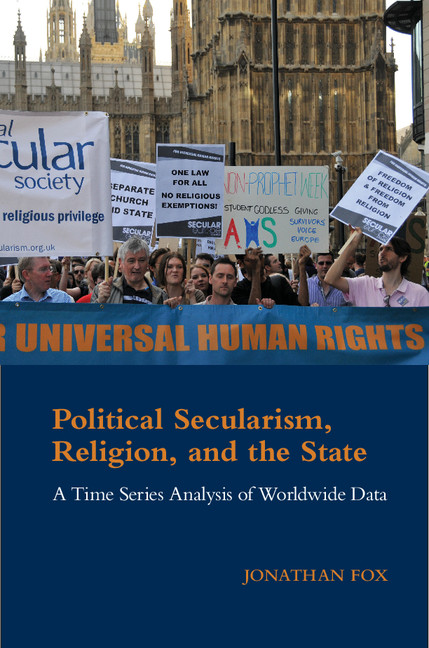
Political Secularism, Religion, and the State

-
Select format
-
- Publisher:
- Cambridge University Press
- Publication date:
- 05 May 2015
- 16 April 2015
- ISBN:
- 9781139924610
- 9781107076747
- 9781107433915
- Dimensions:
- (228 x 152 mm)
- Weight & Pages:
- 0.53kg, 291 Pages
- Dimensions:
- (228 x 152 mm)
- Weight & Pages:
- 0.4kg, 296 Pages
- Subjects:
- Social Theory, Research Methods in Politics, Sociology of Religion, Politics and International Relations, Research Methods In Politics, Religion: General Interest, Sociology
You may already have access via personal or institutional login- Subjects:
- Social Theory, Research Methods in Politics, Sociology of Religion, Politics and International Relations, Research Methods In Politics, Religion: General Interest, Sociology
Show more authors 
You may already have access via personal or institutional login
Book description
This book examines 111 types of state religion policy in 177 countries between 1990 and 2008. Jonathan Fox argues that policy is largely a result of the competition between political secular actors and religious actors, both of which try to influence state religion policy. While there are other factors that influence state religion policy and both the secular and religious camps are divided, Fox offers that the secular-religious competition perspective provides critical insight into the nature of religious politics across the globe. While many states have both increased and decreased their involvement in religion, Fox demonstrates that states which have become more involved in religion are far more common.
Reviews
'Drawing on an impressive wealth of new data, Fox offers more detail and nuance on the relationship between religion and state than any publication to date. He demonstrates that the relationship is often not what it seems: apparent efforts to support religion can serve as mechanisms for control; despite expectations of insignificance, religion remains a central concern in state policies; and rather than being stable, as constitutions might suggest, the relationships between religion and state are ever changing.'
Roger Finke - Pennsylvania State University
'Despite the apparent clarity of Jesus’s admonition to ‘Render unto Caesar the things that are Caesar’s, and unto God the things that are God’s', secular and religious leaders have always competed over issues of religious policy. Jonathan Fox provides an analysis of this competition that is nuanced, sophisticated, and compelling. This is an example of the ‘science’ of comparative politics at its best.'
Ted G. Jelen - University of Nevada, Las Vegas
'Fox’s detailed categorization and analysis of the phenomenon of state religion policy is essential reading.'
Source: Journal of Church and State
Contents
Contents
Metrics
Altmetric attention score
Full text views
Full text views helpTotal number of HTML views: 0
Total number of PDF views: 0 *
 Loading metrics...
* Views captured on Cambridge Core between #date#. This data will be updated every 24 hours.
Usage data cannot currently be displayed.
Accessibility standard: Unknown
Why this information is here
This section outlines the accessibility features of this content - including support for screen readers, full keyboard navigation and high-contrast display options. This may not be relevant for you.
Accessibility Information
Accessibility compliance for the PDF of this book is currently unknown and may be updated in the future.