
Skip to main content Accessibility help
×
  • Cited by 6
    • Show more authors
    • You may already have access via personal or institutional login
    • Select format
    • Publisher:
      Cambridge University Press
      Publication date:
      31 May 2025
      03 April 2025
      ISBN:
      9781009488143
      9781009488136
      9781009488167
      Dimensions:
      (229 x 152 mm)
      Weight & Pages:
      0.545kg, 264 Pages
      Dimensions:
      (229 x 152 mm)
      Weight & Pages:
      0.39kg, 264 Pages
    You may already have access via personal or institutional login
  • Selected: Digital
    Add to cart View cart Buy from Cambridge.org

    Book description

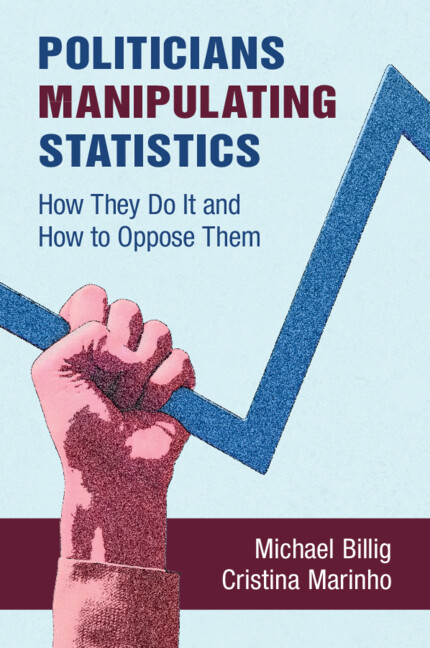
    Highly original and insightful, Billig and Marinho's book investigates how politicians misuse official statistics. Setting this problem in its historical context – and offering vivid case studies of Donald Trump, Boris Johnson and Gérald Darmanin – the authors demonstrate that the manipulation of statistics involves the misuse of words as well as the misuse of numbers. Most importantly, the authors show that politicians will manipulate official statisticians to produce politically convenient, but statistically inappropriate, numbers. Another unique part of the book is that the authors are not content with analysing how statistics are manipulated, but they also rigorously analyse the efforts of statistical agencies in France and Britain to combat such manipulation. The chapters herald unsung heroes who operate largely 'behind the scenes' to expose and oppose the corruption of statistics. An indispensable read for anyone concerned with the intersection of power and data.

    Reviews

    ‘This book transcends the conventional discussion about official statistics, courageously delving into the realm of political manipulation. This impressive and stimulating contribution to the understanding of statistical manipulation provides a remarkable historical contextualization, anchors this phenomenon in today’s anti-democratic practices and, through a diverse array of critical examples, describes various types and contexts of statistical manipulation. Its impact is poised to shape the discussion in this field for years to come.’

    Jorge Vala - University of Lisbon

    ‘Why do people believe numbers instead of facts? This innovative book provides a range of answers via a detailed and comparative discourse analysis of salient case studies about the politics of numbers, the art of persuasion and manipulation, and the desire for simplicity. A masterpiece!’

    Ruth Wodak - Lancaster University

    ‘… a subtle story of why those in charge massage numbers for their own benefit, and what can be done about it. As a statistician, I am beyond happy with the authors’ position on statistics. They rightly hold that statistics are much more than just numbers … It is, ultimately, a fascinating read, weaving together stories of individuals and systems around the globe. In this post-truth world, to understand how numbers are manipulated is a necessary - if not sufficient - step in nipping the consequences in the bud.’

    Ole J. Forsberg - Professor of Mathematics and Chair of Statistics, Knox College, USA

    ‘In a post-truth era of politics opposing the manipulation of statistics is more important than it has ever been … Billig and Marinho’s book offers novel insight concerning the issue of defending democracy … an excellent addition to the critical social psychology of rhetoric and ideology.’

    Alexander Hunt Source: Social Psychological Review

    ‘This book investigating how politicians inappropriately use official statistics for political advantage is a welcome addition to the scholarly literature on the relationship between political power and the use of official data. Concerned with the impact of such statistical manipulation on liberal democracy, Billig and Marinho insightfully identify both political villains and bureaucratic heroes. Easy to read, given its clear and nontechnical prose … Recommended.’

    T. D. Lancaster Source: Choice

    Refine List

    Actions for selected content:

    Select all | Deselect all
    • View selected items
    • Export citations
    • Download PDF (zip)
    • Save to Kindle
    • Save to Dropbox
    • Save to Google Drive

    Save Search

    You can save your searches here and later view and run them again in "My saved searches".

    Please provide a title, maximum of 40 characters.
    ×

    Contents

    • Chapter 1 - Introduction
      pp 1-9

    Metrics

    Full text views

    Total number of HTML views: 0
    Total number of PDF views: 0 *
    Loading metrics...

    Book summary page views

    Total views: 0 *
    Loading metrics...

    * Views captured on Cambridge Core between #date#. This data will be updated every 24 hours.

    Usage data cannot currently be displayed.

    Accessibility standard: Unknown

    Why this information is here

    This section outlines the accessibility features of this content - including support for screen readers, full keyboard navigation and high-contrast display options. This may not be relevant for you.

    Accessibility Information

    Accessibility compliance for the HTML of this book is currently unknown and may be updated in the future.
