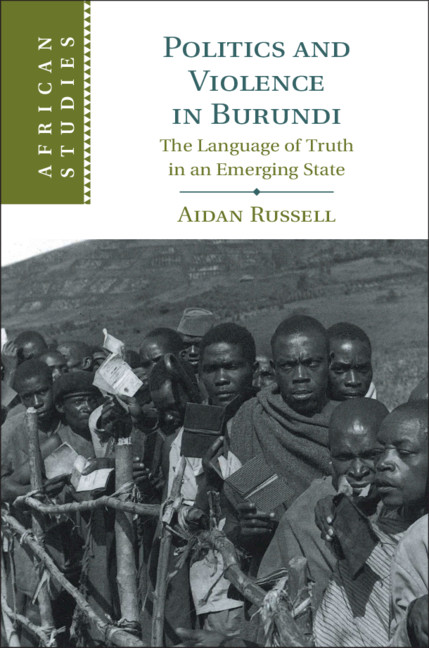

Telling the neglected history of decolonisation and violence in Burundi, Aidan Russell examines the political language of truth that drove extraordinary change, from democracy to genocide. By focusing on the dangerous border between Burundi and Rwanda, this study uncovers the complexity from which ethnic ideologies, side-lined before independence in 1962, became gradually all-consuming by 1972. Framed by the rhetoric and uncertainty of 'truth', Russell draws on both African and European language source material to demonstrate how values of authority and citizenship were tested and transformed across the first decade of Burundi's independence, and a post-colony created in the interactions between African peasants and politicians across the margins of their states. Culminating with a rare examination of the first postcolonial genocide on the African continent, a so-called 'forgotten genocide' on the world stage, Russell reveals how the postcolonial order of central Africa came into being.
'Aidan Russell has written a powerful and disturbing study of how struggles over power and a government’s claim to monopolise truth led to the ethnicisation of politics and to violence in a newly independent country.'
Frederick Cooper - New York University
'Path-breaking, erudite and meticulously researched, this stands as an impressive achievement. No other work has done more to explicate the paradoxes, subtleties and brutalities of Burundi’s tragic history. Few analysts have shown a deeper understanding of the relationship of language (Kirundi) to popular perceptions of truth, and ultimately to politics, than Aidan Russell in this outstanding contribution. I cannot recommend it too highly to anyone seriously interested in making sense of Burundi politics.'
René Lemarchand - Professor Emeritus, University of Florida
'This book reveals the power and potential of national history as Russell puts language at the center of African politics. Violence and truth, speech and borders, lies and citizenship constitute the history of Burundi after 1962, and they remain in constant tension with every memory and speech about the postcolony.'
Luise White - Professor Emerita, University of Florida
Loading metrics...
* Views captured on Cambridge Core between #date#. This data will be updated every 24 hours.
Usage data cannot currently be displayed.
This section outlines the accessibility features of this content - including support for screen readers, full keyboard navigation and high-contrast display options. This may not be relevant for you.
Accessibility compliance for the HTML of this book is currently unknown and may be updated in the future.
