The Politics of Ritual Kinship

-
Select format
-
- Publisher:
- Cambridge University Press
- Publication date:
- 02 October 2009
- 28 November 1999
- ISBN:
- 9780511523496
- 9780521621854
- 9780521038003
- Dimensions:
- (228 x 152 mm)
- Weight & Pages:
- 0.66kg, 332 Pages
- Dimensions:
- (228 x 152 mm)
- Weight & Pages:
- 0.497kg, 332 Pages
You may already have access via personal or institutional login
Show more authors 
You may already have access via personal or institutional login
Book description
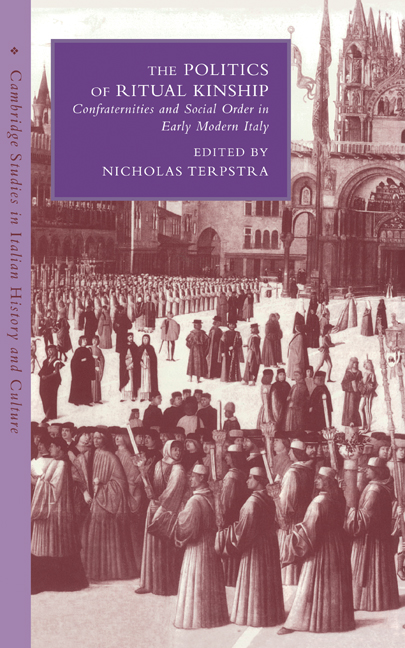
Confraternities were the most common form of organized religious life in medieval and early modern Europe. They were at once the lay face of the church, the spiritual heart of civic government, and the social kin who claimed the allegiance of peers and the obedience of subordinates. In this 1999 collection, fifteen scholars examine the development of confraternities in Italy, where they emerged first and had the greatest impact. Individual essays explore a common set of themes across Italy from the twelfth to the eighteenth centuries: the ubiquity of confraternities, social construction, and devotional ethos; their ritual culture and civic religion; their antagonistic and collaborative relations with both civic and ecclesiastical authorities; and their role in social welfare and social control of marginal groups. The authors demonstrate how the ritual kinship expressed in confraternities emerged in the Middle Ages and became a powerful force in 'civilizing' early modern Italian society.
Reviews
‘… breathtaking in the range of subjects and timescale considered … a welcome addition to the growing body of scholarship on Italian confraternities’.
William B. Wurthmann Source: Journal of Ecclesiastical History
‘… the contributors enrich our understanding of the complex nature of lay charitable and pious activities and identities on the brink of the modern age.’
Jennifer D. Selwyn Source: Archivum Historicum
Contents
Contents
Metrics
Altmetric attention score
Full text views
Full text views helpTotal number of HTML views: 0
Total number of PDF views: 0 *
 Loading metrics...
* Views captured on Cambridge Core between #date#. This data will be updated every 24 hours.
Usage data cannot currently be displayed.
Accessibility standard: Unknown
Why this information is here
This section outlines the accessibility features of this content - including support for screen readers, full keyboard navigation and high-contrast display options. This may not be relevant for you.
Accessibility Information
Accessibility compliance for the PDF of this book is currently unknown and may be updated in the future.