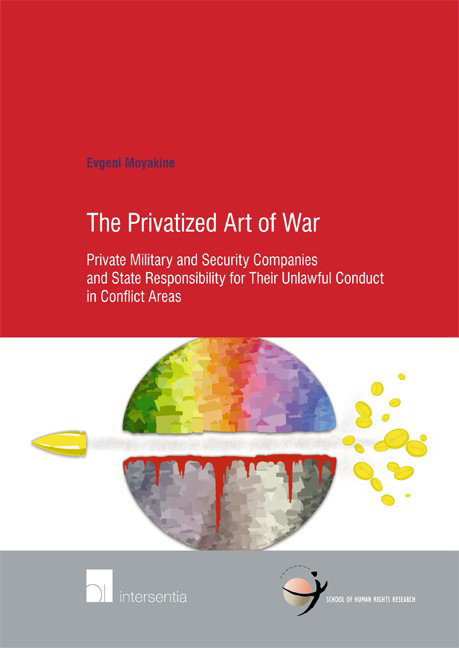
The Privatized Art of War

-
Select format
-
- Publisher:
- Intersentia
- Publication date:
- 28 November 2017
- 05 February 2015
- ISBN:
- 9781780685632
- 9781780682815
- Dimensions:
- Weight & Pages:
- Dimensions:
- Weight & Pages:
- Subjects:
- Law, Humanitarian Law
- Series:
- School of Human Rights Research
You may already have access via personal or institutional login- Subjects:
- Law, Humanitarian Law
- Series:
- School of Human Rights Research
Show more authors 
You may already have access via personal or institutional login
Book description
In the modern globalized world, so-called private military and security companies (PMSCs) are employed by a variety of actors in times of both war and peace. They are employed by, and perform a plethora of services for, not only international organizations, NGOs, and multinationals, but also States. It goes without saying that, especially in areas torn apart by armed conflicts, these corporations and their personnel can and sometimes do engage in different types of misconduct that may constitute violations of international law. While there are still regulatory gaps in the national and international legal frameworks applicable to PMSCs and self-regulatory schemes of the industry generally appear to be lacking effectiveness, the lines of responsibility often remain unclear. In light of this, State responsibility becomes an important instrument for attaining justice and ensuring respect for international law by private contractors.The use of PMSCs by States in conflict zones may, in certain instances, be considered morally problematic and might enable States to outsource fundamental governmental tasks to essentially private actors without necessarily being held responsible for instances of misconduct. This book investigates the possibility of applying the doctrine of State responsibility to the employment of PMSCs in areas affected by conflicts and to breaches of international law committed by these companies and their personnel. It examines an array of circumstances in which the unlawful conduct of PMSCs and their staff may be attributed to States under international law and the extent of such attribution. The study further analyzes the application of positive obligations imposed by international law on States and the scope of this application. It is illustrated that not only States hiring PMSCs, but also States where these companies are active, and States where they are registered or incorporated, are to be held responsible when violations of international law are attributed to these States in accordance with certain modes of attribution. In addition, the States in question also bear international responsibility when they fail to comply with their positive duties of result and diligent conduct stemming from the fields of international humanitarian and human rights law.
Contents
Contents
Metrics
Full text views
Full text views helpTotal number of HTML views: 0
Total number of PDF views: 0 *
 Loading metrics...
* Views captured on Cambridge Core between #date#. This data will be updated every 24 hours.
Usage data cannot currently be displayed.
Accessibility standard: Unknown
Why this information is here
This section outlines the accessibility features of this content - including support for screen readers, full keyboard navigation and high-contrast display options. This may not be relevant for you.
Accessibility Information
Accessibility compliance for the PDF of this book is currently unknown and may be updated in the future.