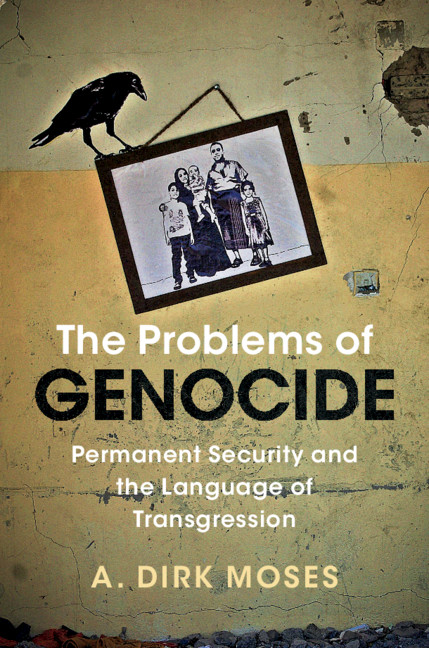
The Problems of Genocide

-
Select format
-
- Publisher:
- Cambridge University Press
- Publication date:
- 07 January 2021
- 04 February 2021
- ISBN:
- 9781316217306
- 9781107103580
- 9781107503120
- Dimensions:
- (228 x 152 mm)
- Weight & Pages:
- 1.02kg, 612 Pages
- Dimensions:
- (228 x 152 mm)
- Weight & Pages:
- 0.889kg, 612 Pages
You may already have access via personal or institutional login
Show more authors 
You may already have access via personal or institutional login
Book description
Genocide is not only a problem of mass death, but also of how, as a relatively new idea and law, it organizes and distorts thinking about civilian destruction. Taking the normative perspective of civilian immunity from military attack, A. Dirk Moses argues that the implicit hierarchy of international criminal law, atop which sits genocide as the 'crime of crimes', blinds us to other types of humanly caused civilian death, like bombing cities, and the 'collateral damage' of missile and drone strikes. Talk of genocide, then, can function ideologically to detract from systematic violence against civilians perpetrated by governments of all types. The Problems of Genocide contends that this violence is the consequence of 'permanent security' imperatives: the striving of states, and armed groups seeking to found states, to make themselves invulnerable to threats.
Reviews
‘This refreshingly original book turns the problem of genocide on its head. Contrariwise to international law and the dominant memory regimes, Moses points at the aspiration for permanent security as the crux of the matter. Passionate and historically sweeping.’
Maria Mälksoo - author of The Politics of Becoming European: A Study of Polish and Baltic Post-Cold War Security Imaginaries
‘A pioneer of genocide studies, A. Dirk Moses has written a terrific, transgressive book destined to upend the field he has helped to define. Uncomfortable with morality tales, Moses is intent on smashing the hierarchy of international crimes established in the aftermath of World War II. A gut punch to conventional wisdom, this is critical global history at its best.’
Jens Meierhenrich - author of Lawfare: A Genealogy (forthcoming)
‘This brilliant, closely argued, and exhaustively referenced book makes a deeply persuasive case for replacing the prism of genocide with the crime of permanent security, calling out the multiple standards at play in the global order. A seminal paradigm-changer.’
Nandini Sundar - author of The Burning Forest: India's War Against the Maoists
‘Dirk Moses is the most original and provocative scholar writing on the problem of genocide. At its core deeply humanitarian, his book challenges every comfortable assumption of the meaning of genocide. This is essential reading for everyone concerned with human rights and mass atrocities.’
Eric D. Weitz - author of A World Divided: The Global Struggle for Human Rights in the Age of Nation-States
‘The Problems of Genocide can be strongly recommended to readers of this journal who have an interest in the macro-issues relating to criminal law and criminal justice, broadly conceived.’
David O. Friedrichs Source: Rutgers
‘Highly recommended.’
A. Kolin Source: Choice Magazine
‘… The Problems of Genocide is possibly one of the most significant works on the intellectual history of genocide ever since the notion entered the realm of the history of ideas.’
Dimitrios A. Kourtis Source: Journal of Conflict and Security Law
‘Moses' study makes numerous contributions to various literatures and disciplines … The author postulates a paradigm shift in genocide research, security studies and international law … [His] book is necessary and admirable.’
Norbert Finzsch Source: H-Soz-Kult
‘What’s in a name? Why and how does it matter whether a particular situation is designated a genocide? And why is it problematic for us to categorise mass violence in this way? Dirk Moses’ important new book … addresses these questions head on with an elegantly argued and intricate treatment of the problems at the heart of what he terms the 'language of transgression' - the concept and discourse of genocide … a rich, satisfying and provocative read.’
Rachel Kerr Source: International Journal of Military History and Historiography
‘… [a] masterful genealogy of the concept [of genocide]’
G. Daniel Cohen Source: American Historical Review
Contents
Contents
Metrics
Altmetric attention score
Full text views
Full text views helpTotal number of HTML views: 0
Total number of PDF views: 0 *
 Loading metrics...
* Views captured on Cambridge Core between #date#. This data will be updated every 24 hours.
Usage data cannot currently be displayed.
Accessibility standard: WCAG 2.2 AAA
Why this information is here
This section outlines the accessibility features of this content - including support for screen readers, full keyboard navigation and high-contrast display options. This may not be relevant for you.
Accessibility Information
The HTML of this book complies with version 2.2 of the Web Content Accessibility Guidelines (WCAG), offering more comprehensive accessibility measures for a broad range of users and attains the highest (AAA) level of WCAG compliance, optimising the user experience by meeting the most extensive accessibility guidelines.
Content Navigation
Table of contents navigation
Allows you to navigate directly to chapters, sections, or non‐text items through a linked table of contents, reducing the need for extensive scrolling.
Index navigation
Provides an interactive index, letting you go straight to where a term or subject appears in the text without manual searching.
Reading Order and Textual Equivalents
Single logical reading order
You will encounter all content (including footnotes, captions, etc.) in a clear, sequential flow, making it easier to follow with assistive tools like screen readers.
Short alternative textual descriptions
You get concise descriptions (for images, charts, or media clips), ensuring you do not miss crucial information when visual or audio elements are not accessible.
Visualised data also available as non‐graphical data
You can access graphs or charts in a text or tabular format, so you are not excluded if you cannot process visual displays.
Visual Accessibility
Use of high contrast between text and background colour
You benefit from high‐contrast text, which improves legibility if you have low vision or if you are reading in less‐than‐ideal lighting conditions.