
Skip to main content Accessibility help
×
  • Cited by 7
    • Show more authors
    • You may already have access via personal or institutional login
    • Select format
    • Publisher:
      Cambridge University Press
      Publication date:
      22 December 2022
      05 January 2023
      ISBN:
      9781009288118
      9781009288149
      9781009288101
      Dimensions:
      (229 x 152 mm)
      Weight & Pages:
      0.46kg, 216 Pages
      Dimensions:
      (229 x 152 mm)
      Weight & Pages:
      0.32kg, 216 Pages
    You may already have access via personal or institutional login
  • Selected: Digital
    Add to cart View cart Buy from Cambridge.org

    Book description

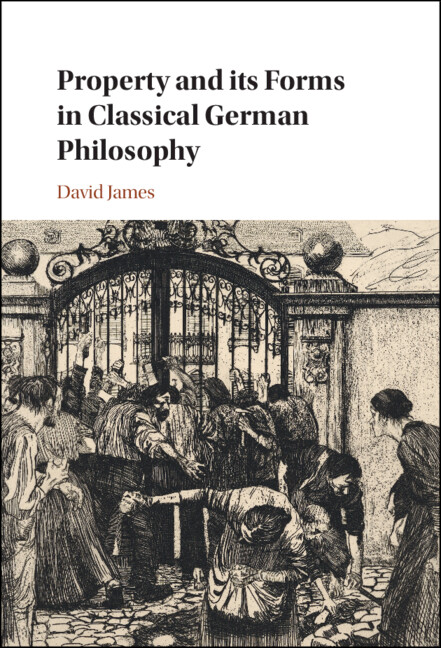
    The theme of property is directly relevant to some of the most divisive social and political issues today, such as wealth inequality and the question of whether governments should limit it by introducing measures that restrict the right to property. Yet what is property? And when seeking to answer this question, do we tend to identify the concept with just one dominant historical form of property? In this book, David James reconstructs the theories of property developed by four key figures in classical German philosophy - Kant, Fichte, Hegel and Marx. He argues that although their theories of property are different, the concept of social recognition plays a crucial role in all of them, and assesses these philosophers' arguments for the specific forms of property they claim should exist in a society that is genuinely committed to the idea of freedom.

    Reviews

    ‘Property and its Forms in Classical German Philosophy challenges the liberal, ‘pre-political' conception of private property stemming from John Locke that is familiar and standard in contemporary political philosophy. The book examines and defends four alternative, powerful accounts of property-from Kant, Fichte, Hegel, and Marx-that have a social component to what is mine and thine. James's thorough, learned discussion contributes not only to our understanding of German political thought but also to fundamental inquiries into the nature and basis of modern liberal capitalism.'

    Jeffrey Church - University of Houston

    ‘David James brilliantly demonstrates that, beyond their controversies about economic systems, classic German philosophers share the same concept of property. It isn't primarily a relation between a person and a thing, but a system of mutual limitation of free spheres of action. This opens highly promising perspectives for the current debates on distributive justice.'

    Jean-Christophe Merle - University of Vechta/Universität des Saarlandes

    ‘This excellent book is a must read for anyone interested in theories of property in classical German philosophy…’

    Michael Baur Source: Journal of the History of Philosophy

    Refine List

    Actions for selected content:

    Select all | Deselect all
    • View selected items
    • Export citations
    • Download PDF (zip)
    • Save to Kindle
    • Save to Dropbox
    • Save to Google Drive

    Save Search

    You can save your searches here and later view and run them again in "My saved searches".

    Please provide a title, maximum of 40 characters.
    ×

    Contents

    Metrics

    Altmetric attention score

    Full text views

    Total number of HTML views: 0
    Total number of PDF views: 0 *
    Loading metrics...

    Book summary page views

    Total views: 0 *
    Loading metrics...

    * Views captured on Cambridge Core between #date#. This data will be updated every 24 hours.

    Usage data cannot currently be displayed.

    Accessibility standard: Unknown

    Why this information is here

    This section outlines the accessibility features of this content - including support for screen readers, full keyboard navigation and high-contrast display options. This may not be relevant for you.

    Accessibility Information

    Accessibility compliance for the HTML of this book is currently unknown and may be updated in the future.
