
Skip to main content Accessibility help
×
  • Cited by 2
    • Volume 22
    • You may already have access via personal or institutional login
    • Select format
    • Publisher:
      Intersentia
      Publication date:
      28 September 2018
      24 November 2016
      ISBN:
      9781780687575
      9781780684437
      Dimensions:
      Weight & Pages:
      Dimensions:
      Weight & Pages:
    You may already have access via personal or institutional login
  • Selected: Digital
    Add to cart View cart Buy from Cambridge.org

    Book description

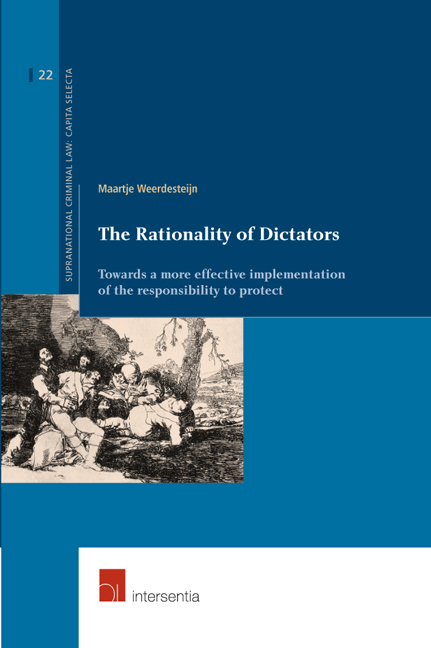
    A non-democratic system of government is an important risk factor for the perpetration of atrocity crimes, meaning genocide, crimes against humanity, war crimes and ethnic cleansing. At the 2005 World Summit the international community accepted the responsibility to protect populations from these crimes when the domestic state is failing to do so. The implementation of the responsibility to protect, however, leaves much to be desired. This book studies the role dictators play in orchestrating mass atrocities and analyses their decision-making process when the international community tries to stop or mitigate the perpetration of these crimes. Through a comparative case study of Pol Pot and Slobodan Milosevic it argues that the role ideology plays in the decision-making process of the dictator is an important determinant of their responsiveness. In doing so, it challenges the common notion that all dictators are primarily motivated by retaining their position of power and argues that while dictators are frequently characterised as raging mad men, this is not necessarily always the case. It rather argues in favour of a more nuanced approach to rationality, that uses the work of Max Weber to acknowledge that different types of rationality exist, when analysing the decision-making process of dictators. The book is therefore an indispensable resource for scholars who are interested in the role of dictators in bringing forth and stopping mass atrocities and for anyone who wants more insight into the rationality of dictators.Maartje Weerdesteijn is an interdisciplinary scholar and lecturer at Utrecht University. She holds a bachelor from Maastricht University and a master from VU University Amsterdam where she worked for several years as a lecturer. She conducted her PhD research at Tilburg University and published in renowned international journals, including Politics and Governance, International Criminal Law Review and Genocide Studies and Prevention.

    Refine List

    Actions for selected content:

    Select all | Deselect all
    • View selected items
    • Export citations
    • Download PDF (zip)
    • Save to Kindle
    • Save to Dropbox
    • Save to Google Drive

    Save Search

    You can save your searches here and later view and run them again in "My saved searches".

    Please provide a title, maximum of 40 characters.
    ×

    Contents

    Metrics

    Altmetric attention score

    Full text views

    Total number of HTML views: 0
    Total number of PDF views: 0 *
    Loading metrics...

    Book summary page views

    Total views: 0 *
    Loading metrics...

    * Views captured on Cambridge Core between #date#. This data will be updated every 24 hours.

    Usage data cannot currently be displayed.

    Accessibility standard: Unknown

    Why this information is here

    This section outlines the accessibility features of this content - including support for screen readers, full keyboard navigation and high-contrast display options. This may not be relevant for you.

    Accessibility Information

    Accessibility compliance for the PDF of this book is currently unknown and may be updated in the future.
