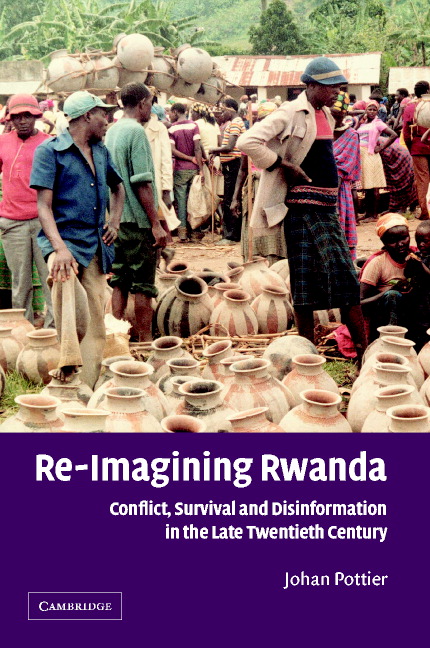
Re-Imagining Rwanda

-
Select format
-
- Publisher:
- Cambridge University Press
- Publication date:
- 22 September 2009
- 26 September 2002
- ISBN:
- 9780511491092
- 9780521528733
- Dimensions:
- Weight & Pages:
- Dimensions:
- (228 x 152 mm)
- Weight & Pages:
- 0.438kg, 276 Pages
Show more authors 
You may already have access via personal or institutional login
Book description
The tragic conflict in Rwanda and the Great Lakes in 1994–1996 attracted the horrified attention of the world's media. Journalists, diplomats and aid workers struggled to find a way to make sense of the bloodshed. Johan Pottier's troubling study shows that the post-genocide regime in Rwanda was able to impose a simple yet persuasive account of Central Africa's crises upon international commentators new to the region, and he explains the ideological underpinnings of this official narrative. He also provides a sobering analysis of the way in which this simple, persuasive, but fatally misleading analysis of the situation on the ground led to policy errors that exacerbated the original crisis. Professor Pottier has extensive field experience in the region, from before and after the genocide, and he has also worked among refugees in eastern Zaire.
Reviews
‘… an important and courageous book, and well informed … this analysis is essential reading for people interested in the area and in the role of the press in general’.
Source: Journal of African History
‘In this courageous and important book, Pottier succeeds admirably in reaffirming the necessity of scholarly analysis, as enshrined in the academic monograph, to provide the basis for well-balanced and historically informed analyses of major events … Pottier provides us with an insightful description of the build-up and aftermath of Rwanda‘s tragic genocide and ensuing war … chapter 5 … is a brilliant example of how the detailed anthropological understandings of a culture as lived by ordinary people can provide the best basis for understanding and interpreting larger and more complex events and (mis)representations at regional, national, and international levels. This important book should be required reading for anyone - from foreign diplomats and politicians, journalists, aid and development workers to academics - committed to building a better Rwanda, and for anyone whose task requires an engagement with the Great Lakes Region of Central Africa.‘
Source: Journal of the Royal Anthropological Institute
'This is an important book on the political construction of knowledge … it is essential reading for anyone interested in the conflicts of Central Africa, or complex humanitarian emergencies more generally.'
Source: African Affairs
Contents
Contents
Metrics
Altmetric attention score
Full text views
Full text views helpTotal number of HTML views: 0
Total number of PDF views: 0 *
 Loading metrics...
* Views captured on Cambridge Core between #date#. This data will be updated every 24 hours.
Usage data cannot currently be displayed.
Accessibility standard: Unknown
Why this information is here
This section outlines the accessibility features of this content - including support for screen readers, full keyboard navigation and high-contrast display options. This may not be relevant for you.
Accessibility Information
Accessibility compliance for the PDF of this book is currently unknown and may be updated in the future.