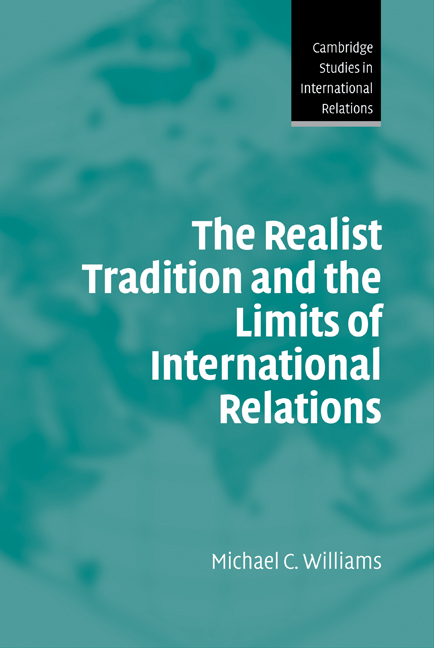
The Realist Tradition and the Limits of International Relations

-
Select format
-
- Publisher:
- Cambridge University Press
- Publication date:
- 22 September 2009
- 06 January 2005
- ISBN:
- 9780511491771
- 9780521827522
- 9780521534758
- Dimensions:
- (228 x 152 mm)
- Weight & Pages:
- 0.523kg, 256 Pages
- Dimensions:
- (228 x 152 mm)
- Weight & Pages:
- 0.38kg, 254 Pages
You may already have access via personal or institutional login- Series:
- Cambridge Studies in International Relations (100)
Show more authors 
You may already have access via personal or institutional login
Book description
Realism is commonly portrayed as theory that reduces international relations to pure power politics. Michael Williams provides an important reexamination of the Realist tradition and its relevance for contemporary international relations. Examining three thinkers commonly invoked as Realism's foremost proponents - Hobbes, Rousseau, and Morgenthau - the book shows that, far from advocating a crude realpolitik, Realism's most famous classical proponents actually stressed the need for a restrained exercise of power and a politics with ethics at its core. These ideas are more relevant than ever at a time when the nature of responsible responses to international problems are at the centre of contemporary political debate. This original interpretation of major thinkers will interest scholars of international relations and the history of ideas.
Reviews
''If we needed any more evidence of realism’s resurgence in the field of International Relations, then Michael C. Williams’s original and thought-provoking book on the realist tradition should serve as the final testament … This is a book that all realists and their critics should ponder.'
Source: International Affairs
'This book makes an important contribution to recent efforts to reinterpret realism.'
Source: Political Studies Review
Contents
Contents
Metrics
Altmetric attention score
Full text views
Full text views helpTotal number of HTML views: 0
Total number of PDF views: 0 *
 Loading metrics...
* Views captured on Cambridge Core between #date#. This data will be updated every 24 hours.
Usage data cannot currently be displayed.
Accessibility standard: Unknown
Why this information is here
This section outlines the accessibility features of this content - including support for screen readers, full keyboard navigation and high-contrast display options. This may not be relevant for you.
Accessibility Information
Accessibility compliance for the PDF of this book is currently unknown and may be updated in the future.