Skip to main content Accessibility help
×
    Show more authors
  • You may already have access via personal or institutional login
  • Select format
  • Publisher:
    Cambridge University Press
    Publication date:
    05 July 2011
    02 June 2011
    ISBN:
    9780511977206
    9781107006874
    9781107540484
    Dimensions:
    (228 x 152 mm)
    Weight & Pages:
    0.55kg, 284 Pages
    Dimensions:
    (229 x 152 mm)
    Weight & Pages:
    0.42kg, 284 Pages
You may already have access via personal or institutional login
  • Selected: Digital
    Add to cart View cart Buy from Cambridge.org

    Book description

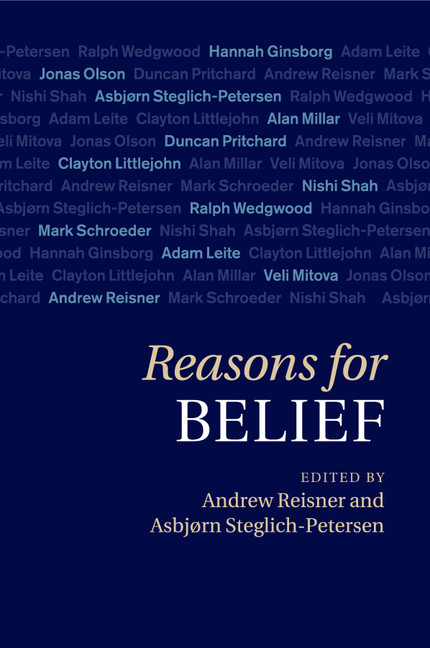
    Philosophers have long been concerned about what we know and how we know it. Increasingly, however, a related question has gained prominence in philosophical discussion: what should we believe and why? This volume brings together twelve new essays that address different aspects of this question. The essays examine foundational questions about reasons for belief, and use new research on reasons for belief to address traditional epistemological concerns such as knowledge, justification and perceptually acquired beliefs. This book will be of interest to philosophers working on epistemology, theoretical reason, rationality, perception and ethics. It will also be of interest to cognitive scientists and psychologists who wish to gain deeper insight into normative questions about belief and knowledge.

    Reviews

    "This book focuses on what are called theoretical reasons. The topic of interest resides both in practical philosophy, where the importance of the ability to give reasons for action has long been recognized, and in several specific areas of epistemology, where reasons play important roles in regard to questions of justification, warrant, and epistemic entitlement.... Recommended.... Upper-level undergraduates through researchers/faculty."
    --N.D. Smith, Lewis and Clark College, Choice

    Refine List

    Actions for selected content:

    Select all | Deselect all
    • View selected items
    • Export citations
    • Download PDF (zip)
    • Save to Kindle
    • Save to Dropbox
    • Save to Google Drive

    Save Search

    You can save your searches here and later view and run them again in "My saved searches".

    Please provide a title, maximum of 40 characters.
    ×

    Contents

    • 1 - How to be a teleologist about epistemic reasons
      pp 13-33
    • View abstract

      Summary

      This chapter explores the prospects of a slightly different strategy in solving the value problem for the teleological account of epistemic reasons. The starting point of the strategy is to concede the main criticism of teleological accounts of epistemic reasons, namely that epistemic properties are not valuable generally and in all contexts, and that a teleological account relying on such a claim therefore fails. The notion of reasons to form beliefs about propositions or subject matters is in some respects similar to the notion of having a reason to engage in enquiry, i.e. a reason to actively pursue evidence bearing on a certain proposition or subject matter. The chapter argues that the relationship between epistemic reasons, reasons to form beliefs about certain propositions, and normative statements about what a person ought to believe, could be explained by supposing that epistemic reasons are hypothetical instrumental reasons.
    • 2 - Is there reason to be theoretically rational?
      pp 34-53
    • View abstract

      Summary

      This chapter focuses at the more specific matter of whether there is reason to be theoretically rational. It argues that there is very strong reason to be theoretically rational. Unfortunately, answering the question about theoretical rationality does not settle questions about the normativity of practical rationality, but the chapter outlines in a speculative way how the considerations raised in favor of the normativity of theoretical rationality might be used to show that the requirements of practical rationality are normative. The use of wide-scope oughts, or perhaps wide-scope reasons, in giving an account of rational requirements is important for any view that holds that rational requirements are normative. The initial error is in thinking that rational requirements are conceptually identical to normative requirements. The truth of the particular normative requirement is, like any other ought, determined by the various features of the world on which normativity is dependent.
    • 3 - Epistemic motivation
      pp 54-74
    • Towards a metaethics of belief
    • View abstract

      Summary

      This chapter sets the programme for building up a metaethics of belief from the unexplored angle of motivation. It introduces and transposes to epistemology three standard metaethical debates, internalism versus externalism about the connection between moral judgements and motivation; Humeanism versus anti-Humeanism about the nature of motivation; and cognitivism versus non-cognitivism about moral judgements. The chapter shows how the position on motivation affects the commitments in the higher, more metaphysical, realms of our metaethics of belief: in particular, it makes cognitivism about epistemic judgements prima facie plausible. It shows that loftier metaethical questions can be answered from a stance on motivation. As far as motivation goes, then, our metaethics of belief should be anti-Humean about the nature of epistemic motivation, and internalist about how epistemic judgements motivate us. Methodologically, the kind in question is one which builds itself up from theoretically lower-level commitments concerning motivation.
    • 4 - Error theory and reasons for belief
      pp 75-93
    • View abstract

      Summary

      This chapter outlines the alleged structural similarities between moral reasons and epistemic reasons and gives a more precise characterization of epistemic error theory. It distinguishes between transcendent norms, which imply categorical reasons, and immanent norms, which do not imply categorical reasons. The chapter explores the question of what error theorists should say about reasons for belief. It examines what Terence Cuneo claims to be three undesirable results of epistemic error theory, namely that epistemic error theory is self-defeating or polemically toothless, that epistemic error theory implies that there can be no arguments for anything, and that epistemic error theory rules out the possibility of epistemic merits and demerits. The chapter argues that for the purpose of distinguishing belief from other kinds of attitudes the norms involved in belief ascriptions need not be understood as transcendent rather than immanent and consequently there are no worrisome implications for epistemic error theory.
    • 5 - Can reasons for belief be debunked?
      pp 94-108
    • View abstract

      Summary

      Since the debate between evidentialists and pragmatists is not about the causes of belief, but instead about what normative standard to apply in determining what to believe, we have no choice but to accept the evidentialist standard. Whether one explicitly recognizes it or not, one is committed to evidentialism just in virtue of asking what to believe. Addressed to the error theorist, arguments favoring evidentialism over pragmatism merely beg the question. By attributing beliefs about doxastic reasons, the theorist about doxastic reasons commits himself to the falsity of his own view. Transcendental arguments seek to vindicate the objective validity of the fundamental normative judgments by bridging the gap between the first and third-personal points of view. As long as the results of Kantian arguments are confined to claims about what norms must be accepted from the first-personal point of view, error theories about those norms appear to be left open.
    • 6 - Reasons and belief's justification
      pp 111-130
    • View abstract

      Summary

      This chapter looks at some competing accounts of reasons and their demands. Some object to the conformity and compliance accounts on the grounds that they represent reasons as making unreasonable demands. The considerations that cause trouble for the conformity and compliance accounts suggest that normative appraisal is concerned with both the quality and results of the deliberative efforts. The chapter argues that there's something wrong with two influential approaches to epistemic justification. It focuses on evidentialism and the knowledge account because they face structurally similar problems. There's more to a belief's justification than the evidentialist maintains and less to a belief's justification than the knowledge account says. The problem with the evidentialist view is that it restricts the scope of epistemic evaluation to relations between a belief and the evidence an individual happens to have on hand.
    • 7 - Perception, generality, and reasons
      pp 131-157
    • View abstract

      Summary

      This chapter argues that perceptual experiences must have content if they are to rationalize beliefs, at least in the sense that has traditionally been invoked in the context of epistemological debates about empirical justification. The representational content, Bill Brewer thinks, is modeled on that of a person's thought about the world around him, as expressed in his linguistic communication with others, and registered by their everyday attitude ascriptions to him. A view of perception which apparently meets this need, while still remaining within the spirit of the object view, is defended by Mark Johnston, for whom perception presents with states and events as well as objects and stuffs. The modifications made to the object view do indeed entail that perception resembles thought in having representational content, and specifically representational content with the generality characteristic of the content of thought.
    • 8 - Immediate warrant, epistemic responsibility, and Moorean dogmatism
      pp 158-179
    • View abstract

      Summary

      Epistemologists and non-philosophers find the Moorean reasoning unattractive. It is not easy to locate the source of this dissatisfaction, however. This chapter argues that it arises from requirements of responsibility that apply to rational agents in the course of conscious reasoning or deliberation. Dogmatism alone isn't enough to evade standard arguments for skepticism about the external world. Warrants are things of a type that is suited to play the role of normative epistemic reasons in an agent's deliberations about what to believe. A person might have a warrant to believe a particular proposition, believe that proposition, and yet not hold that belief in a reasonable, epistemically appropriate, or epistemically satisfactory way. The external world skeptic holds that no one is doxastically justified in believing anything about the external world by means of the senses. The Moorean dogmatist diagnoses this skeptical claim as arising from a principle about experiential warrant.
    • 9 - Primitively rational belief-forming processes
      pp 180-200
    • View abstract

      Summary

      This chapter focuses on belief-forming processes, that is, types of mental process that result in the thinker's forming a belief in some proposition. It discusses a specific example of the belief-forming process that has three properties. The chapter articulates some crucial features that all rational belief-forming processes must have, without attempting to ensure that these crucial features are picked out in strictly non-normative terms. It explains what it would mean for the rationality of a belief-forming process to be a priori. The chapter argues that the rationality of the primitively rational processes is a priori in this way. It argues that the mere existence of an essential connection between a belief-forming process and the truth was not enough to make the process rational; it is also necessary that one should be able to engage in this process precisely because of its connection with the truth.
    • 10 - What does it take to “have” a reason?
      pp 201-222
    • View abstract

      Summary

      The truism that adopting an unjustified belief does not put one in a better evidential position with respect to believing its consequences leads most philosophers to conclude that bare belief is insufficient for the having relation involved in subjective evidence. This chapter presents alternative explanation of PP, the truism that when a belief lacks propositional justification, it does not contribute to the propositional justification for its consequences. The assumption of a high bar on what it takes to have evidence, despite its overwhelming initial plausibility, has been complicating the dialectic about basic perceptual epistemology, and consequently the dialectic about foundationalism and coherentism, internalism and externalism, and rationalism and empiricism, for a very long time. Beliefs can be justified or unjustified because they fall under the reach of rational criticism, and they fall under the reach of rational criticism because they are states that we hold for reasons.
    • 11 - Knowledge and reasons for belief
      pp 223-243
    • View abstract

      Summary

      This chapter seeks to make sense of the idea that, for agents, knowledge at least normally goes along with being justified in believing. It indicates how one might develop an account of testimony building on a non standard account of knowledge from indicator phenomena. A conception of the importance of recognitional abilities is developed to yield an account of reasons for belief in the cases under consideration and a general view of the connection between knowledge, justified belief and reasons. A problem structure analogous to that described in relation to testimony arises in cases of perceptual knowledge. By contrast with perceptual knowledge, the problem is not that what is thought to supply the reason is not of the right category to constitute a reason. The chapter explains how with respect to various kinds of knowledge one can gain a lot from what initially seemed to be so little.
    • 12 - What is the swamping problem?
      pp 244-259
    • View abstract

      Summary

      This chapter discusses the constitutive relationship between belief and truth. This relationship is expressed in terms of the slogan that belief in some sense 'aims' at the truth; that the telos of belief is truth. The standard way of expressing the swamping problem is as posing a difficulty not for a general epistemological thesis like epistemic value T-monism but rather for particular epistemological proposals, such as reliabilism. The epistemic value conferred on a belief by that belief having an epistemic property is instrumental epistemic value relative to the further epistemic good of true belief. It is important to note that the problem that Plato expressed is different to the problem posed by the swamping problem. With epistemic value K-monism in play, however, the question of why knowledge is more valuable than mere true belief has a straightforward answer: because knowledge, unlike true belief, is a fundamental epistemic value.

    Metrics

    Altmetric attention score

    Full text views

    Total number of HTML views: 0
    Total number of PDF views: 0 *

    Loading metrics...

    Book summary page views

    Total views: 0 *
    Loading metrics...

    * Views captured on Cambridge Core between #date#. This data will be updated every 24 hours.

    Usage data cannot currently be displayed.

    Accessibility standard: Unknown

    Why this information is here

    This section outlines the accessibility features of this content - including support for screen readers, full keyboard navigation and high-contrast display options. This may not be relevant for you.

    Accessibility Information

    Accessibility compliance for the PDF of this book is currently unknown and may be updated in the future.