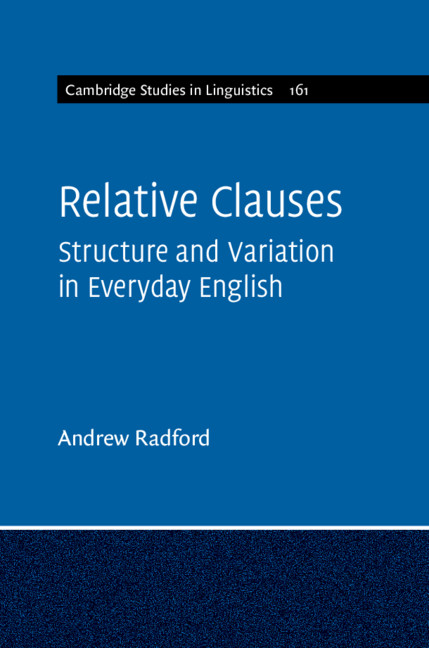
Relative Clauses

-
Select format
-
- Publisher:
- Cambridge University Press
- Publication date:
- 10 June 2019
- 20 June 2019
- ISBN:
- 9781108687744
- 9781108492805
- 9781108729680
- Dimensions:
- (228 x 152 mm)
- Weight & Pages:
- 0.59kg, 324 Pages
- Dimensions:
- (228 x 152 mm)
- Weight & Pages:
- 0.48kg, 328 Pages
You may already have access via personal or institutional login
Show more authors 
You may already have access via personal or institutional login
Book description
Using novel examples from live, unscripted radio/TV broadcasts and the internet, this path-breaking book will force us to reconsider the nature of everyday English and its complex interplay of syntactic, pragmatic, sociolinguistic and psycholinguistic factors. Uncovering unusual types of non-standard relative clauses, Andrew Radford develops theoretically sophisticated analyses in an area that has traditionally hardly been touched on: that of nonstandard (yet not clearly dialectal) variation in English. Making sense of a huge amount of data, the book demonstrates that some types of non-standard relative clauses have a complex syntactic structure of their own in which the relation between the relative clause and its antecedent is either syntactically encoded or pragmatic in nature, while others come about as a result of hypercorrection, and yet others arise from processing errors.
Contents
Contents
Metrics
Altmetric attention score
Full text views
Full text views helpTotal number of HTML views: 0
Total number of PDF views: 0 *
 Loading metrics...
* Views captured on Cambridge Core between #date#. This data will be updated every 24 hours.
Usage data cannot currently be displayed.
Accessibility standard: Unknown
Why this information is here
This section outlines the accessibility features of this content - including support for screen readers, full keyboard navigation and high-contrast display options. This may not be relevant for you.
Accessibility Information
Accessibility compliance for the HTML of this book is currently unknown and may be updated in the future.