Remote Compositional Analysis

-
Select format
-
- Publisher:
- Cambridge University Press
- Publication date:
- 15 November 2019
- 28 November 2019
- ISBN:
- 9781316888872
- 9781107186200
- Dimensions:
- (247 x 174 mm)
- Weight & Pages:
- 1.45kg, 652 Pages
- Dimensions:
- Weight & Pages:
You may already have access via personal or institutional login
Show more authors 
You may already have access via personal or institutional login
Book description
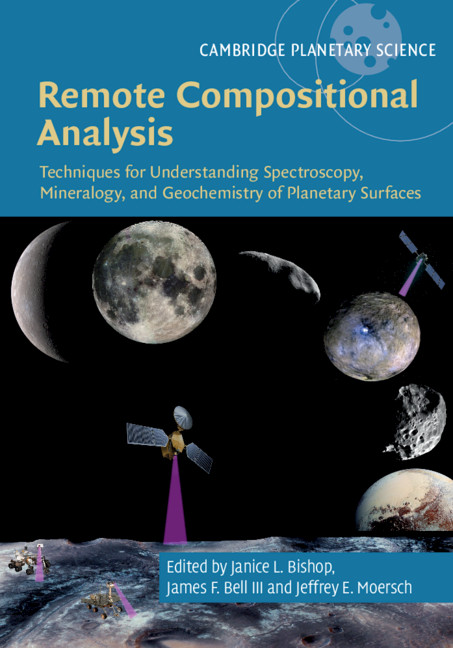
How do planetary scientists analyze and interpret data from laboratory, telescopic, and spacecraft observations of planetary surfaces? What elements, minerals, and volatiles are found on the surfaces of our Solar System's planets, moons, asteroids, and comets? This comprehensive volume answers these topical questions by providing an overview of the theory and techniques of remote compositional analysis of planetary surfaces. Bringing together eminent researchers in Solar System exploration, it describes state-of-the-art results from spectroscopic, mineralogical, and geochemical techniques used to analyze the surfaces of planets, moons, and small bodies. The book introduces the methodology and theoretical background of each technique, and presents the latest advances in space exploration, telescopic and laboratory instrumentation, and major new work in theoretical studies. This engaging volume provides a comprehensive reference on planetary surface composition and mineralogy for advanced students, researchers, and professional scientists.
Reviews
‘… provides a thoroughly updated entry point to the field, covering the techniques used on missions from Mercury to Pluto and almost everywhere in between … Researchers will appreciate the copious end-of-chapter references (chapter 3 alone provides 132 citations). Though the density of information may be intimidating to novices, libraries supporting graduate astronomy programs should certainly acquire this book.’
S. G. Decker Source: Choice
Contents
Contents
Metrics
Altmetric attention score
Full text views
Full text views helpTotal number of HTML views: 0
Total number of PDF views: 0 *
 Loading metrics...
* Views captured on Cambridge Core between #date#. This data will be updated every 24 hours.
Usage data cannot currently be displayed.
Accessibility standard: Unknown
Why this information is here
This section outlines the accessibility features of this content - including support for screen readers, full keyboard navigation and high-contrast display options. This may not be relevant for you.
Accessibility Information
Accessibility compliance for the HTML of this book is currently unknown and may be updated in the future.