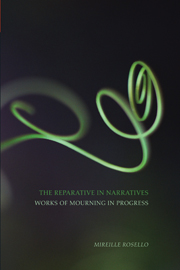
The Reparative in Narratives

-
The digital format of this book is no longer available to purchase from Cambridge Core. Other formats may be available.
-
Select format
-
- Publisher:
- Liverpool University Press
- Publication date:
- 05 June 2015
- 31 January 2010
- ISBN:
- 9781846315916
- 9781846312205
- Dimensions:
- Weight & Pages:
- 00kg,
- Dimensions:
- Weight & Pages:
You may already have access via personal or institutional login
Show more authors 
You may already have access via personal or institutional login
Book description
The authors studied in this book can be visualized as the islands that constitute an unknown, fragile and trembling literary and cultural Francophone archipelago. The archipelago does not appear on any map, in the middle of an ocean whose name we already know. No Francophone anthology would put these authors together as a matter of course because what connects them is a narrative grammar rather than a national origin or even a language. Yet, their writing techniques and their apprehension of the real (the ways in which they know and name the world) both reflect and actively participate in our evolving perception of what Gayatri Spivak calls the 'planet'. The Reparative in Narratives argues that argue that they repair trauma through writing. One description of these awe-inspiring, tender and sometimes horrifying tales is that their narrators are survivors who have experienced and sometimes inflicted unspeakable acts of violence. And yet, ultimately, despair, nihilism, cynicism or silenceare never the consequences of their encounter with what some quickly call evil. The traumatic event has not killed them and has not killed their desire to write or perform, although the decidedly altered life that they live in the aftermath of the disaster forces them to become different types of storytellers. They are the first-person narrators of their story, and their narration reinvents them as speaking subjects. In turn, this requires that we accept new reading pacts. That pact is a temporal and geographical signature: the reparative narrative needs readers prepared to accept that healing belongs to the realm of possibilities and that exposure and denunciation do not exhaust the victim's range of possibilities. Rosello contends that this context-specific yet repeating pattern constitutes a response to the contemporary figuration of both globalized and extremely localized types of traumatic memories.
Reviews
"Engagingly written and brilliantly argued, this is a landmark work that will shape critical thinking on memory and colonialism in France and beyond.'"
Source: French Studies, vol 65, no 2
Contents
Contents
Metrics
Full text views
Full text views helpTotal number of HTML views: 0
Total number of PDF views: 0 *
 Loading metrics...
* Views captured on Cambridge Core between #date#. This data will be updated every 24 hours.
Usage data cannot currently be displayed.
Accessibility standard: Unknown
Why this information is here
This section outlines the accessibility features of this content - including support for screen readers, full keyboard navigation and high-contrast display options. This may not be relevant for you.
Accessibility Information
Accessibility compliance for the PDF of this book is currently unknown and may be updated in the future.