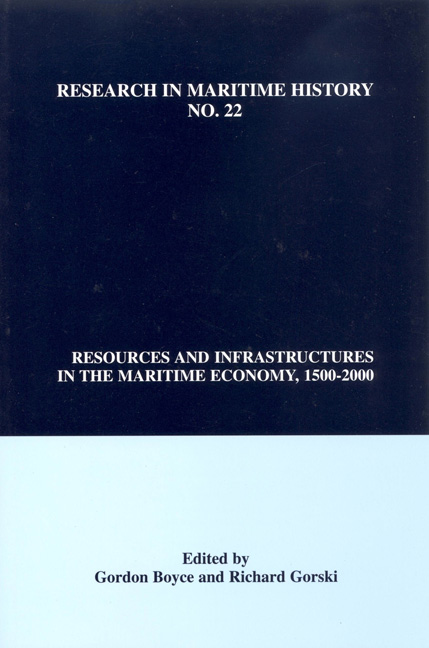
Resources and Infrastructures in the Maritime Economy, 1500–2000

-
The digital format of this book is no longer available to purchase from Cambridge Core. Other formats may be available.
-
Select format
-
- Publisher:
- Liverpool University Press
- Publication date:
- 05 May 2018
- 01 December 2002
- ISBN:
- 9781786949127
- 9780973007329
- Dimensions:
- Weight & Pages:
- Dimensions:
- Weight & Pages:
- Series:
- Research in Maritime History
You may already have access via personal or institutional login- Series:
- Research in Maritime History
Show more authors 
You may already have access via personal or institutional login
Book description
This book provides a study of both the physical and intangible frameworks that enabled maritime resources to flow and infrastructures to operate. The aim is to demonstrate the complexity and diversity of the legal, social, cultural, and institutional forces at work within maritime economics. Port development, planning, and policy-making constitute the physical frameworks, while agency structures and consular networks make up the non-physical factors under discussion. Both land and sea commodities are examined, including capital mobilised from other sectors, and a particularly pertinent maritime commodity, fish. Through case studies, theory-driven analysis, evidence from statistical data, and regional and national comparisons, it successfully illustrates the structure of resource flow and the shape of maritime economic activity on an international scale spanning the eighteenth, nineteenth, and twentieth centuries. Nations examined include Scotland, England, New Zealand, Italy, Denmark, plus several Nordic and Mediterranean states. The book consists of three sections: the first exploring intangible infrastructures and their components; the second, resource flow and economic development; and, finally, the physical infrastructures of the ports themselves.
Contents
Contents
Metrics
Altmetric attention score
Full text views
Full text views helpTotal number of HTML views: 0
Total number of PDF views: 0 *
 Loading metrics...
* Views captured on Cambridge Core between #date#. This data will be updated every 24 hours.
Usage data cannot currently be displayed.
Accessibility standard: Unknown
Why this information is here
This section outlines the accessibility features of this content - including support for screen readers, full keyboard navigation and high-contrast display options. This may not be relevant for you.
Accessibility Information
Accessibility compliance for the PDF of this book is currently unknown and may be updated in the future.