Scribal Correction and Literary Craft

-
Select format
-
- Publisher:
- Cambridge University Press
- Publication date:
- 05 November 2014
- 06 November 2014
- ISBN:
- 9781139923279
- 9781107076228
- 9781107431683
- Dimensions:
- (228 x 152 mm)
- Weight & Pages:
- 0.68kg, 368 Pages
- Dimensions:
- (229 x 152 mm)
- Weight & Pages:
- 0.54kg, 368 Pages
You may already have access via personal or institutional login- Series:
- Cambridge Studies in Medieval Literature (91)
Show more authors 
You may already have access via personal or institutional login
Book description
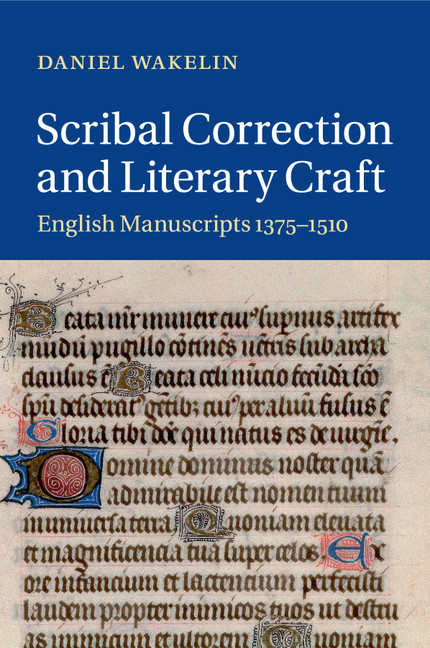
This extensive survey of scribal correction in English manuscripts explores what correcting reveals about attitudes to books, language and literature in late medieval England. Daniel Wakelin surveys a range of manuscripts and genres, but focuses especially on poems by Chaucer, Hoccleve and Lydgate, and on prose works such as chronicles, religious instruction and practical lore. His materials are the variants and corrections found in manuscripts, phenomena usually studied only by editors or palaeographers, but his method is the close reading and interpretation typical of literary criticism. From the corrections emerge often overlooked aspects of English literary thinking in the late Middle Ages: scribes, readers and authors seek, though often fail to achieve, invariant copying, orderly spelling, precise diction, regular verse and textual completeness. Correcting reveals their impressive attention to scribal and literary craft - its rigour, subtlety, formalism and imaginativeness - in an age with little other literary criticism in English.
Awards
Co-Winner of the 2015 George A. and Jean S. DeLong Book History Prize, Society for the History of Authorship, Reading and Publishing (SHARP)
Contents
Contents
Metrics
Altmetric attention score
Full text views
Full text views helpTotal number of HTML views: 0
Total number of PDF views: 0 *
 Loading metrics...
* Views captured on Cambridge Core between #date#. This data will be updated every 24 hours.
Usage data cannot currently be displayed.
Accessibility standard: Unknown
Why this information is here
This section outlines the accessibility features of this content - including support for screen readers, full keyboard navigation and high-contrast display options. This may not be relevant for you.
Accessibility Information
Accessibility compliance for the HTML of this book is currently unknown and may be updated in the future.