
Skip to main content Accessibility help
×
  • Cited by 5
    • Volume 20
      Show more authors
    • You may already have access via personal or institutional login
    • Select format
    • Publisher:
      Intersentia
      Publication date:
      25 September 2018
      27 February 2017
      ISBN:
      9781780685014
      9781780683874
      Dimensions:
      Weight & Pages:
      Dimensions:
      Weight & Pages:
    You may already have access via personal or institutional login
  • Selected: Digital
    Add to cart View cart Buy from Cambridge.org

    Book description

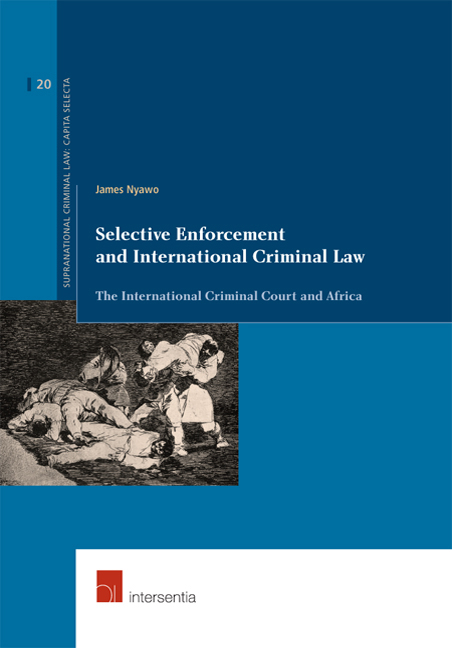
    The dynamics of enforcing international criminal justice through the International Criminal Court (ICC) has become a challenging exercise in Africa. At times the uneasy relationship between the ICC, the African Union and a few influential African states has given rise to concerns about the future of international criminal justice in general, and in Africa in particular. Still, the enthusiasts for international criminal justice as enforced by the ICC, interpret the challenges that the ICC is encountering in Africa as part of the growing pains of a new institution in the international system. The distractors have already prepared the ICC's obituary. One of the criticisms levelled against the ICC, and which is the motivation for, and central theme behind, this book is that it has morphed and ceased to be an independent legal institution instead becoming a political tool utilised by politically powerful states in the West against their political opponents in Africa. More specifically the Court is alleged to be selectively enforcing international criminal law by merely officially opening investigations and prosecutions in Africa. Although this book recognises that selective implementation of criminal justice is acceptable both at the domestic and international level, it analyses the legal and political factors behind the Court's focus on international crimes committed in Africa when there are other situations to which the court should potentially turn its attention, such as in Syria, Afghanistan or the Occupied Palestinian Territories. The book seeks to determine whether such a focus implies that Africa has the monopoly over international crimes or whether African victims or perpetrators are any different from those in the Middle East? In addition the book attempts to uncover the basis and the validity of the African Union and some African states' criticisms of the ICC. James Nyawo holds a Doctorate from the School of Law at Middlesex University, UK. He previously held the position of Visiting Lecturer with the Department of International & Cooperative Law at Khartoum University, Sudan and is currently an External Research Fellow at the International Victimology Institute (INTERVICT), Tilburg, Netherlands. He has worked as a humanitarian practitioner and consultant with national, international and UN agencies working with landmine victims, internally displaced persons and refugees in Angola, Uganda (North), South Sudan and Sudan.

    Refine List

    Actions for selected content:

    Select all | Deselect all
    • View selected items
    • Export citations
    • Download PDF (zip)
    • Save to Kindle
    • Save to Dropbox
    • Save to Google Drive

    Save Search

    You can save your searches here and later view and run them again in "My saved searches".

    Please provide a title, maximum of 40 characters.
    ×

    Contents

    Metrics

    Full text views

    Total number of HTML views: 0
    Total number of PDF views: 0 *
    Loading metrics...

    Book summary page views

    Total views: 0 *
    Loading metrics...

    * Views captured on Cambridge Core between #date#. This data will be updated every 24 hours.

    Usage data cannot currently be displayed.

    Accessibility standard: Unknown

    Why this information is here

    This section outlines the accessibility features of this content - including support for screen readers, full keyboard navigation and high-contrast display options. This may not be relevant for you.

    Accessibility Information

    Accessibility compliance for the PDF of this book is currently unknown and may be updated in the future.
