Self-Making Man

-
Select format
-
- Publisher:
- Cambridge University Press
- Publication date:
- 22 June 2017
- 26 June 2017
- ISBN:
- 9781139149341
- 9781107022942
- 9781108714785
- Dimensions:
- (228 x 152 mm)
- Weight & Pages:
- 0.79kg, 478 Pages
- Dimensions:
- (229 x 152 mm)
- Weight & Pages:
- 0.65kg, 478 Pages
You may already have access via personal or institutional login
Show more authors 
You may already have access via personal or institutional login
Book description
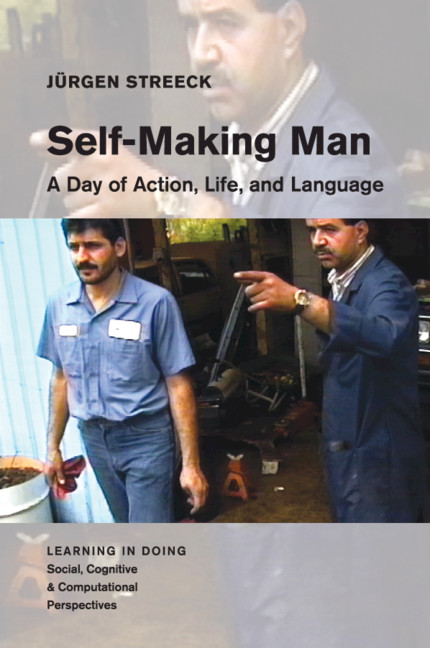
This book portrays one day in the communicative life of the owner of an auto repair-shop in Texas. He walks, looks, points, shows and explains engines, makes sense by gesture, speaks, manages, makes his life-world, and in the process reproduces social structures and himself as individual. Self-Making Man is the first comprehensive study of a communicating person; it reveals socially shared and personal practices, as well as improvisational actions by which a person inhabits and makes sense of the world with others. After decades of discussion on embodiment, this study is the first to investigate one body in its full range of communicative activities. Grounded in phenomenology and committed to the methodological rigor of context analysis and conversation analysis, Self-Making Man departs radically from contemporary research practice: it shows that, to take embodiment in human interaction seriously, we must conceive of it as individuation and organic, self-sustaining life: as autopoeisis.
Reviews
‘Potentially unique among gesture studies monographs in sensing the richness of gesture’s relationality is Jürgen Streeck’s Self-Making Man, which offers an interdisciplinary approach to gesture interweaving microethnography, sociology, cognitive linguistics/semiotics, embodied interaction, ecological psychology, enaction theory, neuroscience, and phenomenology. In an academic area increasingly concerned with large corpora, sophisticated statistical tools, analytical interfaces, high numbers of naïve participants, and clear-cut boundaries between researcher and researched, Streeck’s book is also unique in its focus on one automechanic’s making and understanding of gestures within a relational environment that openly involves the researcher and evolves over the course of a single day.’
Simon Harrison Source: Phenomenology and the Cognitive Sciences
Contents
Contents
Metrics
Altmetric attention score
Full text views
Full text views helpTotal number of HTML views: 0
Total number of PDF views: 0 *
 Loading metrics...
* Views captured on Cambridge Core between #date#. This data will be updated every 24 hours.
Usage data cannot currently be displayed.
Accessibility standard: Unknown
Why this information is here
This section outlines the accessibility features of this content - including support for screen readers, full keyboard navigation and high-contrast display options. This may not be relevant for you.
Accessibility Information
Accessibility compliance for the HTML of this book is currently unknown and may be updated in the future.