Self-Organized Criticality

-
Select format
-
- Publisher:
- Cambridge University Press
- Publication date:
- 05 November 2012
- 13 January 1998
- ISBN:
- 9780511622717
- 9780521483711
- Dimensions:
- Weight & Pages:
- Dimensions:
- (228 x 152 mm)
- Weight & Pages:
- 0.28kg, 170 Pages
You may already have access via personal or institutional login
Show more authors 
You may already have access via personal or institutional login
Book description
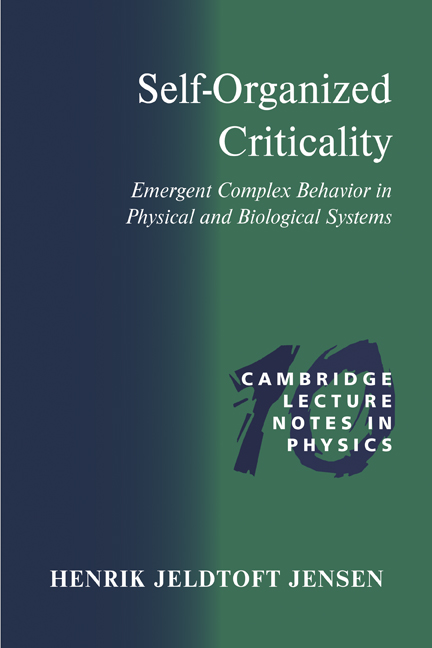
Self-organized criticality (SOC) is based upon the idea that complex behavior can develop spontaneously in certain multi-body systems whose dynamics vary abruptly. This book is a clear and concise introduction to the field of self-organized criticality, and contains an overview of the main research results. The author begins with an examination of what is meant by SOC, and the systems in which it can occur. He then presents and analyzes computer models to describe a number of systems, and he explains the different mathematical formalisms developed to understand SOC. The final chapter assesses the impact of this field of study, and highlights some key areas of new research. The author assumes no previous knowledge of the field, and the book contains several exercises. It will be ideal as a textbook for graduate students taking physics, engineering, or mathematical biology courses in nonlinear science or complexity.
Reviews
‘All in all, I enjoyed the book and found the effort of reading it stimulating and worthwhile.’
A. C. Newell Source: Journal of Fluid Mechanisms
Contents
Contents
Metrics
Altmetric attention score
Full text views
Full text views helpTotal number of HTML views: 0
Total number of PDF views: 0 *
 Loading metrics...
* Views captured on Cambridge Core between #date#. This data will be updated every 24 hours.
Usage data cannot currently be displayed.
Accessibility standard: Unknown
Why this information is here
This section outlines the accessibility features of this content - including support for screen readers, full keyboard navigation and high-contrast display options. This may not be relevant for you.
Accessibility Information
Accessibility compliance for the PDF of this book is currently unknown and may be updated in the future.