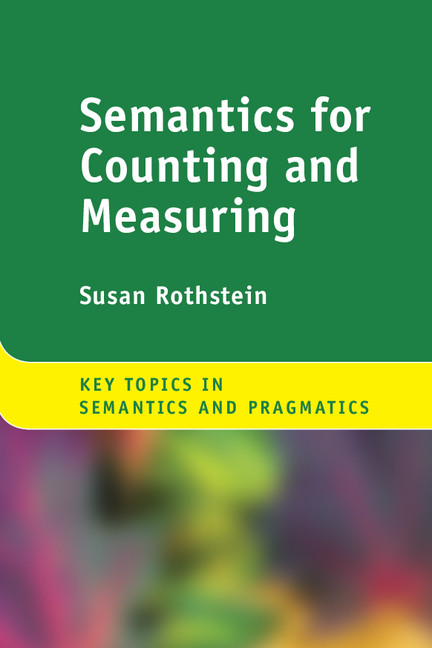
Semantics for Counting and Measuring

-
Select format
-
- Publisher:
- Cambridge University Press
- Publication date:
- 20 April 2017
- 06 April 2017
- ISBN:
- 9780511734830
- 9781107001275
- 9780521171823
- Dimensions:
- (216 x 138 mm)
- Weight & Pages:
- 0.5kg, 290 Pages
- Dimensions:
- (216 x 140 mm)
- Weight & Pages:
- 0.4kg, 290 Pages
You may already have access via personal or institutional login- Subjects:
- Language and Linguistics, Semantics and Pragmatics
Show more authors 
You may already have access via personal or institutional login
Book description
The use of numerals in counting differs quite dramatically across languages. Some languages grammaticalise a contrast between count nouns (three cats, three books) vs 'non-count' or mass nouns (milk, mud), marking this distinction in different ways. Others use a system of numeral classifiers, while yet others use a combination of both. This book draws attention to the contrast between counting and measuring, and shows that it is central to our understanding of how we use numerical expressions, classifiers and count nouns in different languages. It reviews some of the more recent major linguistic results in the semantics of numericals, counting and measuring, and theories of the mass/count distinction, and presents the author's new research on the topic. The book draws heavily on crosslinguistic research, and presents in-depth case studies of the mass/count distinction and counting and measuring in a number of typologically unrelated languages. It also includes chapters on classifiers, constructions and adjectival uses of measure phrases.
Reviews
‘At the interface between cognition, language, and ontology, traditional views on mass vs count are seriously challenged by languages such as Hungarian, Brazilian Portuguese and Yudja. Rothstein brilliantly deals with these difficult issues by distinguishing counting and measuring as two types of semantic operation. A work of great breadth that opens new research avenues.'
Roberta Pires de Oliveira - National Council for Scientific and Technological Development (CNPq), Brazil and Universidade Federal de Santa Catarina, Brazil
Contents
Contents
Metrics
Altmetric attention score
Full text views
Full text views helpTotal number of HTML views: 0
Total number of PDF views: 0 *
 Loading metrics...
* Views captured on Cambridge Core between #date#. This data will be updated every 24 hours.
Usage data cannot currently be displayed.
Accessibility standard: Unknown
Why this information is here
This section outlines the accessibility features of this content - including support for screen readers, full keyboard navigation and high-contrast display options. This may not be relevant for you.
Accessibility Information
Accessibility compliance for the HTML of this book is currently unknown and may be updated in the future.