
Skip to main content Accessibility help
×
  • Cited by 8
    • Show more authors
    • You may already have access via personal or institutional login
    • Select format
    • Publisher:
      Cambridge University Press
      Publication date:
      09 April 2021
      08 April 2021
      ISBN:
      9781108915304
      9781108843379
      9781108824385
      Dimensions:
      (216 x 138 mm)
      Weight & Pages:
      0.52kg, 322 Pages
      Dimensions:
      (216 x 139 mm)
      Weight & Pages:
      0.43kg, 324 Pages
    You may already have access via personal or institutional login
  • Selected: Digital
    Add to cart View cart Buy from Cambridge.org

    Book description

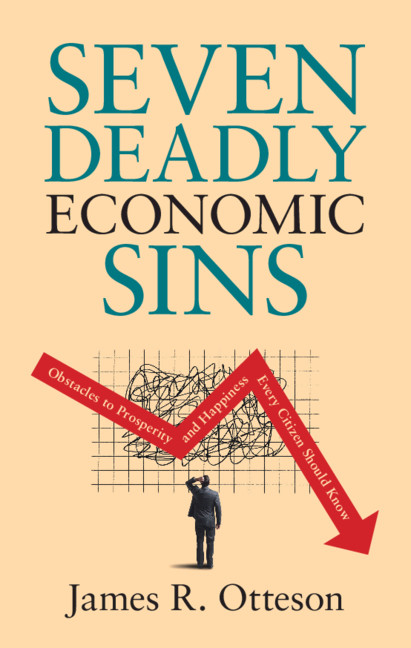
    You have heard of the Seven Deadly Sins: pride, greed, lust, envy, gluttony, wrath, and sloth. Each is a natural human weakness that impedes happiness. In addition to these vices, however, there are economic sins as well. And they, too, wreak havoc on our lives and in society. They can seem intuitively compelling, yet they lead to waste, loss, and forgone prosperity. In this thoughtful and compelling book, James Otteson tells the story of seven central economic fallacies, explaining why they are fallacies, why believing in them leads to mistakes and loss, and how exorcizing them from our thinking can help us avoid costly errors and enable us to live in peace and prosperity.

    Reviews

    'Otteson, a philosopher, has written for non-economists the best short introduction to economics, and to a wider political economy. It is lucid, generous, open-handed yet thorough, and solidly based scientifically. Come to think of it, most economists should read it, too. They might stop using 'philosophical' as a term of contempt, and get back to an Adam-Smithian depth of understanding.'

    Deirdre McCloskey - University of Illinois, Chicago

    'The word 'Deadly' in Otteson's title is no exaggeration. The great frustrations and famines of recent decades have been failures of state management, rather than contradictions of capitalism. Otteson's contribution is to explain why these catastrophes are the result of good intentions, moral misunderstandings, and confusions about what markets can do. As society moves toward reopening the economy and restoring prosperity, this book is essential reading for what might be done, what can't be done, and the things that lie in between.'

    Michael C. Munger - Duke University

    'James Otteson is not just a scholar of markets, he is their Mozart. In this compelling tour, Otteson lays out economic principles the way Mozart laid out a sonata. Otteson orders and presents key principles in a fashion any American can understand and appreciate.'

    Amity Shlaes - author of Great Society

    James R. Otteson’s Seven Deadly Economic Sins is a fine effort to introduce readers to the basic principles of market economics. The hamartiological framing - the 'sins' are bad assumptions about how markets work - is part of the author’s effort to make the subject more engaging than a typical treatise on economics. It works. Mr. Otteson, a professor of business ethics at Notre Dame, writes with an apt combination of casual wit and rigorous logic."

    Barton Swain Source: The Wall Street Journal

    Refine List

    Actions for selected content:

    Select all | Deselect all
    • View selected items
    • Export citations
    • Download PDF (zip)
    • Save to Kindle
    • Save to Dropbox
    • Save to Google Drive

    Save Search

    You can save your searches here and later view and run them again in "My saved searches".

    Please provide a title, maximum of 40 characters.
    ×

    Contents

    Metrics

    Altmetric attention score

    Full text views

    Total number of HTML views: 0
    Total number of PDF views: 0 *
    Loading metrics...

    Book summary page views

    Total views: 0 *
    Loading metrics...

    * Views captured on Cambridge Core between #date#. This data will be updated every 24 hours.

    Usage data cannot currently be displayed.

    Accessibility standard: Unknown

    Why this information is here

    This section outlines the accessibility features of this content - including support for screen readers, full keyboard navigation and high-contrast display options. This may not be relevant for you.

    Accessibility Information

    Accessibility compliance for the HTML of this book is currently unknown and may be updated in the future.
