
Skip to main content Accessibility help
×
  • Cited by 11
    • Show more authors
    • You may already have access via personal or institutional login
    • Select format
    • Publisher:
      Cambridge University Press
      Publication date:
      08 December 2022
      22 December 2022
      ISBN:
      9781009216746
      9781009216739
      9781009216753
      Dimensions:
      (229 x 152 mm)
      Weight & Pages:
      0.56kg, 278 Pages
      Dimensions:
      (229 x 152 mm)
      Weight & Pages:
      0.41kg, 276 Pages
    You may already have access via personal or institutional login
  • Selected: Digital
    Add to cart View cart Buy from Cambridge.org

    Book description

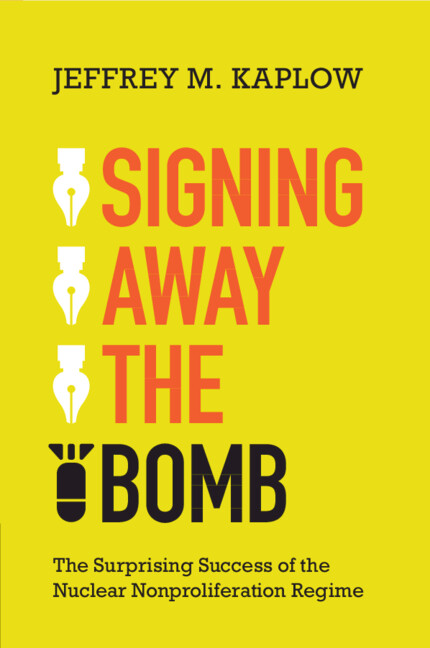
    For more than fifty years, the Treaty on the Non-Proliferation of Nuclear Weapons (NPT) and the wider nuclear nonproliferation regime have worked to prevent the spread of nuclear weapons. Analysts and pundits have often viewed the regime with skepticism, repeatedly warning that it is on the brink of collapse, and the NPT lacks many of the characteristics usually seen in effective international institutions. Nevertheless, the treaty continues to enjoy near-universal membership and high levels of compliance. This is the first book to explain why the nonproliferation regime has been so successful, bringing to bear declassified documents, new data on regime membership and weapons pursuit, and a variety of analytic approaches. It offers important new insights for scholars of nuclear proliferation and international security institutions, and for policymakers seeking to strengthen the nonproliferation regime and tighten international constraints on the spread of nuclear weapons.

    Reviews

    ‘This book makes an essential contribution to our understanding of nuclear nonproliferation. Many studies of nuclear proliferation have either ignored the Non-Proliferation Treaty (NPT) or found the treaty to be ineffective. Jeffrey Kaplow persuasively demonstrates that those who dismiss the NPT get it wrong. By elaborating on theories about how international institutions provide information, examining government deliberations in some key cases, and employing multiple quantitative tests, Kaplow shows that the NPT has slowed proliferation while also highlighting other features of the nonproliferation regime that have been less constraining, including the inconsistency of enforcement against violators and the role of the NPT in fostering nuclear latency. Kaplow's conclusion that the nonproliferation regime has been “both successful and fragile” points to a need for states to renew their efforts to strengthen the NPT.'

    Jeffrey W. Knopf - Professor and Program Chair, Nonproliferation and Terrorism Studies, Middlebury Institute of International Studies at Monterey

    Refine List

    Actions for selected content:

    Select all | Deselect all
    • View selected items
    • Export citations
    • Download PDF (zip)
    • Save to Kindle
    • Save to Dropbox
    • Save to Google Drive

    Save Search

    You can save your searches here and later view and run them again in "My saved searches".

    Please provide a title, maximum of 40 characters.
    ×

    Contents

    Metrics

    Altmetric attention score

    Full text views

    Total number of HTML views: 0
    Total number of PDF views: 0 *
    Loading metrics...

    Book summary page views

    Total views: 0 *
    Loading metrics...

    * Views captured on Cambridge Core between #date#. This data will be updated every 24 hours.

    Usage data cannot currently be displayed.

    Accessibility standard: Unknown

    Why this information is here

    This section outlines the accessibility features of this content - including support for screen readers, full keyboard navigation and high-contrast display options. This may not be relevant for you.

    Accessibility Information

    Accessibility compliance for the HTML of this book is currently unknown and may be updated in the future.
