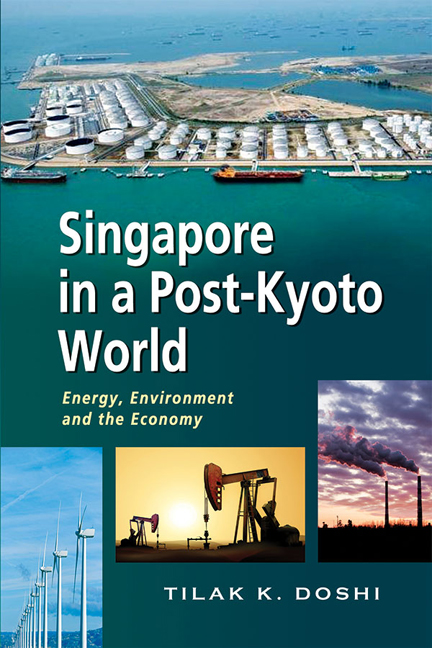
Singapore in a Post-Kyoto World

-
Select format
-
- Publisher:
- ISEAS–Yusof Ishak Institute
- Publication date:
- 19 May 2017
- 06 June 2015
- ISBN:
- 9789814620673
- 9789814620390
- Dimensions:
- Weight & Pages:
- Dimensions:
- Weight & Pages:
- 00kg,
- Subjects:
- Engineering, Energy Technology
- Series:
- ISEAS Energy Series
You may already have access via personal or institutional login- Subjects:
- Engineering, Energy Technology
- Series:
- ISEAS Energy Series
Show more authors 
You may already have access via personal or institutional login
Book description
Singapore had, by the 1980s, emerged as one of the world's great oil refining and trading centres, with the 'East of Suez' region within its sphere of influence. The city-state's policy-making went against the grain in much of its practice of economic development. It ensured that energy products were bought and sold in the domestic market at essentially global prices, in contrast to the common practice in developing countries of subsidizing energy fuels for social equity. Without a drop of oil of its own, Singapore also managed to attract large foreign investments in the capital-intensive oil refining and petrochemical manufacturing sectors in an export-oriented strategy. This was at a time when governments of most newly independent countries were busy trying to promote heavy industry by protectionist trade policies and import-substituting industrialization. The purpose of this book is two-fold. It is intended to introduce a host of energy-related discussions relevant to a wider group of readers who do not 'do energy' for a living, yet are keenly interested in understanding the many complexities of modern industrial societies which need to balance economic, environmental, and security priorities of ordinary citizens. It is also meant to serve as an introductory assessment of key energy-related issues, with a particular relevance for small advanced countries such as Singapore.
Contents
Contents
Metrics
Full text views
Full text views helpTotal number of HTML views: 0
Total number of PDF views: 0 *
 Loading metrics...
* Views captured on Cambridge Core between #date#. This data will be updated every 24 hours.
Usage data cannot currently be displayed.
Accessibility standard: Unknown
Why this information is here
This section outlines the accessibility features of this content - including support for screen readers, full keyboard navigation and high-contrast display options. This may not be relevant for you.
Accessibility Information
Accessibility compliance for the PDF of this book is currently unknown and may be updated in the future.