
Skip to main content Accessibility help
×
  • Cited by 9
    • Show more authors
    • You may already have access via personal or institutional login
    • Select format
    • Publisher:
      Cambridge University Press
      Publication date:
      31 October 2019
      21 November 2019
      ISBN:
      9781108768887
      9781108488075
      9781108738415
      Dimensions:
      (247 x 174 mm)
      Weight & Pages:
      0.97kg, 484 Pages
      Dimensions:
      (244 x 170 mm)
      Weight & Pages:
      0.85kg, 486 Pages
    You may already have access via personal or institutional login
  • Selected: Digital
    Add to cart View cart Buy from Cambridge.org

    Book description

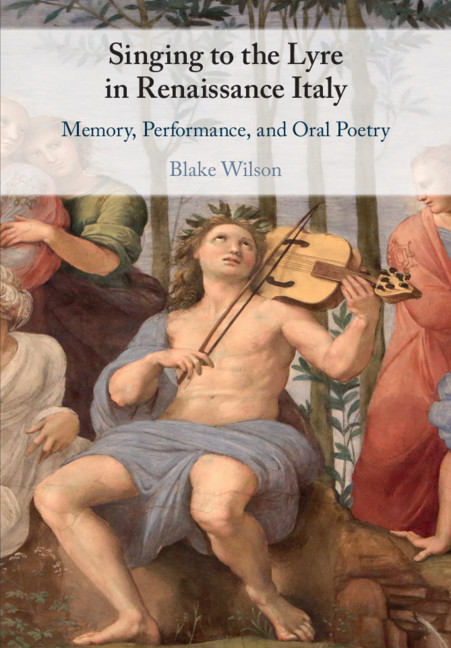
    A primary mode for the creation and dissemination of poetry in Renaissance Italy was the oral practice of singing and improvising verse to the accompaniment of a stringed instrument. Singing to the Lyre is the first comprehensive study of this ubiquitous practice, which was cultivated by performers ranging from popes, princes, and many artists, to professionals of both mercantile and humanist background. Common to all was a strong degree of mixed orality based on a synergy between writing and the oral operations of memory, improvisation, and performance. As a cultural practice deeply rooted in language and supported by ancient precedent, cantare ad lyram (singing to the lyre) is also a reflection of Renaissance cultural priorities, including the status of vernacular poetry, the study and practice of rhetoric, the oral foundations of humanist education, and the performative culture of the courts reflected in theatrical presentations and Castiglione's Il cortegiano.

    Awards

    Choice Outstanding Academic Title 2020, Choice Reviews.

    Reviews

    ‘For many years Blake Wilson has tantalised us with a string of articles on singers of improvised verse in Italy in the Middle Ages and early Renaissance. Now, with this important and wide-ranging book, we come to know the world of the cantarini, from simple street singers to accomplished improvisers of versified epics performing in public, to refined singers ‘to the lyre', without whom no festivity or banquet was complete. Drawing on a wide range of materials, Wilson is able to trace the lives of the famous canterini in surprising detail. Along the way, we learn of the longevity of the chanson de geste; the attraction of blind singers to the profession; the role of memory in improvisation; the art of performing extempore verse; the question of improvised verse as intellectual property; and above all, the central figure of Orpheus, in philosophy, religion, poetry, theatre, and music.'

    Bonnie J. Blackburn - Wolfson College, Oxford

    Refine List

    Actions for selected content:

    Select all | Deselect all
    • View selected items
    • Export citations
    • Download PDF (zip)
    • Save to Kindle
    • Save to Dropbox
    • Save to Google Drive

    Save Search

    You can save your searches here and later view and run them again in "My saved searches".

    Please provide a title, maximum of 40 characters.
    ×

    Contents

    Metrics

    Altmetric attention score

    Full text views

    Total number of HTML views: 0
    Total number of PDF views: 0 *
    Loading metrics...

    Book summary page views

    Total views: 0 *
    Loading metrics...

    * Views captured on Cambridge Core between #date#. This data will be updated every 24 hours.

    Usage data cannot currently be displayed.

    Accessibility standard: Unknown

    Why this information is here

    This section outlines the accessibility features of this content - including support for screen readers, full keyboard navigation and high-contrast display options. This may not be relevant for you.

    Accessibility Information

    Accessibility compliance for the HTML of this book is currently unknown and may be updated in the future.
