
Skip to main content Accessibility help
×
  • Cited by 33
    • Show more authors
    • You may already have access via personal or institutional login
    • Select format
    • Publisher:
      Cambridge University Press
      Publication date:
      18 December 2014
      22 December 2014
      ISBN:
      9781139381345
      9781107031210
      9781107658967
      Dimensions:
      (228 x 152 mm)
      Weight & Pages:
      0.56kg, 294 Pages
      Dimensions:
      (228 x 152 mm)
      Weight & Pages:
      0.4kg, 296 Pages
    You may already have access via personal or institutional login
  • Selected: Digital
    Add to cart View cart Buy from Cambridge.org

    Book description

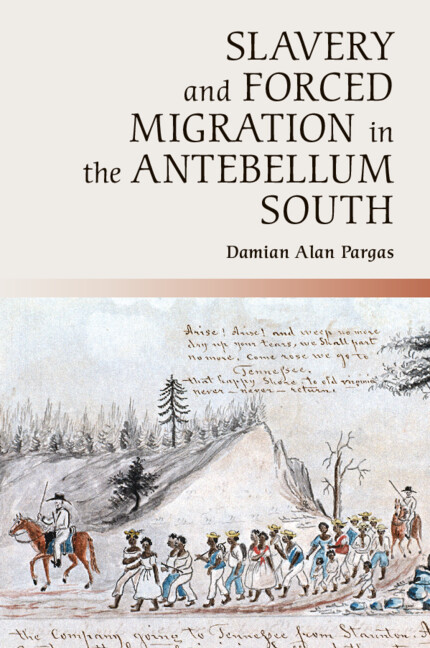
    American slavery in the antebellum period was characterized by a massive wave of forced migration as millions of slaves were moved across state lines to the expanding southwest, scattered locally, and sold or hired out in towns and cities across the South. This book sheds new light on domestic forced migration by examining the experiences of American-born slave migrants from a comparative perspective. Juxtaposing and contrasting the experiences of long-distance, local, and urban slave migrants, it analyzes how different migrant groups anticipated, reacted to, and experienced forced removal, as well as how they adapted to their new homes.

    Reviews

    'While much has been written about African slaves’ experiences upon arriving in Colonial America, Pargas’s work investigates the largely understudied subject of American-born slaves and how their experiences as migrants affected their life experiences and identity formation. By addressing this previously ignored area of history, the book better informs one’s understanding of slavery, of the wide variety of slaves' experiences, and of slaves' struggles for agency over their own lives in the pre-Civil War South. Summing up: highly recommended.'

    T. K. Byron Source: Choice

    'Deeply researched, elegantly conceived, and adroitly argued, Damian Alan Pargas’s book is a fine-grained study of enslaved people’s responses to the changing political economy of slavery in the United States between 1800 and 1860 … This is a widely accessible book that skillfully blends history and historiography. Woven through the analysis is a rebuttal to claims that slaveholders were guided by a paternalistic duty to their bondspersons … the nimbleness with which Pargas analyzes his subjects and the force and clarity of the narrative contributes a nuanced revision to a central process of nineteenth-century African American history.'

    Calvin Schermerhorn Source: The Journal of American History

    'In this much needed new study, Damian Alan Pargas recognizes the importance of all forms of forced migration and the effect it had on millions of enslaved people. For decades now, many historians have thought of the domestic slave trade as only the long-distance, interstate sale and transfer of slaves from the upper South to the lower South. One of the strongest points of this book is his inclusion of the even larger local slave trade as part of the domestic slave trade.'

    Steven Deyle Source: The American Historical Review

    'Slavery and Forced Migration in the Antebellum South synthesizes an impressive array of primary and secondary scholarship in ways helpful to new and lay audiences. Pargas's bibliography is a marvel. In addition, some of the questions begged by his analysis ought to prompt a new generation of scholars to probe the cultural, social, and political entrapment of millions of Americans in cycles of forced migration and then, in a rush hastened by war, the varied situations of freed people building their lives anew.'

    Susan Eva O’Donovan Source: Southern Spaces

    'Damian Alan Pargas has produced a valuable volume on the many aspects of the forced migration of enslaved people in the antebellum South … well documented, this volume should high on a list of mandatory reading for classes on slavery in the antebellum South, sociology, and southern history in general.'

    Charles Vincent Source: The Journal of Southern History

    Refine List

    Actions for selected content:

    Select all | Deselect all
    • View selected items
    • Export citations
    • Download PDF (zip)
    • Save to Kindle
    • Save to Dropbox
    • Save to Google Drive

    Save Search

    You can save your searches here and later view and run them again in "My saved searches".

    Please provide a title, maximum of 40 characters.
    ×

    Contents

    Bibliography
    III. Websites
    Documenting the American South. . Consulted Jan. 5, 2014.
    Digital Library on American Slavery. . Consulted Sept. 1, 2013.
    US GenWeb Archives. . Consulted Mar. 6, 2012.
    IV. Unpublished Literature
    Crawford, Stephen C. “Quantitative Memory: A Study of the WPA and Fisk University Slave Narrative Collections.” PhD dissertation, University of Chicago, Chicago, Ill., 1980.
    Sweig, Donald M. “Northern Virginia Slavery: A Statistical and Demographic Investigation.” Ph.D. dissertation, College of William and Mary, Williamsburg, Va., 1982.
    Wingfield, Charles L. “The Sugar Plantations of William J. Minor, 1830–1860.” M.A. thesis, Louisiana State University, Baton Rouge, 1950.
    V. Published Sources
    Abdy, E.S.Journal of a Residence and Tour in the United States of North America, from April 1833 to October 1834. First published 1835. Reprint New York: Negro Universities Press, 1969.
    Adams, Nehemiah. A South-Side View; or, Three Months at the South, in 1854. Boston: T.R. Marvin and B.B. Mussey & Co., 1854.
    Affleck, Thomas. The Cotton Plantation Record and Account Book, No. 2. Suitable for a Force of 80 Hands, or Under. Louisville: Morton & Griswold, 1852.
    Aime, Valcour. Plantation Diary of the Late Mr. Valcour Aime, Formerly the Proprietor of the Plantation known as the St. James Sugar Refinery, Situated in the Parish of St. James, and Now Owned by Mr. John Burnside. New Orleans: Clark & Hofeline, 1878.
    Albert, Octavia V. Rogers. Charlotte Brooks and Other Slaves. First published 1890. Reprint New York: Oxford University Press, 1998.
    Allen, William Frances. Slave Songs of the United States. New York: Simpson & Co., 1867.
    Anderson, William J.Life and Narrative of William J. Anderson, Twenty-Four Years a Slave. Chicago: Daily Tribune Book and Job Printing Office, 1857.
    Andrews, Ethan Allen. Slavery and the Domestic Slave Trade in the United States, in a Series of Letters Addressed to the Executive Committee of the American Union for the Relief and Improvement of the Colored Race. First published 1836. Reprint Freeport, N.Y.: Books for Libraries Press, 1971.
    Ashton, Susanna. “Slavery Imprinted: The Life and Narrative of William Grimes.” Early African American Print Culture. Edited by Cohen, Lara Langer and Stein, Jordan Alexander. Philadelphia: University of Pennsylvania Press, 2012.
    Bailey, David Thomas. “A Divided Prism: Two Sources of Black Testimony on Slavery.” Journal of Southern History 46 (Aug. 1980): 381–404.
    Ball, Charles. Fifty Years in Chains; Or, the Life of an American Slave. New York: H. Dayton, 1859.
    Bancroft, Frederic. Slave-Trading in the Old South. First published 1931. Reprint Columbia: University of South Carolina Press, 1996.
    Baptist, Edward E.Creating an Old South: Middle Florida’s Plantation Frontier Before the Civil War. Chapel Hill: University of North Carolina Press, 2001.
    Baptist, Edward E.. “‘Cuffy,’ ‘Fancy Maids’, and ‘One-Eyed Men’: Rape, Commodification, and the Domestic Slave Trade in the United States,” The American Historical Review 106 (Dec. 2001): 1619–50.
    Barton, Keith C. “’Good Cooks and Washers’: Slave Hiring, Domestic Labor, and the Market in Bourbon County, Kentucky,” Journal of American History 84 (Sept. 1997): 436–60.
    Bauer, Craig A.A Leader Among Peers: The Life and Times of Duncan Farrar Kenner. Lafayette: Center for Louisiana Studies, University of Southwestern Louisiana, 1993.
    Berlin, Ira. The Making of African America: The Four Great Migrations. New York: Viking, 2010.
    Berlin, Ira. Generations of Captivity: A History of African-American Slaves. Cambridge, Mass.: Harvard University Press, 2003.
    Berlin, Ira. Many Thousands Gone: The First Two Centuries of Slavery in North America. Cambridge, Mass.: Harvard University Press, 1998.
    Berlin, Ira, et al, eds. Freedom: A Documentary History of Emancipation, 1861–1867, Series I, Volume I. New York: Cambridge University Press, 1985.
    Berry, Daina Ramey. Swing the Sickle for the Harvest is Ripe: Gender and Slavery in Antebellum Georgia. Urbana: University of Illinois Press, 2007.
    Berry, Daina Ramey. “’We’m Fus’ Rate Bargain’: Value, Labor, and Price in a Georgia Slave Community.” The Chattel Principle: Internal Slave Trades in the Americas. Edited by Johnson, Walter. New Haven: Yale University Press, 2004.
    Bibb, Henry. Narrative of the Life and Adventures of Henry Bibb, an American Slave. New York: The Author, 1849.
    Blackett, R.J.M.. “Dispossessing Massa: Fugitive Slaves and the Politics of Slavery after 1850.” American Nineteenth-Century History 10 (June 2009): 119–36.
    Blassingame, John W.The Slave Community: Plantation Life in the Antebellum South. New York: Oxford University Press, 1979.
    Blassingame, John W.. ed. Slave Testimony: Two Centuries of Letters, Speeches, Interviews, and Narratives. Baton Rouge: Louisiana State University Press, 1977.
    Blassingame, John W.. “Using the Testimony of Ex-Slaves: Approaches and Problems.” Journal of Southern History 41 (Nov. 1975):473–92.
    Breeden, James O., ed. Advice Among Masters: The Ideal Slave Management in the Old South. Westport, Conn.: Greendwood Press, 1980.
    Breene, T.H.Tobacco Culture: The Mentality of the Great Tidewater Planters on the Eve of Revolution. Princeton: Princeton University Press, 1985.
    Bremer, Fredrika. The Homes of the New World: Impressions of America. 2 vols. New York: Harper & Bros., 1853.
    Briesen, Martha von, ed., Letters of Elijah Fletcher. Charlottesville: University of Virginia Press, 1965.
    British and Foreign Anti-Slavery Society. Slavery and the Internal Slave Trade in the United States of North America. London: Thomas Ward and Co., 1841.
    Brown, Henry. Narrative of Henry Box Brown. Boston: Brown & Stearns, 1849.
    Brown, John. Slave Life in Georgia: A Narrative of the Sufferings, and Escape of John Brown, a Fugitive Slave, Now in England. Edited by Chamerovzow, Louis A.. London: L.A. Chamerovzow, 1855.
    Brown, William Wells. Narrative of William Wells Brown, a Fugitive Slave. Boston: The Anti-Slavery Office, 1847.
    Bruce, Henry Clay. The New Man: Twenty-Nine Years a Slave, Twenty-Nine Years a Free Man. York, Pa.: P. Anstadt & Sons, 1895.
    Buchanan, Thomas C. “Rascals on the Antebellum Mississippi: African American Steamboat Workers and the St. Louis Hanging of 1841.” Journal of Social History 34 (Summer 2001): 797–816.
    Buckingham, J. S.The Slave States of America. 2 vols. London: Fisher, Son & Co., 1842.
    Burke, Diane Mutti. On Slavery’s Border: Missouri’s Small-Slaveholding Households, 1815–1865. Athens: University of Georgia Press, 2010.
    Camp, Stephanie M.H.Closer to Freedom: Enslaved Women and Everyday Resistance in the Plantation South. Chapel Hill: University of North Carolina Press, 2004.
    Campbell, Israel. An Autobiography. Bond and Free: Or, Yearnings for Freedom, from My Green Briar House. Being the Story of My Life in Bondage, and My Life in Freedom. Philadelphia: C.E.P. Brinkloe & Co., 1861.
    Campbell, James M.Slavery on Trial: Race, Class, and Criminal Justice in Antebellum Richmond, Virginia. Gainesville: University Press of Florida, 2007.
    Campbell, Neil, and Kean, Alasdair. American Cultural Studies: An Introduction to American Culture. London: Routledge, 2006.
    Campbell, Stanley W.The Slave Catchers: Enforcement of the Fugitive Slave Law, 1850–1860. Chapel Hill: University of North Carolina Press, 2011.
    Carey, Anthony Gene. Sold Down the River: Slavery in the Lower Chattahoochee Valley of Alabama and Georgia. Tuscaloosa: University of Alabama Press, 2011.
    Cashin, Joan. A Family Venture: Men and Women on the Southern FrontierBaltimore: Johns Hopkins University Press, 1991.
    Chaplin, Joyce E. “Creating a Cotton South in Georgia and South Carolina, 1760–1815,” Journal of Southern History 57 (May 1991): 171–200.
    Charlton, Lewis. Sketch of the Life of Lewis Charlton, with Reminiscences of Slavery. Portland, Maine: Daily Press Print Co., n.d.
    City of Charleston. Digest of the Ordinances of the City Council of Charleston, from the Year 1783 to July 1818. Charleston: Archibald E. Miller, 1818.
    Clarke, Lewis Garrard. Narrative of the Sufferings of Lewis Clarke, During a Captivity of More than Twenty-Five Years, among the Algerines of Kentucky, One of the So-Called Christian States of America. Boston: David H. Ela, 1845.
    Clayton, Ronnie W., ed. Mother Wit: The Ex-Slave Narratives of the Louisiana Writers’ Project. New York: Peter Lang Publishing, 1990.
    Cobb, Thomas R.R.An Inquiry Into the Law of Negro Slavery in the United States of America. Philadelphia: T. and J.W. Johnson & Co., 1858.
    Collins, Elizabeth. Memories of the Southern States. Taunton, England: Barnicott, 1865.
    Collins, Robert. Essay on the Treatment and Management of Slaves. Written for the Seventh Annual Fair of the Southern Central Agricultural SocietyMacon, Ga: Benjamin F. Griffin, 1852.
    Conway, M. D.Testimonies Concerning Slavery. First published 1865. Reprint New York: Arno Press, 1969.
    Craven, Avery Odell. Soil Exhaustion as a Factor in the Agricultural History of Virginia and Maryland, 1606–1860. Urbana: University of Illinois Press, 1926.
    Crenshaw, Kimberlé, et al, eds. Critical Race Theory: The Key Writings that Formed the Movement. New York: New Press, 1995.
    Davis, David Brion. Inhuman Bondage: The Rise and Fall of Slavery in the New World. New York: Oxford University Press, 2006.
    Davis, Edwin Adams. “Bennet H. Barrow: Ante-Bellum Planter of the Felicianas.” Journal of Southern History 5 (Nov. 1939): 431–46.
    Davis, Edwin Adams. ed. Plantation Life in the Florida Parishes of Louisiana, 1836–1846, as Reflected in the Diary of Bennet H. Barrow. New York: AMS Press, 1967.
    Davis, Noah. A Narrative of the Life of Rev. Noah Davis, a Colored Man. Baltimore: John F. Weishampel, 1859.
    Devereux, Thomas P., and Battle, William H.. Reports of Cases at Law, Argued and Determined in the Supreme Court of North Carolina, from December Term 1834, to June Term 1836, Both Inclusive. Raleigh: Turner & Hedges, 1837.
    Deyle, Steven. Carry Me Back: The Domestic Slave Trade in American Life. New York: Oxford University Press, 2005.
    Dimond, Arthur E. Grey, and Hattaway, Herman, eds. Letters from Forest Place: A Plantation Family’s Correspondence, 1846–1881. Oxford, Miss.: University Press of Mississippi, 1993.
    Doar, David. Rice and Rice Planting in the South Carolina Low Country. Charleston: Charleston Museum, 1936.
    Douglass, Frederick. Narrative of the Life of Frederick Douglass, an American Slave. First published 1845. New York: Dover, 1995.
    Drago, Edmund, ed. Broke by the War: Letters of a Slave Trader. Columbia: University of South Carolina Press, 1991.
    Drake, Pam. Pictures of the “Peculiar Institution” as It Exists in Louisiana and Mississippi, by an Eye-Witness. Boston: J.P. Yerrington & Sons, 1850.
    Drew, Benjamin, ed. A North-Side View of Slavery. The Refugee, or Narratives of Fugitive Slaves in Canada. Boston: John P. Jewitt & Co., 1856.
    Dunaway, Wilma. The African-American Family in Slavery and Emancipation. New York: Cambridge University Press, 2003.
    Dunaway, Wilma. Slavery in the American Mountain South. New York: Cambridge University Press, 2003.
    Duncan, Georgena. “’One negro, Sarah…one horse named Collier, one cow and calf named Pink’: Slave Records from the Arkansas River Valley.” The Arkansas Historical Quarterly 69 (Winter 2010):325–45.
    Dunn, Richard S. “Winney Grimshaw, a Virginia Slave, and Her Family.” Early American Studies: An Interdisciplinary Journal 9 (Fall 2011): 493–521.
    Dupre, Daniel S.Transforming the Cotton Frontier: Madison County, Alabama, 1800–1840. Baton Rouge: Louisiana State University Press, 1997.
    Dusinberre, William. Them Dark Days: Slavery in the American Rice Swamps. New York: Oxford University Press, 1996.
    Easterby, J.H. ed. The South Carolina Rice Plantation as Revealed in the Papers of Robert F.W. Allston. Chicago: University of Chicago Press, 1945.
    Eliot, William Greenleaf. The Story of Archer Alexander: From Slavery to Freedom. Boston: Cupples, Upham, & Co., 1885.
    Clifton, Ellis, and Ginsburg, Rebecca, eds. Cabin, Quarter, Plantation: Architecture and Landscapes of North American Slavery. New Haven: Yale University Press, 2010.
    Epstein, Dena J.Sinful Tunes and Spirituals: Black Folk Music to the Civil War. Urbana: University of Illinois Press, 1977.
    Evans, Estwick. A Pedestrious Tour of Four Thousand Miles Through the Western States and Territories during the Winter and Spring of 1818. Concord, NH: Joseph C. Spear, 1818.
    Featherstonhaugh, G.W.Excursion through the Slave States. London: John Murray, 1844.
    Federal Writers’ Project. Slave Narratives: A Folk History of the United States of America from Interviews with Former Slaves. 17 vols. Washington, D.C., 1941.
    Fedric, Francis. Slave Life in Virginia and Kentucky; or, Fifty Years of Slavery in the Southern States of America. London: Wertheim, MacIntosh, and Hunt, 1863.
    Fields, Barbara Jeanne. Slavery and Freedom on the Middle Ground: Maryland during the Nineteenth Century. New Haven: Yale University Press, 1985.
    Flint, Timothy. Recollections of the Last Ten Years. First published 1826. Reprint New York: De Capo Press, 1968.
    Fogel, Robert William. Without Consent or Contract: The Rise and Fall of American Slavery. New York: Norton, 1989.
    Fogel, Robert William, and Engerman, Stanley L.. Time on the Cross: The Economics of American Negro Slavery. Boston: Little, Brown, 1974.
    Follett, Richard. The Sugar Masters: Planters and Slaves in Louisiana’s Cane World, 1820–1860. Baton Rouge: Louisiana State University Press, 2005.
    Foshee, Andrew W. “Slave Hiring in Rural Louisiana,” Louisiana History 36 (Winter 1985): 63–73.
    Fox-Genovese, Elizabeth. Within the Plantation Household: Black and White Women of the Old South. Chapel Hill: University of North Carolina Press, 1988.
    Franklin, John Hope, and Schweninger, Loren. Runaway Slaves: Rebels on the Plantation. New York: Oxford University Press, 1999.
    Frederickson, George M.The Black Image in the White Mind: The Debate on Afro-American Character and Destiny, 1817–1914. Middletown, Conn.: Wesleyan University Press, 1987.
    Frobel, Anne S.The Civil War Diary of Anne S. Frobel of Wilton Hill in Virginia. Florence, Ala.: M. H. and D. M. Lancaster, 1986.
    Gamble, Robert S.Sully: The Biography of a House. Chantilly, Va.: Sully Foundation, 1973.
    Gardeur, René J. Le “The Origins of the Sugar Industry.” Green Fields: Two Hundred Years of Louisiana Sugar. Compiled by the Center for Louisiana Studies, University of Southwestern Louisiana. Lafayette, La.: The Center for Louisiana Studies, 1980.
    Genovese, Eugene. Roll, Jordan, Roll: The World the Slaves Made. New York: Vintage, 1976.
    Genovese, Eugene. “Yeoman Farmers in a Slaveholders’ Democracy.” Agricultural History 49 (April 1975): 331–42.
    Genovese, Eugene. The World the Slaveholders Made: Two Essays in Interpretation. New York: Vintage, 1971.
    Genovese, Eugene D. and Fox-Genovese, Elizabeth. Fatal Self-Deception: Slaveholding Paternalism in the Old South. New York: Cambridge University Press, 2011.
    George, James Z.Reports of Cases Argued and Determined in the High Court of Errors and Appeals for the State of Mississippi, Vol. XXXVII, Vol. VIII, Containing Cases Determined at a Part of the April Term, 1859, and a Part of the October Term, 1859. Philadelphia: T. & J.W. Johnson & Co., 1860.
    Gill, Harold B. “Wheat Culture in Colonial Virginia.” Agricultural History 52 (1978): 380–93.
    Grattan, Peachy R.Reports of Cases Decided in the Supreme Court of Appeals, and in the General Court, of Virginia, Vol. VII, From April 1, 1850, to July 1, 1851. Richmond: Colin & Nowlan, 1852.
    Gray, Lewis Cecil. History of Agriculture in the Southern States to 1860. 2 vols. Washington: The Carnegie Institution of Washington, 1933.
    Green, William. Narrative of Events in the Life of William Green. Springfield, Ill.: L.M. Guernsey, 1853.
    Greenblatt, Steven, et al, eds. Cultural Mobility: A Manifesto. New York: Cambridge University Press, 2009.
    Greene, Jack P., ed. The Diary of Colonel Landon Carter of Sabine Hall, 1752–1778. Charlottesville: University of Virginia Press, 1965.
    Grimes, William. Life of William Grimes, the Runaway Slave. New York: n.p., 1825.
    , G.S.S., “Sketches of the South Santee.” Travels in the Old South, Selected from the Periodicals of the Times. 2 vols. Edited by Schwaab, Eugene L.. Lexington, Ky.: University of Kentucky Press, 1973.
    Gudmestad, Robert H. “Slave Resistance, Coffles, and Debates over Slavery in the Nation’s Capital.” The Chattel Principle: Internal Slave Trades in the Americas. Edited by Johnson, Walter. New Haven: Yale University Press, 2004.
    Gudmestad, Robert H.. A Troublesome Commerce: The Transformation of the Interstate Slave Trade. Baton Rouge: Louisiana State University Press, 2003.
    Gutman, Herbert G.The Black Family in Slavery and Freedom, 1750–1925. New York: Vintage, 1976.
    Gutman, Herbert G.. Slavery and the Numbers Game: A Critique of Time on the Cross. Urbana: University of Illinois Press, 1975.
    Hall, Capt. Basil. “A Naval Officer Sees All Sections, 1827–1828.” American Social History as Recorded by British Travellers. Edited by Nevins, Allan. New York: Henry Holt & Co., 1923.
    Hall, Capt. Basil. Travels in North America, in the Years 1827 and 1828. Edinburgh: Cadell & Co., 1829.
    Hall, Samuel, and Elder, Orville. Samuel Hall, 47 Years a Slave; A Brief Story of His Life Before and After Freedom Came to Him. Washington, Iowa: Journal Print, 1912.
    Hamilton, Thomas. Men and Manners in America. 2 vols. Edinburgh: W. Blackwood, 1834.
    Hayden, William. Narrative of William Hayden, Containing a Faithful Account of His Travels for a Number of Years, Whilst a Slave, in the South. Cincinnati: W. Hayden, 1846.
    Heard, William H.From Slavery to the Bishopric in the A.M.E. Church: An Autobiography. Philadelphia: A.M.E. Book Concern, 1928.
    Henry, Thomas W.Autobiography of Rev. Thomas W. Henry, of the A.M.E. Church. Baltimore: n.p., 1872, 9.
    Henson, Josiah. The Life of Josiah Henson, Formerly a Slave, Now an Inhabitant of Canada, as Narrated by Himself. Boston: Arthur D. Phelps, 1849.
    Hilliard, Kathleen M.Masters, Slaves, and Exchange: Power’s Purchase in the Old South. New York: Cambridge University Press, 2014.
    Hodgson, Adam. Remarks During a Journey through North America in the Years 1819, 1820, and 1821, in a Series of Letters. First published 1823. Reprint Westport, Conn.: Negro University Press, 1970.
    Hudson, Larry E.To Have and to Hold: Slave Work and Family Life in Antebellum South Carolina. Athens: University of Georgia Press, 1997.
    Hughes, Louis. Thirty Years a Slave: From Bondage to Freedom. Milwaukee: South Side Printing Co., 1896.
    Hughes, Sarah S. “Slaves for Hire: The Allocation of Black Labor in Elizabeth City County, Virginia, 1782 to 1810.” William & Mary Quarterly 35 (April 1978): 260–86.
    Ingraham, Joseph Holt. The South-West. By a Yankee. 2 vols. New York: Harper & Bros., 1835.
    Jackson, Andrew. Narrative and Writings of Andrew Jackson, of Kentucky. Syracuse: Daily and Weekly Star Office, 1847.
    Jacobs, Harriet. Incidents in the Life of a Slave Girl. First published 1861. Reprint Mineola, N.Y.: Dover, 2001.
    Jacobs, John S. “A True Tale of Slavery.” The Leisure Hour: A Family Journal of Instruction and Recreation. Feb. 14, 1861.
    Janney, Werner L., and Janney, Asa Moore, eds., John Jay Janney’s Virginia: An American Farm Lad’s Life in the Early 19th Century. McLean, Va., EPA Publications, 1978.
    Jennison, Watson W.Cultivating Race: The Expansion of Slavery in Georgia, 1750–1860. Lexington: University Press of Kentucky, 2012.
    Jervey, Edward D., and Harold Huber, C.. “The Creole Affair.” Journal of Negro History 65 (summer 1980): 196–211.
    Johnson, Isaac. Slavery Days in Old Kentucky. n.p., 1901.
    Johnson, Thomas L.Africa for Christ: Twenty-Eight Years a Slave. London: Alexander & Shepherd, 1892.
    Johnson, Walter. River of Dark Dreams: Slavery and Empire in the Cotton Kingdom. Cambridge, Mass.: Harvard University Press, 2013.
    Johnson, Walter. “On Agency,” Journal of Social History 37 (Autumn 2003): 113–24.
    Johnson, Walter. “A Nettlesome Classic Turns Twenty-Five: Re-Reading Eugene D. Genovese’s Roll, Jordan, Roll,” Common Place 1 (July 2001): .
    Johnson, Walter. Soul by Soul: Life Inside the Antebellum Slave Market. Cambridge, Mass.: Harvard University Press, 1999.
    Johnson, Walter, ed. The Chattel Principle: Internal Slave Trades in the Americas. New Haven: Yale University Press, 2004.
    Jones, Friday. Days of Bondage. Autobiography of Friday Jones. Being a Brief Narrative of His Trials and Tribulations. Washington: Commercial Publishing Co., 1883.
    Jones, Katherine M.The Plantation South. Indianapolis: Bobbs-Merrill Co., 1957.
    Joyner, Charles. Down by the Riverside: A South Carolina Slave Community. Urbana: University of Illinois Press, 1984.
    Katz, Bernard, ed. The Social Implications of Early Negro Music in the United States. New York: Arno Press, 1969.
    Kaye, Anthony E.Joining Places: Slave Neighborhoods in the Old South. Chapel Hill: University of North Carolina Press, 2007.
    Keckley, Elizabeth. Behind the Scenes, or, Thirty Years a Slave, and Four Years in the White House. New York: G.W. Carleton & Co., 1868.
    Kelley, Sean M.Los Brazos de Dios: A Plantation Society in the Texas Borderlands, 1821–1865. Baton Rouge: Louisiana State University Press, 2010.
    Kimball, Gregg D.American City, Southern Place: A Cultural History of Antebellum Richmond. Athens: University of Georgia Press, 2000.
    King, Wilma, ed. A Northern Woman in the Plantation South: The Letters of Tryphena Blanche Holder Fox, 1856–1876. Columbia: University of South Carolina Press, 1997.
    Klein, Herbert. The Atlantic Slave Trade. New York: Cambridge University Press, 2000.
    Klingaman, David. “The Significance of Grain in the Development of the Tobacco Colonies.” Journal of Economic History, vol. 29, no. 2 (June 1969): 268–78.
    Kolchin, Peter Kolchin. American Slavery, 1619–1877. New York: Hill & Wang, 1993.
    Kulikoff, Allan. Tobacco and Slaves: The Development of Southern Cultures in the Chesapeake, 1680–1800. Chapel Hill: University of North Carolina Press, 1986.
    Kulikoff, Allan. “Uprooted Peoples: Black Migrants in the Age of the American Revolution, 1790–1820,” in Berlin, Ira and Hoffman, Ronald, Slavery and Freedom in the Age of the American Revolution (Charlottesville: University of Virginia Press, 1983, pp. 143–71.
    Lack, Paul D. “An Urban Slave Community: Little Rock, 1831–1862.” The Arkansas Historical Quarterly 41 (autumn 1982): 258–87.
    Lander, E.M. “Slave Labor in South Carolina Cotton Mills.” Journal of Negro History 38 (Apr. 1953): 161–73.
    Leon, J.A.On Sugar Cultivation; in Louisiana, Cuba, & the British Possessions. London: J. Ollivier, 1848.
    Lewis, Ronald L. “Slave Families at Early Chesapeake Ironworks,” The Virginia Magazine of History and Biography 86 (April 1978): 169–79.
    Lightner, David L.Slavery and the Commerce Power: How the Struggle Against the Interstate Slave Trade Led to the Civil War. New Haven: Yale University Press, 2006.
    Lyell, Charles. A Second Visit to the United States of North America. 2 vols. New York: Harper & Bros., 1850.
    Maltz, Earl M.Fugitive Slave on Trial: Anthony Burns and Abolitionist Outrage. Lawrence: University Press of Kansas, 2010.
    Markus, Hazel Rose, and Hamedani, Maryann G.. “Sociocultural Psychology: The Dynamic Interdependence among Self Systems and Social Systems.” Handbook of Cultural Starling Stuckey, Slave Culture: Nationalist Theory and the Foundations of Black America. New York: Oxford University Press, 1987. Psychology. Edited by Shinobu Kitayama and Dov Cohen. New York: Guilford Press, 2007.
    Martin, Jonathan D.Divided Mastery: Slave Hiring in the Antebellum South. Cambridge, Mass.: Harvard University Press, 2004.
    Mason, IsaacLife of Isaac Mason, a Slave. Worcester, Mass.: n.p., 1893.
    McClelland, Peter, and Zeckhauser, Richard. Demographic Dimensions of the New Republic: American Interregional Migration, Vital Statistics, and Manumissions, 1800–1860. New York: Cambridge University Press, 1982.
    McDonald, Roderick A.The Economy and Material Culture of Slaves: Goods and Chattels on the Sugar Plantations of Jamaica and Louisiana. Baton Rouge: Louisiana State University Press, 1993.
    McDonald, Roderick A.. “Independent Economic Production by Slaves on Antebellum Louisiana Sugar Plantations.” Cultivation and Culture: Labor and the Shaping of Slave Life in the Americas. Edited by Berlin, Ira and Morgan, Philip D.. Charlottesville: University of Virginia Press, 1993.
    McNeilly, Donald P.The Old South Frontier: Cotton Plantations and the Formation of Arkansas Society, 1819–1861. Fayetteville: University of Arkansas Press, 2000.
    Miller, James David. South by Southwest: Planter Emigration and Identity in the Slave South. Charlottesville: University of Virginia Press, 2002.
    Miller, Steven F. “Plantation Labor Organization and Slave Life on the Cotton Frontier: The Alabama-Mississippi Black Belt, 1815–1840.” Cultivation and Culture: Labor and the Shaping of Slave Life in the Americas. Edited by Berlin, Ira and Morgan, Philip D.. Charlottesville: University of Virginia Press, 1993.
    Moody, V. Alton. Slavery on Louisiana Sugar Plantations. New Orleans: Cabildo, 1924.
    Moore, John Hebron. The Emergence of the Cotton Kingdom in the Old Southwest: Mississippi, 1770–1860. Baton Rouge: Louisiana State University Press, 1988.
    Morgan, Philip D.Slave Counterpoint: Black Culture in the Eighteenth-Century Chesapeake & Lowcountry. Chapel Hill: University of North Carolina Press, 1997.
    Morgan, Philip D.. “The Ownership of Property by Slaves in the Mid-Nineteenth-Century Low Country.” Journal of Southern History, vol. 49, no. 3 (Aug. 1983): 399–420.
    Morris, Christopher. Becoming Southern: The Evolution of a Way of Life, Warren County and Vicksburg, Mississippi, 1770–1860. New York: Oxford University Press, 1995.
    Netherton, Nan, et al. Fairfax County, Virginia: A History. Fairfax, Va.: Fairfax County Board of Supervisors, 1978.
    Nevins, Allan, ed. America Through British Eyes. 2 vols. New York: Oxford University Press, 1948.
    Northup, Solomon. Twelve Years a Slave: Narrative of Solomon Northup, a Citizen of New York, Kidnapped in Washington City in 1841, and Rescued in 1853. Auburn, N.Y.: Derby & Miller, 1853.
    Oakes, James. Slavery and Freedom: An Interpretation of the Old South. New York: Knopf, 1990.
    O’Donovan, Susan Eva. Becoming Free in the Cotton South. Cambridge, Mass.: Harvard University Press, 2007.
    Ogden, A.N.Reports of Cases Argued and Determined in the Supreme Court of Louisiana. Vol. XIII for the Year 1858. New Orleans: Office of the Price Current, 1859.
    Olmsted, Frederick Law. A Journey in the Seaboard Slave States in the Years 1853–1854, with Remarks on their Economy. New York: Dix and Edwards, 1856.
    Pargas, Damian Alan. “In the Fields of a ‘Strange Land’: Enslaved Newcomers and the Adjustment to Cotton Cultivation in the Antebellum South.” Slavery & Abolition 34 no. 2 (Apr. 2013): 1–17.
    Pargas, Damian Alan. “The Gathering Storm: Slave Responses to the Threat of Interregional Migration in the Early Nineteenth Century.” Journal of Early American History 2 no. 3 (Fall 2012): 286–315.
    Pargas, Damian Alan. The Quarters and the Fields: Slave Families in the Non-Cotton South. Gainesville: University of Florida Press, 2010.
    Pargas, Damian Alan. “‘Various Means of Providing for Their Own Tables’: Comparing Slave Family Economies in the Antebellum South,” American Nineteenth Century History 7 (Sept. 2006): 361–87.
    Parish, Peter J.Slavery: History and Historians. New York: Harper Collins, 1989.
    Parker, Allen. Recollections of Slavery Times. Worcester: Chas. Burbank & Co., 1895.
    Parker, Amos A.Trip to the West and Texas. Boston: Benjamin B. Mursey, 1836.
    Parsons, C.G.An Inside View of Slavery. First published 1855. Reprint Savannah: The Beehive Press, 1974.
    Pattern, J. Alexander. “Scenes from Lynchburg.” Travels in the Old South, Selected from Periodicals of the Times. 2 vols. Edited by Schwaab, Eugene L.. Lexington: University Press of Kentucky, 1973.
    Pennington, James W.C.A Narrative of the Events of the Life of J.H. Banks, an Escaped Slave, from the Cotton State, Alabama, in America. Liverpool: M. Rourke, 1861.
    Pennington, James W.C.. The Fugitive Blacksmith; Or, Events in the History of James W.C. Pennington, Pastor of a Presbyterian Church, New York, Formerly a Slave in the State of Maryland, United States. London: Charles Gilpin, 1849.
    Perdue, Charles L., et al, eds. Weevils in the Wheat: Interviews with Virginia Ex-Slaves. Charlottesville: University of Virginia Press, 1976.
    Peterson, Henry. An Address on American Slavery, Delivered Before the Semi-Annual Meeting, of the Junior Anti-Slavery Society, of Philadelphia, July 4th, 1838. Philadelphia: Merrihew and Gunn, 1838.
    Phillips, Ulrich B., ed. Plantation and Frontier: Documents, 1649–1863, Illustrative of Industrial History of the Colonial and Ante-Bellum South. 2 vols. Cleveland: The Arthur H. Clark Co., 1909.
    Picquet, Louisa. Louisa Picquet, the Octoroon: Or, Inside Views of Domestic Slave Life. New York: The Author, 1861.
    Postmes, Tom & Branscombe, Nyla, eds. Rediscovering Social Identity. New York: Psychology Press, 2010.
    Price, Richard, and Mintz, Sidney W.. The Birth of African American Culture: An Anthropological Perspective. Boston: Beacon, 1992.
    Pritchard, Walter. “Routine on a Louisiana Sugar Plantation Under the Slavery Regime.” The Mississippi Valley Historical Review 14 (Sept. 1927): 168–78.
    Pritchard, Walter. “A Tourist’s Description of Louisiana in 1860,” The Louisiana Historical Quarterly 21 (Oct. 1938): 11–15.
    Pritchett, Jonathan B. “The Interregional Slave Trade and the Selection of Slaves for the New Orleans Market,” Journal of Interdisciplinary History 28 (summer 1997): 57–85.
    Pulszky, Francis and Theresa, . White, Red, Black. First published 1853. New York: Johnson Reprint Co., 1970.
    Raboteau, Albert J.Slave Religion: The ‘Invisible Institution’ in the Antebellum South. New York: Oxford University Press, 1980.
    Randolph, Peter. From Slave Cabin to the Pulpit. The Autobiography of Rev. Peter Randolph: The Southern Question Illustrated and Sketches of Slave Life. Boston: James H. Earle, 1893.
    Randolph, , , Peyton. Reports of Cases Argued and Determined in the Court of Appeals of Virginia; To Which Are Added, Reports of Cases Decided in the General Court of Virginia, Vol. V. Richmond: Peter Cottom, 1828.
    Redpath, James. The Roving Editor; or, Talks with the Slaves in the Southern States. First published 1859. Reprint New York: Negro Universities Press, 1969.
    Ripley, Eliza. Socials Life in Old New Orleans, Being Recollections of My Childhood. New York, 1912.
    Robinson, Solon. Solon Robinson, Pioneer and Agriculturalist: Selected Writings. Edited by Kellar, Herbert Anthony. 2 vols. Indianapolis: Indiana Historical Bureau, 1936.
    Robinson, William H.From Log Cabin to Pulpit, or, Fifteen Years in Slavery. Eau Claire, Wisc.: James H. Tifft, 1913.
    Rockman, Seth. Scraping By: Wage Labor, Slavery, and Survival in Early Baltimore. Baltimore: Johns Hopkins University Press, 2009.
    Rodrigue, John C.Reconstruction in the Cane Fields: From Slavery to Free Labor in Louisiana’s Sugar Parishes. Baton Rouge: Louisiana State University Press, 2001.
    Rohrbough, Malcolm J.Trans-Appalachian Frontier: People, Societies, and Institutions, 1775–1850. Bloomington: Indiana University Press, 2008.
    Roper, Moses. A Narrative of the Adventures and Escape of Moses Roper, from American Slavery. Philadelphia: Merrihew & Gunn, 1838.
    Rothman, Adam. Slave Country: American Expansion and the Origins of the Deep South. Cambridge, Mass.: Harvard University Press, 2005.
    Rothman, Adam. “The Domestification of the Slave Trade in the United States.” The Chattel Principle: Internal Slave Trades in the Americas. Edited by Johnson, Walter. New Haven: Yale University Press, 2004, pp. 32–54.
    Russell, William Howard. My Diary North and South. 2 vols. London: Bradbury & Evans, 1863.
    Scarborough, William K.The Overseer: Plantation Management in the Old South. Baton Rouge: Louisiana State University Press, 1966.
    Schafer, Judith Kelleher. Slavery, the Civil Law, and the Supreme Court of Louisiana. Baton Rouge: LSU Press, 1994.
    Schermerhorn, Calvin. Money over Mastery, Family over Freedom: Slavery in the Antebellum Upper South. Baltimore: Johns Hopkins University Press, 2010.
    Schwalm, Leslie A.A Hard Fight for We: Women’s Transition from Slavery to Freedom in South Carolina. Urbana: University of Illinois Press, 1997.
    Schweninger, Loren, ed. The Southern Debate over Slavery: Volume 2, Petitions to Southern County Courts, 1775–1867. Urbana: University of Illinois Press, 2008.
    Schweninger, Loren,. “The Underside of Slavery: The Internal Economy, Self-Hire, and Quasi-Freedom in Virginia, 1780–1865.” Slavery & Abolition 12 (Sept. 1991): 1–22.
    Sheldon, Marianne Buroff. “Black-White Relations in Richmond, Virginia, 1782–1820.” Journal of Southern History 45 (Feb. 1979): 27–44.
    Singleton, William Henry. Recollections of My Slavery Days. N.p., 1922.
    Sitterson, J. Carlyle. Sugar Country: The Cane Sugar Industry in the South, 1753–1950. Lexington, Ken.: University of Kentucky Press, 1953.
    Smith, James Lindsay. Autobiography of James L. Smith, Including, Also, Reminiscences of Slave Life, Recollections of the War, Education of Freedmen, Causes of the Exodus, etc. Norwich: Press of the Bulletin Co., 1881.
    Smith, John David, ed. Florida Plantation Records from the Papers of George Noble Jones. Gainesville: University Press of Florida, 2006.
    Smith, Mark M.Debating Slavery: Economy and Society in the Antebellum South. New York: Cambridge University Press, 1998.
    Sobel, Mechal. The World They Made Together: Black and White Values in Eighteenth-Century Virginia. Princeton: Princeton University Press, 1987.
    Starobin, Robert S.Industrial Slavery in the Old South. New York: Oxford University Press, 1970.
    Stephenson, Wendell Holmes. Isaac Franklin: Slave Trader and Planter of the Old South. First published 1938. Reprint Gloucester, Mass.: P. Smith, 1968.
    Stevenson, Brenda E.Life in Black and White: Family and Community in the Slave South. New York: Oxford University Press, 1996.
    Steward, Austin. Twenty-Two Years a Slave and Forty Years a Freeman. First published 1857. Reprint Syracuse, N.Y.: Syracuse University Press, 2002.
    Still, William. The Underground Railroad: A Record of Facts, Authentic Letters, &c. First published 1872. New York: Negro Universities Press, 1968.
    Stirling, James. Letters from the Slave States. First published 1857. Reprint New York: Negro Universities Press, 1969.
    Stroyer, Jacob. Sketches of My Life in the South. Salem: Salem Press, 1879.
    Stuckey, Starling. Slave Culture: Nationalist Theory and the Foundations of Black America. New York: Oxford University Press, 1987.
    Sydnor, Charles S.Slavery in Mississippi. First published 1933. Reprint Baton Rouge: Louisiana State University Press, 1966.
    Tadman, Michael. “The Demographic Cost of Sugar: Debates on Slave Societies and Natural Increase in the Americas.” The American Historical Review, vol. 105, no. 5 (Dec., 2000): 1534–75.
    Tadman, Michael. “The Hidden History of Slave Trading in Antebellum South Carolina: John Springs III and other ‘Gentlemen Dealing in Slaves.’” South Carolina Historical Magazine 97 (Jan. 1996): 6–29.
    Tadman, Michael. Speculators and Slaves: Masters, Traders, and Slaves in the Old South. Madison: University of Wisconsin Press, 1989.
    Takagi, Midori. “Rearing Wolves to Our Own Destruction”: Slavery in Richmond, Virginia, 1782–1865. Charlottesville: University of Virginia Press, 1999.
    Taylor, Rosser H.Antebellum South Carolina: A Social and Cultural History. New York: De Capo Press, 1970.
    Thompson, Charles. Biography of a Slave; Being the Experiences of the Rev. Charles Thompson, a Preacher of the United Brethren Church, While a Slave in the South, Together with Startling Occurrences Incidental to Slave Life. Dayton, Ohio: United Brethren Publishing House, 1875.
    Thorpe, T.B. “Sugar and the Sugar Region of Louisiana.” Harper’s New Monthly Magazine 42 (Nov. 1853): 747–48.
    Tixier, Victor. Tixier’s Travels on the Osage Prairies, edited by McDermott, John Francis. First published 1844. Reprint Norman: University of Oklahoma Press, 1940.
    Torrey, Jesse. American Slave Trade; Or, An Account of the Manner in Which the Slave Traders Take Free People. London: J.M. Cobbett, 1822.
    Tower, Philo. Slavery Unmasked: Being a Truthful Narrative of a Three Years’ Residence and Journeying in Eleven Southern States. First published 1856. Reprint New York: Negro Universities Pres, 1969.
    Troutman, Phillip. “Correspondences in Black and White: Sentiment and the Slave Market Revolution.” New Studies in the History of American Slavery. Edited by Baptist, Edward E. and Camp, Stephanie M.H.. Athens: University of Georgia Press, 2006.
    Troutman, Phillip. “Grapevine in the Slave Market: African-American Geopolitical Literacy and the 1841 Creole Revolt.” The Chattel Principle: Internal Slave Trades in the Americas. Edited by Johnson, Walter. New Haven: Yale University Press, 2004.
    Turner, J.A.The Cotton Planter’s Manual: Being a Compilation of Facts from the Best Authorities on the Culture of Cotton. New York: Orange Judd & Co., 1857.
    Veney, Bethany. The Narrative of Bethany Veney, a Slave Woman. Worcester, Mass.: n.p., 1889.
    Vlach, John Michael. Back of the Big House: The Architecture of Plantation Slavery. Chapel Hill: University of North Carolina Press, 1993.
    Wade, Richard C.Slavery in the Cities. New York: Oxford University Press, 1964.
    Walsh, Lorena S. “Plantation Management in the Chesapeake, 1620–1820,” Journal of Economic History 49 (June 1989): 393–406.
    Watson, Henry. Narrative of Henry Watson, a Fugitive Slave. Boston: Bela Marsh, 1848.
    Webb, William. The History of William Webb, Composed by Himself. Detroit: Egbert Hoekstra, 1873.
    Weiner, Marli F.Mistresses and Slaves: Plantation Women in Antebellum South Carolina, 1830–1860. Urbana: University of Illinois Press, 1997.
    Weld, Thomas. American Slavery As It Is: Testimony of a Thousand Witnesses. New York: American Anti-Slavery Society, 1839.
    Whitten, David O. “Slave Buying in 1835 Virginia as Revealed by Letters of a Louisiana Negro Sugar Planter.” Louisiana History 11 (summer 1970): 231–44.
    Whittier, John G., et al, Voices of the True-Hearted. Philadelphia: Merrihew & Thompson, 1846.
    Wiethoff, William E.Crafting the Overseer’s Image. Columbia: University of South Carolina Press, 2006.
    Williams, Heather Andrea. Help Me to Find My People: The African American Search for Family Lost in Slavery. Chapel Hill: University of North Carolina Press, 2012.
    Wood, Betty. Women’s Work, Men’s Work: The Informal Slave Economies of Lowcountry Georgia. Athens: University of Georgia Press, 1995.

    Metrics

    Altmetric attention score

    Full text views

    Total number of HTML views: 0
    Total number of PDF views: 0 *
    Loading metrics...

    Book summary page views

    Total views: 0 *
    Loading metrics...

    * Views captured on Cambridge Core between #date#. This data will be updated every 24 hours.

    Usage data cannot currently be displayed.

    Accessibility standard: Unknown

    Why this information is here

    This section outlines the accessibility features of this content - including support for screen readers, full keyboard navigation and high-contrast display options. This may not be relevant for you.

    Accessibility Information

    Accessibility compliance for the PDF of this book is currently unknown and may be updated in the future.
