Sovereign Joy

-
Select format
-
- Publisher:
- Cambridge University Press
- Publication date:
- 16 June 2022
- 07 July 2022
- ISBN:
- 9781009086905
- 9781316514382
- 9781009078207
- Dimensions:
- (229 x 152 mm)
- Weight & Pages:
- 0.53kg, 282 Pages
- Dimensions:
- (229 x 152 mm)
- Weight & Pages:
- 0.44kg, 284 Pages
- Subjects:
- Sociology of Race and Ethnicity, Area Studies, Latin American Studies, History, Latin American History
- Series:
- Afro-Latin America
You may already have access via personal or institutional login- Subjects:
- Sociology of Race and Ethnicity, Area Studies, Latin American Studies, History, Latin American History
- Series:
- Afro-Latin America
Show more authors 
You may already have access via personal or institutional login
Book description
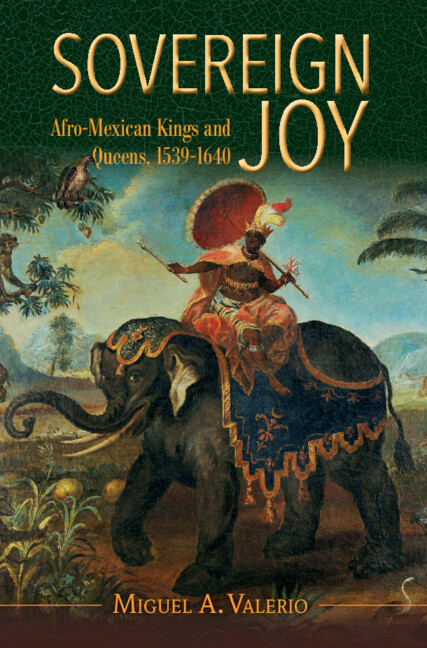
Sovereign Joy explores the performance of festive black kings and queens among Afro-Mexicans between 1539 and 1640. This fascinating study illustrates how the first African and Afro-creole people in colonial Mexico transformed their ancestral culture into a shared identity among Afro-Mexicans, with particular focus on how public festival participation expressed their culture and subjectivities, as well as redefined their colonial condition and social standing. By analyzing this hitherto understudied aspect of Afro-Mexican Catholic confraternities in both literary texts and visual culture, Miguel A. Valerio teases out the deeply ambivalent and contradictory meanings behind these public processions and festivities that often re-inscribed structures of race and hierarchy. Were they markers of Catholic subjecthood, and what sort of corporate structures did they create to project standing and respectability? Sovereign Joy examines many of these possibilities, and in the process highlights the central place occupied by Africans and their descendants in colonial culture. Through performance, Afro-Mexicans affirmed their being: the sovereignty of joy, and the joy of sovereignty.
Awards
Winner, 2023 Alfred B. Thomas Award for Best Book, Southeastern Council of Latin American Studies
Howard F. Cline Book Prize in Mexican History, Latin American Studies Association
Reviews
‘Insightful and provocative, Sovereign Joy amplifies the sonorous and accentuates the performative so that sound and play consume every page as they surely did Black and Colonial life. Valerio’s nuanced reading engages but also disrupts the analytically staid field of Afro-Mexican Studies with its focus on structure, institutional expressions, and ideology. Truly rewarding.’
Herman Bennett - author of African Kings and Black Slaves: Sovereignty and Dispossession in the Early Modern Atlantic
‘Sovereign Joy ushers in a vibrant era of scholarship on Afro-Mexican communal organizations. Emphasizing participant subjectivities, Valerio’s elegant prose guides readers through these royally inflected spectacles. Readers will breathe in the sights, smells, and sounds of these joyful Baroque events.’
Nicole von Germeten - author of The Enlightened Patrolman: Early Law Enforcement in Mexico City
‘Sovereign Joy demonstrates the ways Afro-Mexicans plotted within colonial structures to form and perform their festive culture as a powerful act of collective agency and defiance.’
Mariselle Meléndez - author of Deviant and Useful Citizens: The Cultural Production of the Female Body in Eighteenth-Century Peru
‘Valerio’s Sovereign Joy is an extraordinary book—meticulously researched, brilliantly argued, and beautifully illustrated. The histories of Afro-Mexican presence and of the festivities that sustained Black joy and survival have too long been obscured. Valerio’s timely intervention changes that. Essential reading for Black and performance studies.’
Diana Taylor - author of ¡Presente! The Politics of Presence
‘A phenomenal book of scholarly detective work that painstakingly reconstructs Afro-Mexican cultural practices and legacies that have been long-lost, misinterpreted, and obscured over time. Sovereign Joy is a rich testament to how expanding our interpretive toolset can lead us to recover the very sounds, emotions, feel, and texture of colonial life that have long been considered ephemeral and fleeting. An absolutely amazing work.’
Ben Vinson III - author of Before Mestizaje: The Frontiers of Race and Caste in Colonial Mexico
‘[This book] is important, but I hope that it is moreover a sign of things to come, both from Valerio and from those sure to be inspired by his work. I hope, too, that Latin Americanists, Africanists, and Atlanticists take ample note of just how innovative this book is.’
Joseph M. H. Clark Source: Hispanic American Historical Review
‘A powerful and compelling contribution to the study of the African diaspora in Mexico and the Black Atlantic.’
John C. Marquez Source: William and Mary Quarterly
‘Valerio recovers Afro-Mexicans’ negotiation of identity and sovereignty during and in the cultural spaces created by public festivals … The book’s main contribution is to a field of colonial literary studies that, Valerio stresses, has yet to recognize African descendants’ contributions to colonial and creole culture. Historians reading this book will be left with … a vivid picture of rich and vibrant Afro-Mexican celebrations that inspired general awe and joy in colonial Latin American society, and that might inspire them, in turn, to research the answers to their questions.’
Mariana L. R. Dantas Source: The Americas
‘While the subject of African performances and the involvement of African kings and queens has drawn scholarly attention throughout the Atlantic world, it is understudied in the case of Mexico. To be clear, others have analyzed these same performances, the role of Catholic confraternities among Afro-Mexicans, and the broader implications. Yet Valerio differs by analyzing these events through the lens of festive culture and the creation of space for the subaltern. In essence, Valerio shows the reader how Afro-Mexicans wielded performance to express their sovereignty and self-fashion their identities despite colonial restraints.’
Cacey Farnsworth Source: Journal of World History
Contents
Contents
Metrics
Altmetric attention score
Full text views
Full text views helpTotal number of HTML views: 0
Total number of PDF views: 0 *
 Loading metrics...
* Views captured on Cambridge Core between #date#. This data will be updated every 24 hours.
Usage data cannot currently be displayed.
Accessibility standard: Unknown
Why this information is here
This section outlines the accessibility features of this content - including support for screen readers, full keyboard navigation and high-contrast display options. This may not be relevant for you.
Accessibility Information
Accessibility compliance for the HTML of this book is currently unknown and may be updated in the future.