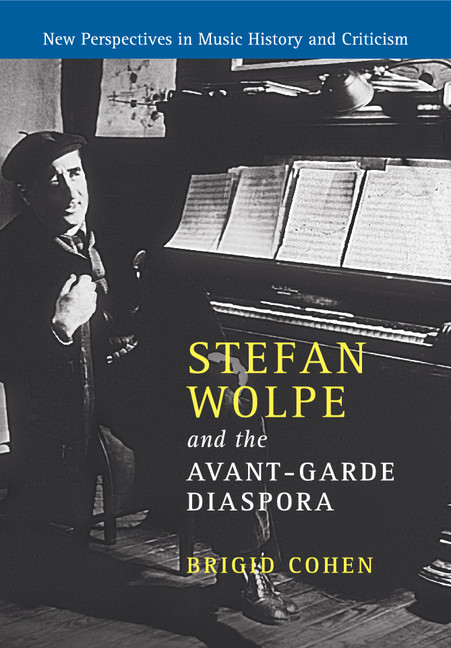
Stefan Wolpe and the Avant-Garde Diaspora

-
Select format
-
- Publisher:
- Cambridge University Press
- Publication date:
- 05 February 2014
- 13 September 2012
- ISBN:
- 9780511758508
- 9781107003002
- 9781316641163
- Dimensions:
- (247 x 174 mm)
- Weight & Pages:
- 0.79kg, 340 Pages
- Dimensions:
- (244 x 170 mm)
- Weight & Pages:
- 0.6kg, 342 Pages
You may already have access via personal or institutional login
Show more authors 
You may already have access via personal or institutional login
Book description
The German-Jewish émigré composer Stefan Wolpe was a vital figure in the history of modernism, with affiliations ranging from the Bauhaus, Berlin agitprop and the kibbutz movement to bebop, Abstract Expressionism and Black Mountain College. This is the first full-length study of this often overlooked composer, launched from the standpoint of the mass migrations that have defined recent times. Drawing on over 2000 pages of unpublished documents, Cohen explores how avant-garde communities across three continents adapted to situations of extreme cultural and physical dislocation. A conjurer of unexpected cultural connections, Wolpe serves as an entry-point to the utopian art worlds of Weimar-era Germany, pacifist movements in 1930s Palestine and vibrant art and music scenes in early Cold War America. The book takes advantage of Wolpe's role as a mediator, bringing together perspectives from music scholarship, art history, comparative literature, postcolonial studies and recent theories of cosmopolitanism and diaspora.
Awards
Winner, 2013 Lewis Lockwood Award, American Musicological Society
Reviews
"The importance of this well-researched book on German-born composer Stefan Wolpe lies as much in descriptions of milieux as in its treatment of Wolpe and his music … The book compares favorably with extant Wolpe scholarship … It will be required reading for scholars of twentieth-century music."
Choice
Contents
Contents
Metrics
Altmetric attention score
Full text views
Full text views helpTotal number of HTML views: 0
Total number of PDF views: 0 *
 Loading metrics...
* Views captured on Cambridge Core between #date#. This data will be updated every 24 hours.
Usage data cannot currently be displayed.
Accessibility standard: Unknown
Why this information is here
This section outlines the accessibility features of this content - including support for screen readers, full keyboard navigation and high-contrast display options. This may not be relevant for you.
Accessibility Information
Accessibility compliance for the HTML of this book is currently unknown and may be updated in the future.