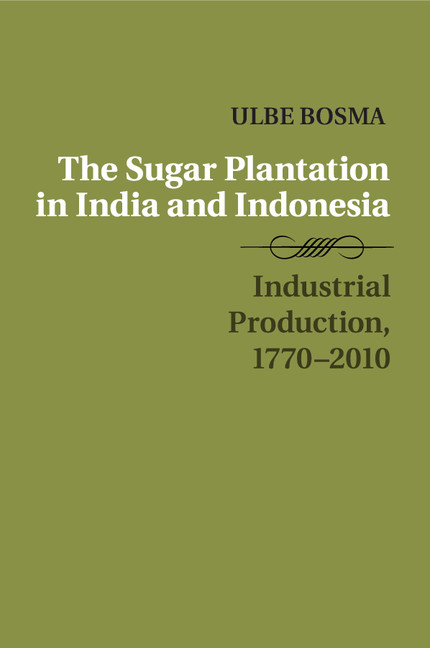
The Sugar Plantation in India and Indonesia

-
Select format
-
- Publisher:
- Cambridge University Press
- Publication date:
- 05 October 2013
- 07 October 2013
- ISBN:
- 9781139626323
- 9781107039698
- 9781316621165
- Dimensions:
- (228 x 152 mm)
- Weight & Pages:
- 0.61kg, 332 Pages
- Dimensions:
- (229 x 152 mm)
- Weight & Pages:
- 0.51kg, 336 Pages
You may already have access via personal or institutional login
Show more authors 
You may already have access via personal or institutional login
Book description
European markets almost exclusively relied on Caribbean sugar produced by slave labor until abolitionist campaigns began around 1800. Thereafter, importing Asian sugar and transferring plantation production to Asia became a serious option for the Western world. In this book, Ulbe Bosma details how the British and Dutch introduced the sugar plantation model in Asia and refashioned it over time. Although initial attempts by British planters in India failed, the Dutch colonial administration was far more successful in Java, where it introduced in 1830 a system of forced cultivation that tied local peasant production to industrial manufacturing. A century later, India adopted the Java model in combination with farmers' cooperatives rather than employing coercive measures. Cooperatives did not prevent industrial sugar production from exploiting small farmers and cane cutters, however, and Bosma finds that much of modern sugar production in Asia resembles the abuses of labor by the old plantation systems of the Caribbean.
Reviews
‘This well-researched global history of a major traditional industry of Asia (sugar) breaks new ground. Departing from the usual preoccupation with plantations, Bosma draws our attention to small-scale production systems and associated property regimes, and connects sugar with empire, India with Indonesia, and colonial developments with postcolonial ones. The book should encourage historians to rethink the notion of industrialization.'
Tirthankar Roy - London School of Economics and Political Science
'… [a] magisterial work … a work of considerable importance that will be a valuable addition to the libraries of economic history.'
Martin Bourke Source: Asian Affairs
'Sugar historians will find this book rewarding as it is rich with details about cane-sugar production in India and Indonesia. The book contrasts the introduction and development of plantation-based production of sugar in both countries following the 1835 abolition of slavery in the United Kingdom and its dependencies.'
Pierre van der Eng Source: World Sugar History Newsletter
Contents
Contents
Metrics
Altmetric attention score
Full text views
Full text views helpTotal number of HTML views: 0
Total number of PDF views: 0 *
 Loading metrics...
* Views captured on Cambridge Core between #date#. This data will be updated every 24 hours.
Usage data cannot currently be displayed.
Accessibility standard: Unknown
Why this information is here
This section outlines the accessibility features of this content - including support for screen readers, full keyboard navigation and high-contrast display options. This may not be relevant for you.
Accessibility Information
Accessibility compliance for the HTML of this book is currently unknown and may be updated in the future.