Taming the Leviathan
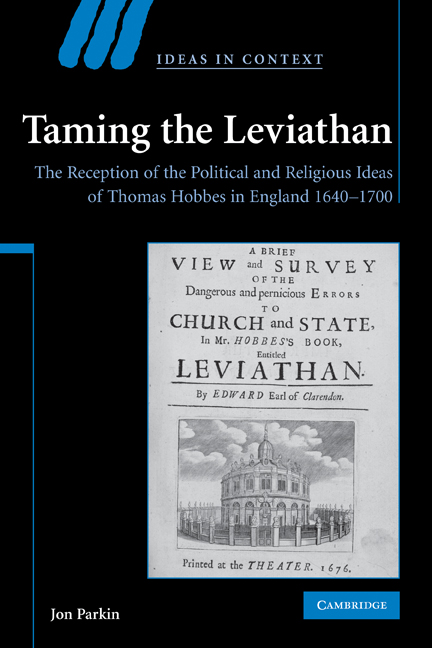

-
Select format
-
- Publisher:
- Cambridge University Press
- Publication date:
- 05 May 2010
- 09 August 2007
- ISBN:
- 9780511720499
- 9780521877350
- 9780521168311
- Dimensions:
- (228 x 152 mm)
- Weight & Pages:
- 0.89kg, 472 Pages
- Dimensions:
- (229 x 152 mm)
- Weight & Pages:
- 0.69kg, 470 Pages
- Subjects:
- History of Ideas, British History after 1450, History, Politics and International Relations
- Series:
- Ideas in Context (82)
You may already have access via personal or institutional login- Subjects:
- History of Ideas, British History after 1450, History, Politics and International Relations
- Series:
- Ideas in Context (82)
Show more authors 
You may already have access via personal or institutional login
Book description
Thomas Hobbes is widely acknowledged as the most important political philosopher to have written in English. Originally published in 2007, Taming the Leviathan is a wide-ranging study of the English reception of Hobbes's ideas. In the first book-length treatment of the topic for over forty years, Jon Parkin follows the fate of Hobbes's texts (particularly Leviathan) and the development of his controversial reputation during the seventeenth century, revealing the stakes in the critical discussion of the philosopher and his ideas. Revising the traditional view that Hobbes was simply rejected by his contemporaries, Parkin demonstrates that Hobbes's work was too useful for them to ignore, but too radical to leave unchallenged. His texts therefore had to be controlled, their lessons absorbed and their author discredited. In other words the Leviathan had to be tamed. Taming the Leviathan significantly revised our understanding of the role of Hobbes and Hobbism in seventeenth-century England.
Reviews
Review of the hardback:'This is a substantial contribution to our fuller understanding of Hobbes and his political thought …'
Source: Contemporary Review
Review of the hardback:'Jon Parkin retells this mocking satire with noticeable gusto in his Taming the Leviathan, a comprehensive and well-argued survey of the reception of Hobbes in England … Parkin overall stresses the English case in all its splendid isolation. … the work stands out as an excellent contribution to the subdiscipline of the history of reading and it will prove to be very useful for historians of political thought and to reception theorists.'
Source: Review of Politics
Review of the hardback:'Parkin, who has consulted and examined a wide variety of manuscript sources - sermons, poems and even plays - presents his elegantly written account of 'Anglican Hobbism' … with great expertise and skill and with an always entertaining portion of laconic humour.'
Source: Journal of Ecclesiastical History
'Parkin's substantial monograph, developing his succinct account in the Cambridge Companion, explores with meticulous and erudite detail the reception of Hobbes' political and religious writings and polemic in the half century of so up until the 1700s … '
Source: British Journal for the History of Philosophy
Contents
Contents
Metrics
Full text views
Full text views helpTotal number of HTML views: 0
Total number of PDF views: 0 *
 Loading metrics...
* Views captured on Cambridge Core between #date#. This data will be updated every 24 hours.
Usage data cannot currently be displayed.
Accessibility standard: Unknown
Why this information is here
This section outlines the accessibility features of this content - including support for screen readers, full keyboard navigation and high-contrast display options. This may not be relevant for you.
Accessibility Information
Accessibility compliance for the PDF of this book is currently unknown and may be updated in the future.