
Skip to main content Accessibility help
×
  • Cited by 35
    • Show more authors
    • You may already have access via personal or institutional login
    • Select format
    • Publisher:
      Cambridge University Press
      Publication date:
      22 September 2009
      14 April 2005
      ISBN:
      9780511482267
      9780521054638
      Dimensions:
      Weight & Pages:
      Dimensions:
      (216 x 138 mm)
      Weight & Pages:
      0.426kg, 324 Pages
    You may already have access via personal or institutional login
  • Selected: Digital
    Add to cart View cart Buy from Cambridge.org

    Book description

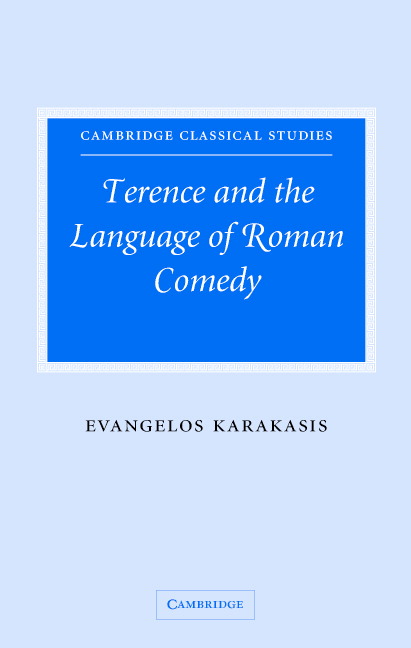
    This book offers a comprehensive examination of the language of Roman comedy in general and that of Terence in particular. The study explores Terence's use of language to differentiate his characters and his language in relation to the language of the comic fragments of the palliata, the togata and the atellana. Linguistic categories in the Terentian corpus explored include colloquialisms, archaisms, hellenisms and idiolectal features. Terence is shown to give his old men an old-fashioned and verbose tone, while low characters are represented as using colloquial diction. An examination of Eunuchus' language shows it to be closer to the Plautine linguistic tradition. The book also provides a thorough linguistic/stylistic commentary on all the fragments of the palliata, the togata and the atellana. It shows that Terence, except in the case of his Eunuchus, consciously distances himself from the linguistic/stylistic tradition of Plautus followed by all other comic poets.

    Refine List

    Actions for selected content:

    Select all | Deselect all
    • View selected items
    • Export citations
    • Download PDF (zip)
    • Save to Kindle
    • Save to Dropbox
    • Save to Google Drive

    Save Search

    You can save your searches here and later view and run them again in "My saved searches".

    Please provide a title, maximum of 40 characters.
    ×

    Contents

    Bibliography
    Bibliography
    Abbot, F. F. (1907) ‘The use of language as a means of characterisation in Petronius’, CPh 2: 43–50
    Adams, J. N. (1972) ‘The language of the later books of Tacitus’ Annals', CQ 22: 350–73
    Adams, J. N. (1973) ‘The vocabulary of the speeches in Tacitus’ historical works', BICS 20: 124–44
    Adams, J. N. (1984) ‘Female speech in Latin comedy’, Antichthon 18: 43–77
    Adams, J. N. and R. G. Mayer eds. (1999) Aspects of the language of Latin poetry, Oxford
    Albrecht, M. (1997) A history of Roman literature, Leiden
    Allardice, J. T. (1929) Syntax of Terence, London
    Altheim, F. (1932) ‘Die Anfänge des Vulgärlateins’, Glotta 20: 153–71
    Anna, G. D' (1955) ‘Contributo alla cronologia dei poeti latini arcaici, III: Quando esordí Gn. Nevio?’, RIL 88: 301–10
    Argenio, R. (1937) ‘Il Plocium di Cecilio Stazio’, MC 7: 359–68
    Arnott, W. G. (1964) ‘The confrontation of Sostratos and Gorgias’, Phoenix 18: 110–23
    Arnott, W. G. (1970) ‘Phormio parasitus: a study in dramatic methods of characterisation’, G&R 17: 32–57
    Arnott, W. G. (1972) ‘Targets, techniques and traditions in Plautus’ Stichus', BICS 19: 54–79
    Arnott, W. G. (1995) ‘Menander's manipulation of language for the individualisation of character’ in Martino, F. De and Sommerstein, A. H., eds., Lo spettacolo delle voci II, Bari, 147–64
    Arias, Abellán, del Carmen, M. (1991) ‘Die deverbalen Adjektive auf -bilis in den Werken des Plautus’, Glotta 69: 124–36
    Ashmore, S. G. (1897) ‘A note on faxo with future indicative in Plautus’, TAPhA 28: ⅶ–ⅷ
    Ashmore, S. G. (1910) The comedies of Terence, New York
    Austin, J. C. (1922) The significant name in Terence, Urbana
    Austin, R. D. ed. (1964) P. Vergili Maronis Aeneidos liber secundus, Oxford
    Axelson, B. (1945) Unpoetische Wörter: ein Beitrag zur Kenntnis der lateinischen Dichtersprache, Lund
    Baerens, W. A. (1922) Sprachlicher Kommentar zur vulgärlateinischen Appendix Probi, Halle
    Bailey, C. ed. (1949) Titi Lucreti de rerum natura libri sex, Oxford
    Bain, D. (1984) ‘Female speech in Menander’, Antichthon 18: 24–42
    Baloira, Bértolo M. A. (1981–3) ‘La lengua de Terencio. Genitivo y ablativo de cualidad’, EClás. 24: 203–20
    Barchiesi, M. (1978) La ‘Tarentilla’ rivisitata: studi su Nevio comico, Pisa
    Bardon, H. (1943–4) ‘Le silence, moyen d’ expression', REL 21–22: 102–20
    Bardon, H. (1952–6) La littérature latine inconnue, Paris
    Barsby, J. ed. (1986) Plautus: Bacchides, Warminster
    Barsby, J. ed. (1999) Terence: Eunuchus, Cambridge
    Baske, J. (1834) De alliterationis usu Plautino particula prior, Königsberg
    Battisti, C. (1949) Avviamento allo studio del latino volgare, Bari
    Beare, W. (1930) ‘Plautus and the Fabula Atellana’, CR 44: 165–68
    Beare, W. (1940) ‘The fabula togata’, Hermathena 55: 35–55
    Beare, W. (1977) The Roman stage, London
    Bennett, C. E. (1910–14) Syntax of Early Latin, Boston
    Bertschinger, J. (1921) ‘Volkstümliche Elemente in der Sprache des Phaedrus’, Diss., Bonn
    Bigot, E. (1948) ‘Sextus Turpilius’, RE 7 A22: 1428–30
    Bini, M. (1981) ‘Forme di asindeto in Terenzio’, GFF 4: 115–22
    Blänsdorf, J. (1996) ‘Un trait original de la comédie de Plaute: le goût de la parodie’, CGITA 9: 133–51
    Bléry, H. (1965) Syntaxe de la subordination dans Térence, Rome
    Bonfante, G. (1994) La lingua parlata in Orazio, Venosa
    Bonfante, G. (1967) ‘La lingua delle atellane e dei mimi’ in Frassinetti, P. ed., Atellanae Fabulae, Rome, ⅰ–ⅹⅹⅳ
    Boscherini, S. (1999) ‘Norma e parola nelle commedie di Cecilio Stazio’, SIFC 27: 99–115
    Bourciez, J. (1927) Le sermo cotidianus dans les Satires d' Horace, Paris
    Boyce, B. (1991) The language of the freedmen in Petronius' Cena Trimalchionis, Leiden
    Branden, A. V. (1984) ‘Le texte punique dans le Poenulus de Plaute’, B&O 26: 159–80
    Brakman, C. (1930) ‘Ad Plinii Nat. Hist. Lib. ⅹⅹⅵ-ⅹⅹⅹⅶ’, Mnemosyne: 58: 207–22
    Brazzano, S. di (1999) ‘Cacata charta’, MD 43: 179–89
    Brenk, F. E. (1987) ‘Heteros tis eimi: on the language of Menander's young lovers’, ICS 12: 31–66
    Brenous, J. (1895) Etude sur les Hellénismes dans la syntaxe latine, Paris
    Brothers, A. J. ed. (1988) Terence: the self-tormentor, Warminster
    Brotherton, B. E. M. (1921) The vocabulary of intrigue in Roman comedy, Chicago, Illinois
    Brown, P. G. McC. (1981) ‘Two notes on Menander's Misoumenos’, ZPE 41 25–6
    Brown, P. G. McC. (1990) ‘Plots and prostitutes in Greek New Comedy’, PLLS 6: 241–66
    Büchner, K. (1974) Das Theater des Terenz, Heidelberg
    Calboli, G. (1991) ‘Il miles gloriosus di Terenzio e l'infinito storico latino’ in Studi di filologia classica in onore di Giusto Monaco II, Palermo, 599–632
    Calboli, G. (1997) Über das Lateinische: vom Indogermanischen zu den romanischen Sprachen, Tübingen
    Callahan, J. (1964) ‘The figurative use of emungere’ in Henderson, C. ed., Classical, mediaeval and Renaissance studies in honor of B. L Ullman I, Rome, 67–78
    Callebat, L. (1968) Sermo cotidianus dans les Métamorphoses d' Apulée, Caen
    Canedo, J. (1935–36) ‘Die lateinischen Inchoativa und ihr Verhältnis zur Komposition’, Glotta 24: 257–66
    Carney, T. F. ed. (1963) P. Terenti Afri Hecyra, Salisbury
    Carney, T. F. ed. (1964) ‘The words sodes and quaeso in Terentian usage’, AClass 7: 57–63
    Cassio, A. C. (1979) ‘Motivi di agone epirrematico in commedia nuova (Aristoph. Nub. 961 sgg., Plaut. Bacch, 420 sgg.)’, AION (filol.) 1: 1–22
    Christes, J. (1971) Der frühe Lucilius, Rekonstruktion und Interpretation des XXIV Buches sowie von Teilen des XXX Buches, Heidelberg
    Cichorius, C. (1964) Untersuchungen zu Lucilius, Berlin
    Citti, F. (1994) ‘Una “mena” per cena, Pompon. “Atell.” Fr. 80s. Ribb. 3’, MD 33: 151–5
    Coleman, R. G. G. (1975) ‘Greek influence on Latin syntax’, TPhS 1975: 101–56
    Coleman, R. G. G. ed. (1977) Vergil Eclogues, Cambridge
    Coleman, R. G. G. (1987) ‘Vulgar Latin and the diversity of Christian Latin’ in Hermann, H. ed., Latin vulgaire – latin tardif I, Tübingen, 37–52
    Coleman, R. G. G. (1990) ‘Dialectal variation in Republican Latin, with special reference to Praenestine’, Proceedings of the Cambridge Philological Society 36: 1–25
    Coleman, R. G. G. (1999) ‘Poetic diction, poetic discourse and the poetic register’ in Adams and Mayer, eds., 21–93
    Collart, J. (1978) ‘Quelques remarques sur l’ emploi de gratia chez les comiques' in Collart, J. ed. (1978) Varron, grammaire antique et stylistique latine, Paris, 293–7
    Collart, J. ed. (1979) Plaute: Curculio, Paris
    Conrad, F. (1930–32) ‘Die Deminutiva im Altlatein, 1: Die Deminutiva bei Plautus’, Glotta 19: 127–148 and 20: 74–84
    Cooper, F. T. (1895) Word Formation in the Roman Sermo Plebeius, New York
    Corbett, P. B. (1964) ‘“Vis comica” in Plautus and Terence: an inquiry into the figurative use by them of certain verbs’, Eranos 62: 52–69
    Cordier, A. (1939) Etudes sur le vocabulaire épique dans l' Enéide, Paris
    Corno, D. del. (1975) ‘Alcuni aspetti del linguaggio di Menandro’, SCO 23: 13–48
    Coulter, C. C. (1916) ‘Compound adjectives in early Latin poetry’, TAPhA 47: 153–72
    Currie, H. M. (1983) ‘Plautus’ Poenulus 1174–1279 and a possible Semitic parallel', LCM 8: 85–6
    Danese, R. (1985) ‘Plauto, Pseudolus 702–705a: la “costruzione stilistica” di un eroe perfetto’, MD 14: 101–12
    Daviault, A. (1981) Comoedia Togata: fragments, Paris
    Degl' Innocenti Pierini, R. (1991) ‘Un prologo polemico di Afranio, Compitalia 25–18 R3’, Prometheus 17: 242–6
    Denzler, B. (1968) Der Monolog bei Terenz, Zürich
    Saint-Denis, E. (1947) ‘Syntaxe du latin parlé dans les Res Rusticae de Varron’, RPh 21: 141–62
    Dickey, E. (1996) Greek forms of address: from Herodotus to Lucian, Oxford
    Diel, E. (1919) ‘Iuventius’, RE 10, 2: 1362
    Diel, E. (1926) ‘Licinius Imbrex’, RE 13, 1: 371
    Douglas, A. E. ed. (1966) Cicero: Brutus, Oxford
    Dover, K. J. (1987) Greek and the Greeks, Oxford
    Dressler, W. (1965) ‘Die Funktion des hist. Infinitivs im lateinischen Verbalsystem’, Kratylos 10: 191–6
    Drexler, H. (1934) ‘Die Komposition von Terenz’ Adelphen und Plautus' Rudens', Philologus Suppl. 26.2: 1–40
    Dziatzko, K. and Kauer, R. eds. (1903) Ausgewählte Komödien des P. Terentius Afer, erklärt von K. Dz., II: Adelphoe, 2te Auflage, bearbeitet von R. K., Leipzig
    Duckworth, G. E. (1952) The nature of Roman comedy, Princeton (repr. with bibliographical appendix by R. L. Hunter (1994) Bristol)
    Durry, M. (1940) ‘Le vocabulaire militaire dans le Phormio’, REL 18: 57–64
    Eckstein, F. (1921) ‘Syntaktische Beiträge zu Plautus’, Philologus 77: 142–73
    Elmer, H. C. (1887) ‘Que, et, atque in the inscriptions of the Republic, in Terence, and in Cato’, AJPh 8: 292–328
    Engelbrecht, A. G. (1883) Studia Terentiana, Vienna
    Enk, P. J. (1940) ‘Observationes de sermonis cottidiani vestigiis apud Propertium obviis’, Mnemosyne 8: 299–322
    Ernout, A. (1931) ‘Un example de répartition sémantique: les mots qui se rapportent à la maison’, REL 9: 40–1
    Ernout, A. (1932) ‘Domus, fores et leurs substituts’, RPh 6: 297–314
    Ernout, A. (1949) Les adjectifs latins en -osus et en -lentus, Paris
    Ernout, A. (1953) Morphologie historique du latin, Paris
    Ernout, A. and Meillet, A. (1951) Dictionnaire étymologique de la langue latine: histoire des mots, Paris
    Ernout, A. and Thomas, F. (1972) Syntaxe latine, Paris
    Faider, P. (1908–9) ‘Le poète comique Cecilius: sa vie et son oeuvre’, MB 12: 269–341; 13: 5–35
    Fantham, E. (1968) ‘Terence, Diphilus and Menander: a reexamination of Terence's Adelphoe act II’, Philologus 112: 196–216
    Fantham, E. (1972) Comparative studies in Republican Latin imagery, Toronto
    Fantham, E. ed. (1998) Ovid Fasti Book IV, Cambridge
    Fassbender, C. (1909) De Iulii Valeri sermone quaestiones selectae, Münster
    Fay, E. W. (1909) ‘The Latin accusatives med, ted’, AJPh 29: 301–10
    Fay, H. C. ed. (1983) Plautus Rudens, Bristol
    Feneron, J. S. (1974) ‘Some elements of Menander's style’, BICS 21: 81–95
    Flury, P. (1968) Liebe und Liebessprache bei Menander, Plautus und Terenz, Heidelberg
    Flobert, P. (1975) Les verbes déponents latins des origines à Charlemagne, Paris
    Focardi, G. (1972) ‘Linguaggio forense nei prologhi terenziani’, SIFC 44: 55–88
    Fordyce, C. J. ed. (1977) P. Vergili Maronis Aeneidos Libri VII-VIII with a commentary, Oxford
    Foster, W. E. (1912) ‘Studies in archaism in Gellius’, Diss., Columbia
    Frank, T. (1927) ‘Naevius and free speech’, AJPh 48: 105–10
    Frank, T. (1930) Life and literature in the Roman Republic, Cambridge
    Fraenkel, E. (1927) ‘Die Vorgeschichte des Versus quadratus’, Hermes 62: 357–70
    Fraenkel, E. (1928) Iktus und Akzent im lateinischen Sprechvers, Berlin
    Fraenkel, E. (1931) ‘Livius Andronicus’, RE Suppl. 5: 598–607
    Fraenkel, E. (1935) ‘Naevius’, RE Suppl. 6: 622–40
    Fraenkel, E. (1960) Elementi Plautini in Plauto, Florence (translation with addenda of Plautinisches im Plautus, Berlin 1922)
    Frassinetti, P. (1953) Fabula Atellana: saggio sul teatro popolare latino, Genova
    Frassinetti, P. ed. (1955) Fabularum Atellanarum Fragmenta, Turin
    Fridh, Å. (1950) Etudes critiques et syntaxiques sur les Variae de Cassiodore, Göteborg
    Gagnér, A. (1920) De hercle mehercle ceterisque id genus particulis priscae poesis latinae scenicae, Greifswald
    Gaide, F. (1988) Les substantifs masculins latins en … (ⅰ)o, … (i)onis, Louvain and Paris
    Gamberale, L. (1967) ‘L’ inizio proverbiale di Menandro fr. 333 K-Th', RFIC 95: 162–4
    García Jurado, F. (1997) ‘Commentario a Titin. com. 1 (Ribb.): inauratae atque inlautae mulieris’, Latomus 56: 544–50
    García Jurado, F. and López Gregoris, R. (1995) ‘Las metáforas de la vida cotidiana en el lenguaje plautino come procedimiento de caraterización de los personajes’, SIFC 13: 233–45
    Garton, C. (1971) ‘The Thesaurus: a comedy of Luscius Lanuvius’, AJPh 92: 17–37
    Georgala, Priovolou S. (1991) ‘Il “pedante” nel mimo, nell’ atellana e nel teatro comico greco', Dioniso 61: 269–75
    Gérard, V. (1897) ‘Le latin vulgaire et le langage familier dans les satires de Perse’, MB 1: 81–103
    Gestri, L. (1940) ‘Studi Plautini II: Il monologo di Nicobulo in Bacchides V. 1 (=1087–1103)’, SIFC 17: 237–60
    Gilleland, M. E. (1979) ‘Linguistic differentiation of character type and sex in the comedies of Plautus and Terence’, Diss., Virginia, Charlottesville
    Gilleland, M. E. (1980) ‘Female speech in Greek and Latin’, AJPh 101: 180–3
    Gilula, D. (1980) ‘The concept of the bona meretrix: a study of Terence's courtesans’, RFIC 108: 142–65
    Gomme, A. W. and Sandbach, F. H. (1973) Menander: a commentary, Oxford
    Grandgent, C. H. (1908) An introduction to vulgar Latin, Boston
    Gratwick, A. S. (1971) ‘Hanno's Punic speech in the Poenulus of Plautus’, Hermes 99: 25–45
    Gratwick, A. S. ed. (1987) Terence: The Brothers, Warminster
    Gratwick, A. S. ed. (1993) Plautus: Menaechmi, Cambridge
    Green, R. P. H. (1991) The works of Ausonius, Oxford
    Grimal, P. (1953) Le siècle des Scipions, Paris
    Gruen, E. S. (1993) Culture and national identity in republican Rome, London
    Guardì, T. (1974) Cecilio Stazio: I frammenti, Palermo
    Guardì, T. (1981) ‘Note sulla lingua di Titinio’, Pan 7: 145–65
    Guardì, T. (1985) Titinio e Atta, Fabula Togata; I frammenti, Palermo
    Haadsma, R. A. and Nuchelmans, J. (1963) Précis de latin vulgaire, Groningen
    Haffter, H. (1934) Untersuchungen zur altlateinischen Dichtersprache, Berlin
    Haffter, H. (1953) ‘Terenz und seine künstlerische Eigenart’, MH 10: 1–20, 73–102
    Hahn, E. A. (1948) ‘ilicet, scilicet, videlicet’, TAPhA 79: 308–37
    Harsh, P. W. (1940) ‘The position of archaic forms in the verse of Plautus’, CPh 35: 126–42
    Hartman, I. I. (1922) ‘De atellana fabula’, Mnemosyne 50: 225–38
    Hartman, I. I. (1923) ‘Ad Titinium’, Mnemosyne 51: 179
    Happ, H. (1967) ‘Die lateinische Umgangssprache und die Kunstsprache des Plautus’, Glotta 45: 60–104
    Haverling, G. (2000) On sco-verbs, prefixes and semantic functions, Göteborg
    Heap, A. M. (1992) ‘Word order in Menander’, LCM 17: 56–8
    Heraeus, W. (1937) Kleine Schriften, Heidelberg
    Herman, J. (1967) Le Latin vulgaire, Paris
    Heusch, H. (1954) Das Archaische in der Sprache Catulls, Bonn
    Hodgman, A. W. (1901)‘On variations of gender in Plautus’, TAPhA 32: ⅼⅹⅹⅹⅲ–ⅼⅹⅹⅹⅴ
    Hodgman, A. W. (1902) ‘Noun declension in Plautus’, CR 16: 294–305
    Hoffmann, Z. (1980–81) ‘Gebetsparodien in Plautus’ Komödien', Helikon 20–21: 207–18
    Hofmann, J. B. (1951) Lateinische Umgangssprache, Heidelberg
    Hofmann, J. B. and Szantyr, A. (1965) Lateinische Syntax und Stilistik, Munich
    Hofmann, W. (1992) ‘Zur Funktion der Fremdsprachen bei Plautus’ in Müller, C. W. ed., Zum Umgang mit fremden Sprachen in der griechisch-römischen Antike: Kolloquium der Fachrichtungen Klassische Philologie der Universitäten Leipzig und Saarbrücken am 21. und 22. November 1989 in Saabrücken, Stuttgart, 143–58
    Hohl, E. (1920) ‘Über den Ursprung der Historia Augusta’, Hermes 55: 296–310
    Holford, Strevens L. (1988) Aulus Gellius, London
    Hough, J. N. (1940) ‘Miscellanea Plautina: vulgarity, extra-dramatic speeches, Roman allusions’, TAPhA 71: 186–98
    Hough, J. N. (1947) ‘Terence's use of Greek words’, CW 41: 18–21
    Hunter, R. L. (1985) The New Comedy of Greece and Rome, Cambridge
    Jocelyn, H. D. ed. (1967) The tragedies of Ennius: the fragments edited with an introduction and commentary, Cambridge
    Jocelyn, H. D. ed. (1969) ‘The poet Gn. Naevius, P. Cornelius Scipio and Q. Caecilius Metellus’, Antichthon 3: 32–47
    Jocelyn, H. D. ed. (1972) ‘Ennius as a dramatic poet’, Fondation Hardt 17: 39–88
    Jocelyn, H. D. ed. (1993) ‘Sprache, Schriftlichkeit und Characterisierung in der römischen Komödie (Plautus, Pseudolus 41–73, 998–1014)’ in Vogt-Spira, G. ed., Beiträge zur mündlichen Kultur der Römer, Tübingen, 125–39
    Johnston, E. (1905) ‘Gemination in Terence’, TAPhA 36: 44
    Jones, K. S. (1987) Synonymy and semantic classification, New York
    Katsouris, A. G. (1975) Linguistic and stylistic characterisation: tragedy and Menander, Ioannina
    Knapp, C. (1917) ‘References to painting in Plautus and Terence’, CPh 12: 143–57
    Krahmalkov, C. R. (1988) ‘Observations on the Punic monologue of Hanno in the Poenulus’, Orientalia 57: 55–66
    Krenkel, W. ed. (1970) Lucilius Satiren, Leiden
    Krieter, Spiro M., (1997) Sklaven, Köche und Hetären: das Dienstpersonal bei Menander: Stellung, Rolle, Komik und Sprache, Stuttgart
    Kroll, W. (1910–12) ‘Der lateinische Relativsatz’, Glotta 3: 1–18
    Kroll, W. (1931) ‘Der Tod des Naevius’, Hermes 66: 469–72
    Kroll, W. (1936) ‘Novius’, RE 17, 1: 1216
    Kroll, W. (1937) ‘Trabea’, RE 6, 22: 1862
    Kühner, R. and Stegmann, C. (1966) Ausführliche Grammatik der lateinischen Sprache, Part II, Hanover
    Laidlaw, W. A. (1938) The prosody of Terence, London
    Langen, P. (1886) Plautinische Studien, Berlin
    Lee, G. M. (1965) ‘Caecilius, 136–7’, Latomus 24: 954
    Lefèvre, E. (1978) Der Phormio des Terenz und der Epidikazomenos des Apollodor von Karystos, Munich
    Lefèvre, E. (1994) Terenz und Menanders Heautontimoroumenos, Munich
    Lejay, P. (1966) Oeuvres d' Horace. Satires, Hildesheim
    Lentano, M. (1993) ‘Parce ac duriter: Catone, Plauto e una formula felice’, Maia 45: 11–16
    Leo, F. (1913) Geschichte der römischen Literatur, Berlin
    Leo, F. (1914) ‘Römische Poesie in der sullanischen Zeit’, Hermes 49: 161–94
    Leo, F. (1966) Plautinische Forschungen: zur Kritik und Geschichte der Komödie, Darmstadt
    Leumann, M. (1945) ‘Der lateinische Genetiv Achilli’, MH 2: 237–58
    Leumann, M. (1947) ‘Die lateinische Dichtersprache’, MH 4: 116–39
    Leumann, M. (1977) Lateinische Laut- und Formenlehre, Munich
    Lilja, S. (1965) Terms of abuse in Roman comedy, Helsinki
    Lindholm, E. (1931) Stilistiche Studien zur Erweiterung der Satzglieder im Lateinischen, Lund
    Lindsay, W. M. ed. (1900), The Captivi of Plautus, London
    Lindsay, W. M. ed. (1922) Early Latin verse, Oxford
    Lloyd-Jones, H. (1973) ‘Terentian technique in the Adephi and the Eunuchus’, CQ 23: 279–84
    Lyons, J. (1996) Linguistic semantics: an introduction, Cambridge
    Lodge, G. (1924–33) Lexicon Plautinum, Stuttgart
    Löfstedt, B. (1982) ‘Die vulgärlateinische Sprachforschung in diesem Jahrhundert. Rückschau und Ausblick’, Aevum 56: 200–4
    Löfstedt, E. (1911) Philologischer Kommentar zur Peregrinato Aetheriae: Untersuchungen zur Geschichte der lateinischen Sprache, Uppsala
    Löfstedt, E. (1912) ‘Plautinischer Sprachgebrauch und Verwandtes’, Glotta 3: 171–91
    Löfstedt, E. (1956) Syntactica: Studien und Beiträge zur historischen Syntax des Lateins, Lund
    Lopez, Lopez A. (1983) Fabularum togatarum fragmenta, Salamanca
    Lowe, J. C. B. (1983a) ‘The Eunuchus: Terence and Menander’, CQ 33: 428–44
    Lowe, J. C. B. (1983b) ‘Terentian originality in the Phormio and Hecyra’, Hermes 111: 431–52
    Ludwig, W. (1968) ‘The originality of Terence and his Greek models’, GRBS 9: 169–82
    MacCary, W. T. and Willcock, M. M. eds. (1976) Plautus: Casina, Cambridge
    McGlynn, P. (1963–7) Lexicon Terentianum, London and Glasgow
    Maltby, R. (1976) ‘A comparative study of the language of Plautus and Terence’, Diss., Cambridge
    Maltby, R. (1979) ‘Linguistic characterisation of old men in Terence’, CPh 74: 136–47
    Maltby, R. (1983) ‘The last act of Terence's Heautontimoroumenos’, PLLS 4: 27–41
    Maltby, R. (1985) ‘The distribution of Greek loan-words in Terence’, CQ 35: 110–23
    Maniet, A. (1966) ‘“Frapper à la porte” en latin préclassique: notes morpho-semantiques sur pello et ses dérivés’, Latomus 25: 28–36
    Mankin, D. ed. (1995) Horace Epodes, Cambridge
    Marache, R. (1957) Mots nouveaux et mots archaïques chez Fronton et Aulu-Gelle, Paris
    Marconi, G. (1966) ‘La cronologia di Livio Andronico’, Atti Accad. dei Lincei 363 MAL VIII, 12, 2125–213
    Marmorale, E. V. (1950) Naevius poeta, Florence
    Marouzeau, J. (1926) ‘Plaute et la première “crise du latin”’, REL 4: 99–103
    Marouzeau, J. ed. (1947) Térence I: Andrienne, Eunuque, Paris
    Marti, H. (1963) ‘Terenz 1909–1959’, Lustrum 8: 5–101
    Martin, R. H. ed. (1959) Terence: Phormio, London
    Martin, R. H. ed. (1976) Terence: Adelphoe, Cambridge
    Martin, R. H. (1995) ‘A not-so-minor character in Terence's Eunuchus’, CPh 90: 139–51
    Martina, M. (1978) ‘Sulla cronologia di Titinio’, QFC 1: 5–25
    Marx, F. (1896) ‘Atilius’, RE 2, 2: 2076
    Marx, F. (1909) ‘Atellanae Fabulae’', RE 2, 2:1914–21
    Marx, F. (1909) ‘Die Beziehung des Altlateins zum Spätlatein’, Neue Jahrbücher für das Klassische Altertum: 434–48
    Marx, F. ed. (1959) Plautus Rudens: Text und Kommentar, Amsterdam
    Mates, B. (1950) ‘Synonymity’, UCPPh 25: 201–26
    Marzullo, A. (1973) Dalla satira al teatro popolare latino, Rome
    Mattingly, H. B. (1957) ‘The date of Livius Andronicus’, CQ 7: 159–63
    Mattingly, H. B. (1960) ‘Naevius and the Metelli’, Historia 9: 414–39
    Maurach, G. (1983) Enchiridion poeticum: hilfsbuch zur lateinischen Dichtersprache, Darmstadt
    Maurach, G. (1995) Lateinische Dichtersprache, Darmstadt
    Mayer, R. G. ed. (1994) Horace Epistles Book I, Cambridge
    Mayer, R. G. (1999) ‘Grecism’ in Adams and Mayer, eds., 157–82
    Meister, K. (1909) ‘Altes Vulgärlatein’, IF 26: 69–90
    Minarini, A. (1983) ‘Note sul diminutivo terenziano’, Paideia 38: 161–73
    Miniconi, P. J. (1958) ‘Les termes d’ injure dans le théâtre comique', REL 36: 159–75
    Mohrmann, C. (1932) Die altchristliche Sondersprache in den Sermones des hl. Augustin, Nijmegen
    Müller, A. (1913) ‘Die Schimpfwörter in der römischen Komödie’, Philologus 72: 492–502
    Müller, H. F. and Taylor, P. (1932) A chrestomathy of Vulgar Latin, Boston
    Müller, R. (1997) Sprechen und Sprache: dialoglinguistische Studien zu Terenz, Heidelberg
    Munk, E. (1826) De Pomponio Bononiensi Atellanarum poeta, Glagovia
    Nelson, H. L. Q. (1951) ‘Le rapport entre le latin littéraire, la langue de conversation et la langue vulgaire au temps de Pétrone’ in Actes du premier congrès international des études classiques, Paris, 220–9
    Neue, F. and Wagener, C. (1892–1905) Formenlehre der lateinischen Sprache, Leipzig
    Neumann, E. (1925) De cottidiani sermonis apud Propertium proprietatibus, Königsberg
    Nicolson, F. W. (1893) ‘The use of hercle (mehercle), edepol (pol) and ecastor (mecastor) by Plautus and Terence’, HSCPh 4: 99–103
    Nougaret, L. (1945) ‘La langue militaire chez Térence’, REL 23: 70–4
    Norden, E. (1898) Die antike Kunstprosa II, Leipzig
    Nuñez, S. (1995) ‘Materiales para una sociología de la lengua latina: Terencio y los modificadores de imperativo’, FlorIlib 6: 347–66
    Oakley, S. P. (1997–98) A commentary on Livy Books VI–X, Oxford
    Oksala, P. (1953) Die griechischen Lehnwörter in den Prosaschriften Ciceros, Helsinki
    Oniga, R. (1994) ‘L’ allitterazione in Plauto e Terenzio: un esperimento di analisi quantitativa', Lexis 12: 117–34
    Önnerfors, A. (1955) ‘Zur Vermischung der Ausdrücke für Ortsruhe und Bewegung im Lateinischen’, Eranos 53: 148–64
    Opelt, I. (1965) Die lateinischen Schimpfwörter und verwandte sprachliche Erscheinungen: eine Typologie, Heidelberg
    Oppermann, H. (1939) ‘Caecilius und die Entwicklung der römischen Komödie’, F&F 15: 196–7
    Palmer, L. R. (1954) The Latin language, London
    Papadimitriou, M. (1982) ‘αρέλκον’, Dodone 11: 427–47
    Papadimitriou, M. (1994) ‘λλιψις κι ποσιώπησις’ στο υπόμνημα του ίλιου ονάτου', Dodone 23: 77–113
    Papadimitriou, M. (1998) τοιχία της ομιλούμνης ατινικής στον ρέντιο και η χρήση τους στη διαφοροποίηση του λόγου των χαρακτήρων του, Ioannina
    Paratore, E. (1959) ‘Studi sulla palliata, ad Ter. Eunuchus 7–13’, RCCM 1: 44–63
    Pasquazi, Bagnolini A. (1977) Note sulla lingua di Afranio, Florence
    Perruzzi, E. (1976) ‘Prenestino conea e lat. ciconia’, QIFL 4: 45–51
    Petersen, W. (1931) ‘The evidence of early Latin on the subjunctive in cum-clauses’, CPh 26: 386–404
    Petersmann, H. (1977) ‘Petrons urbane Prosa: Untersuchungen zu Sprache und Text’, Sitzungsberichte der Österreichischen Akademie der Wissenschaften, Philos.-Hist. Klasse 323
    Petersmann, H. (1995) ‘Zur mündlichen Characterisierung des Fremden in der Komödie des Plautus’ in Benz, L., Stärk, E. and Vogt-Spira, G. eds., Plautus und die Tradition des Steigreifspiels. Festgabe für E. Lefèvre zum 60. Geburtstag, Tübingen, 123–36
    Petersmann, H. (1996–7) ‘Die Nachahmung des sermo rusticus auf der Bühne des Plautus und Terenz’, AAntHung 37 (3–4): 199–211
    Petersmann, H. (1999) ‘The language of the Early Roman satire: its function and characteristics’ in Adams and Mayer, eds., 289–310
    Piccaluga, G. (1991) ‘At ego aiio id fieri in Graecia et Carthagini / Et hic … (Plaut. Casina 71 sg.): il linguaggio ‘religioso’ in Plauto’, RSA 21: 9–22
    Ploen, H. (1882) De copiae verborum differentiis inter varia poesis Romanae antiquioris genera intercedentibus, Strasbourg
    Pociña, A. (1975) ‘Lucio Afranio y la evolución de la fabula togata’, Habis 6: 99–107
    Pociña, A. (1980) ‘El comediografo Cecilio Estacio’, Sodalitas 1: 209–31
    Pociña, A. (1981–3) ‘El comediografo Cecilio Estacio’, EstClás 25: 63–78
    Povsic, B. S. (1987) ‘Locutiones cotidianae quae in T. Macci Plauti comoediis leguntur’, VL 105: 30–6, 106: 27–31
    Prescott, H. W. (1920) ‘Inorganic rôles in Roman comedy’, CPh 15: 245–81
    Prescott, H. W. (1942) ‘Exit monologues in Roman comedy’, CPh 37: 1–21
    Przychocki, G. (1922) ‘De Titinii aetate’ in Charisteria Casimiro de Morawsky septuagenario oblata ab amicis, collegis, discipulis, Cracow, 180–8
    Pulgram, E. (1950) ‘Spoken and written Latin’, Language 26: 458–66
    Radice, B. (1976) Terence: The Comedies, London
    Radke, G. (1951) ‘Terenz und die Mythologie’, Gymnasium 58: 73–5
    Raffaelli, R. (1987) ‘Pomponio e l’ atellana (spunti di analisi stilistiche e tematiche)' in Cispadana e leteratura antica. Atti del convegno di studi tenuto ad Imola nel maggio 1986, Bologna
    Ramage, E. S. (1973) Urbanitas: ancient sophistication and refinement, Cincinnati
    Rambelli, G. (1936) ‘Studi terenziani: due scene dell’ Andria', SIFC 13: 130–60
    Reich, V. (1933) ‘Sprachliche Characteristik bei Terenz (Studien zum Kommentar des Donat)’, WS 51: 72–94
    Reiter, S. (1925) ‘Der Atellanendichter Aprissius’, Philol. Woch. 45: 1435–9
    Ribbeck, O. ed. (1898) Scaenicae Romanorum poesis fragmenta, vol. II Comicorum Fragmenta, Leipzig
    Riedweg, C. (1993) ‘Menander in Rom – Beobachtungen zu Caecilius Statius Plocium fr. I (136–53 Guardì)’, in Slater, N. W. and Zimmermann, B. eds., Drama 2: 133–59
    Riemann, O. (1885) Etudes sur la langue et la grammaire de Tite Live, Paris
    Rieth, O. (1964) Die Kunst Menanders in den ‘Adelphen’ des Terenz, Hildesheim
    Risch, E. (1984) Gerundivum und Gerundium. Gebrauch im klassischen und älteren Latein. Entstehung und Vorgeschichte, Berlin
    Risicato, A. (1966) Lingua parlata e lingua d' arte in Ennio, Messina and Florence
    Ritschl, F. (1965) Parerga zu Plautus und Terenz, Amsterdam
    Robson, D. O. (1938) ‘The nationality of the poet Caecilius Statius’, AJPh 59: 301–8
    Rohlfs, G. (1956) Sermo vulgaris Latinus: vulgärlateinisches Lesebuch, Tübingen
    Romano, D. ed. (1953) Atellana fabulla, Palermo
    Rossbach, O. (1920) ‘Atellanen des L. Pomponius und des Novius’, Woch. für klass. Philol. 33–4: 331–5
    Rosén, H. B. (1970) ‘Uterum dolet und Verwandtes’, Folia Linguistica 4: 135–47
    Rosén, H. (1981) Studies in the syntax of the verbal noun in early Latin, Munich
    Rosén, H. (1999) Latine loqui: trends and directions in the crystallisation of classical Latin, Munich
    Rowell, H. T. (1949) ‘The Campanian origin of Cn. Naevius and its literary attestation’, MAAR 19: 15–34
    Ruckdeschel, F. (1911) Archaismen und Vulgarismen in der Sprache des Horaz, Munich
    Rychlewska, L. ed. (1971) Turpilii comici fragmenta, Leipzig
    Sabbadini, S. (1935) Poeti latini: Nevio, Udine
    Salat, P. (1967) ‘L'adjectif miser, ses synonymes et ses antonymes chez Plaute et chez Térence’, REL 45: 252–75
    Sandbach, F. H. (1970) ‘Menander's manipulation of language for dramatic purposes’, Fondation Hardt 26: 113–36
    Sandys, J. E. (1885) M. Tulli Ciceronis ad M. Brutum Orator, Cambridge
    Schmeck, H. (1955) Aufgaben und Methoden der modernen vulgärlateinischen Forschung, Heidelberg
    Sblendorio-Cugusi, M. T. (1991) I sostantivi latini in -tudo, Bologna
    Schuster, M. (1931) ‘Zum archaistischen Element im Stile Frontos’, WS 49: 153–7
    Sedgwick, W. B. ed. (1960) Plautus: Amphitruo, Manchester
    Sideri, Tolia A. (1988) ‘The compound adjectives in Naevius, Ennius, Plautus, Terentius and Cicero’, Parousia 6: 205–21
    Shackleton, Bailey D. R. (1953) ‘Num in direct questions: a rule restated’, CQ 3: 120–5
    Sheets, G. A. (1983) ‘Plautus and Early Roman tragedy’, ICS 8: 195–209
    Shipp, G. P. (1937) ‘“Chance” in the Latin vocabulary (evenire, cadere, accidere, contingere)’, CR 51: 209–12
    Shipp, G. P. ed. (1960) P. Terenti Afri Andria, Melbourne
    Skutsch, F. (1892) Plautinisches und Romanisches, Leipzig
    Skutsch, F. (1897a) ‘Caecilius Statius’, RE 3, 1: 1189–92
    Skutsch, F. (1897b) ‘Dossenus’, RE 5, 2: 1609–10
    Skutsch, O. (1951) ‘Naevius’, CR 1: 174–7
    Skutsch, O. ed. (1985) The Annals of Q. Ennius, Oxford
    Sloman, A. ed. (1936) P. Terenti Adelphi, Oxford
    Smith, K. W. (1890) Archaisms of Terence mentioned in the Commentary of Donatus, Baltimore
    Soles, M. (1954) ‘Studies in the colloquial language in the poems of Catullus’, Diss., Michigan
    Sommer, F. (1914) Handbuch der lateinischen Laut- und Formenlehre, Heidelberg
    Spencer, F. B. T. (1906) Adnominatio in the plays of Plautus, Rome
    Stefenelli, A. (1962) Die Volkssprache im Werk des Petron im Hinblick auf die romanischen Sprachen, Vienna
    Stein, J. P. (1971) ‘Compound word coinages in the plays of Plautus’, Latomus 30: 598–606
    Steinthal, J. (1918) De interpolationibus Plautinis, Berlin
    Stella, V. (1982) ‘Note semantiche sugli aggettivi in -lentus presenti in Plauto’, SRIC 5: 157–62
    Stinner, A. (1879) De eo quo Cicero in epistulis usus est sermone, Oppeln
    Stockert, W. (1982) ‘Zur sprachlichen Characterisierung der Personen in Plautus’ Aulularia', Gymnasium 89: 4–14
    Sturtevant, E. H. (1925) ‘Concerning the influence of Greek on vulgar Latin’, TAPhA 56: 5–25
    Svennung, J. (1935) Untersuchungen zu Palladius und zur lateinischen Fach- und Volkssprache, Uppsala
    Szilagyi, G. I. (1941), Atellana. Studi sull'arte scenica antica, Budapest
    Sznajder, L. (1996) ‘Construction paratactique et sermo cotidianus dans la langue de Plaute’ in Dangel, J. and Moussy, C. eds., Les structures de l'oralité en latin: colloque du centre Alfred Ernout, Université de Paris IV, 2, 3, et 4 Juin 1994, Paris, 167–90
    Tarrant, R. J. ed. (1976) Seneca: Agamemnon, Cambridge
    Thierfelder, A. (1939) ‘Plautus und römische Tragödie’, Hermes 74: 155–66
    Thesleff, H. (1960) Yes and no in Plautus and Terence, Helsingfors
    Thomsen, H. (1930) Pleonasmus bei Plautus und Terentius I Ausgewälte zeitliche (und verwandte) Begriffe, Uppsala
    Traina, A. (1957–8) ‘Sul’ “vertere” di Cecilio Stazio', AIV 116: 385–93
    Traina, A. (1969) Comoedia: antologia della palliata, Padua
    Traina, A. (1992) ‘“Ed è subito pera”: il pranzo del parassita (Pomponio, fr. 80 s. Ribb.3, 76 s. Frass.)’, MD 28: 175–7
    Tromaras, L. (1985) ‘Ibi inerat pictura haec (Terent. Eunuchus 584–589)’, Hellenika 36: 268–77
    Tromaras, L. ed. (1994) P. Terentius Afer: Eunuchus, Hildesheim (revised German version of Greek edition, Thessaloniki, 1991)
    Tschernjaew, P. (1900) Terentiana, Kasan
    Tuchhaendler, N. (1876) De vocabulis Graecis in linguam Latinam translatis, Berlin
    Väänänen, V. (1959) Le latin vulgaire des inscriptions pompéiennes, Berlin
    Väänänen, V. (1967) Introduction au latin vulgaire, Paris
    Vaccaro, G. (1951) ‘Introduzione allo studio della lingua dell’ uso in Catullo', GIF 4: 33–42
    Valmaggi, L. (1891) L' arcaismo in Tacito, studio grammaticale lessicografico, Turin
    Vereecke, E. (1968) ‘Titinius, témoin de son époque’, RecPhL. 2: 63–92
    Vereecke, E. (1971) ‘Titinius, Plaute et les origines de la fabula togata’, AC 40: 156–85
    Vossler, K. (1954) Einführung ins Vulgärlatein, Munich
    Wahrmann, P. (1908) ‘Vulgärlateinisches bei Terenz’, WS 30: 75–103
    Warmington, E. H. ed. and tr. (1935–40) Remains of Old Latin, London
    Warnecke, B. (1925) ‘Zum Leben des Livius Andronicus’, RhM 74: 232–4
    Watt, W. S. (1963) ‘Heus’, Glotta 41: 138–43
    Waters, W. E. (1902) ‘The uses of the preposition cum in Plautus’, TAPhA 33: ⅼⅹⅹⅴ–ⅼⅹⅹⅶ
    Webster, T. B. L. (1970) Studies in later Greek comedy, Manchester
    Webster, T. B. L. (1974) An introduction to Menander, Manchester
    Williams, G. (1968) Tradition and originality in Roman poetry, Oxford
    Wiseman, T. P. (1988), ‘Satyrs in Rome? The background to Horace's Ars Poetica’, JRS 78: 1–13
    Wissowa, G. (1895) ‘Aquilius’, RE 2, 1: 323
    Wölflin, E. (1876) ‘Bemerkungen über das Vulgärlatein’, Philologus 34: 137–65
    Wölflin, E. (1878) ‘Atellanen und Mimentitel’, RhM 43: 308–9
    Woytek, E. (1972) ‘Bemerkungen zur plautinischen Verwendung einiger Adjektiva auf -bilis statt eines Participium Perfecti passivi’, RhM 115: 249–60
    Wright, J. (1972) ‘Naevius, Tarentilla fr. I (72–74 R3)’, RhM 115: 239–42
    Wright, J. (1974) Dancing in chains: the stylistic unity of the comoedia palliata, Rome
    Wright, J. ed. (1981) Plautus: Curculio Introduction and notes, Ann Arbor
    Zagagi, N. (1980) Tradition and originality in Plautus, Göttingen
    Zagagi, N. (1994) The comedy of Menander: Convention, variation & originality, London
    Zebian, G. (1965) ‘The relative use of the ablatives of quality and respect in Latin literature’, AJPh 86: 240–57
    Zetzel, J. E. G. ed. (1995) Cicero De Re Publica selections, Cambridge
    Zini, S. (1938) Il linguaggio dei personaggi nelle commedie di Menandro, Florence
    Zorzetti, N. (1973) ‘Una citazione di Pacuvio in Afranio’, QTTA 3: 71–5

    Metrics

    Altmetric attention score

    Full text views

    Total number of HTML views: 0
    Total number of PDF views: 0 *
    Loading metrics...

    Book summary page views

    Total views: 0 *
    Loading metrics...

    * Views captured on Cambridge Core between #date#. This data will be updated every 24 hours.

    Usage data cannot currently be displayed.

    Accessibility standard: Unknown

    Why this information is here

    This section outlines the accessibility features of this content - including support for screen readers, full keyboard navigation and high-contrast display options. This may not be relevant for you.

    Accessibility Information

    Accessibility compliance for the PDF of this book is currently unknown and may be updated in the future.
